


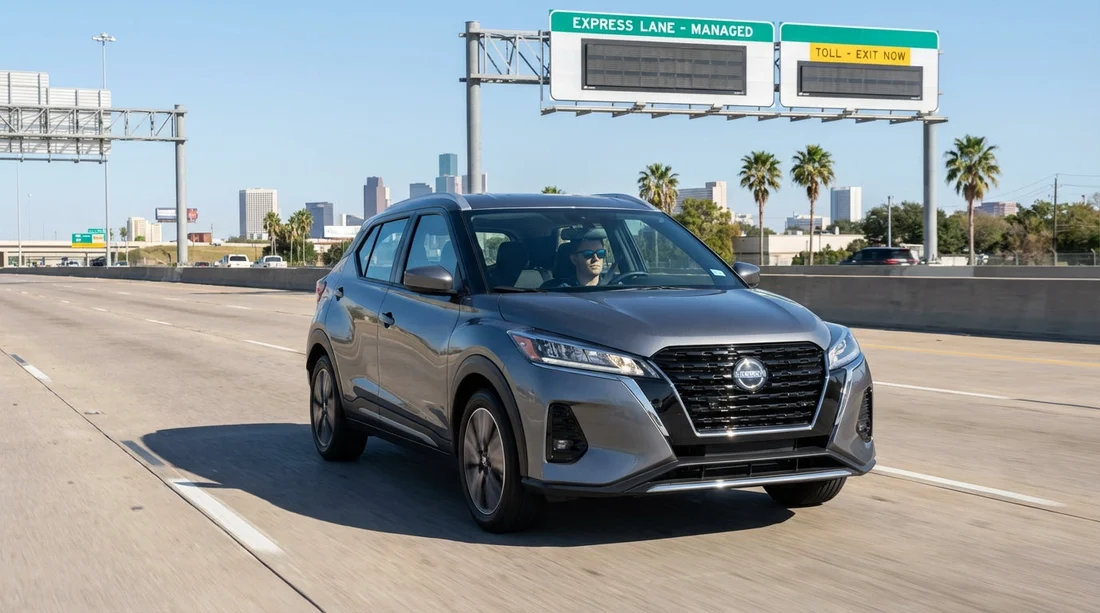
Quick Summary:
- Stay calm, keep your lane, and follow exit signs to the next opening.
- Never stop, reverse, or cross barriers, it can cause crashes and citations.
- Use the next authorised exit, then reroute via frontage roads or main lanes.
- Expect tolls to bill by plate, rentals may add admin fees.
Managed lanes and reversible express lanes in Texas can feel like a trap if you enter by mistake in a car hire vehicle. Many are separated from general traffic by pylons, curbs, or concrete barriers, and exits may be spaced far apart. The good news is that you usually can recover safely without doing anything dramatic. The key is to treat it like a controlled-access motorway, keep moving with the flow, and plan for the next legal exit point.
This guide explains a practical recovery plan for missed access points and lane barriers, what not to do, and how toll billing or violations typically reach you when driving a rental.
First, identify what kind of lane you entered
Texas uses several “special” lane types, and your safest next step depends on which one you are in.
Managed or express toll lanes (often marked Express, Managed, or a toll operator name): These are usually physically separated and priced dynamically. You enter and exit only at marked openings. In Houston, Dallas, Austin, and San Antonio, you will often see overhead signs showing toll prices and destinations.
Reversible lanes: These change direction by time of day. They typically have strong barrier separation, gates, and prominent “Do Not Enter” signals for the closed direction. If you are already inside the lane and traffic is flowing your direction, stay with traffic and look for the next exit. If you see red X signals over your lane, treat that as an urgent cue to follow posted instructions and exit as soon as a signed exit appears, without stopping.
HOV or HOT lanes: Some are separated only by a buffer or pylons, others are barrier-protected. Even if rules are occupancy-based, do not cross solid double lines or barriers to leave. Wait for a permitted merge area or signed exit.
Immediate recovery plan: what to do in the next 60 seconds
1) Keep your speed steady and follow the lane. Sudden braking is one of the biggest risks because drivers behind you may be less able to react in a constrained lane. Maintain a safe following distance and match traffic speed within the limit.
2) Scan for the next authorised exit, not the nearest gap. Managed lanes often have long stretches with no exit. Look for overhead signs that say “Exit”, “To”, or specific interchanges. Many entrances have “Last exit before…” messaging, which is your hint that you may be committed for a while.
3) Do not attempt a “quick fix”. The most common unsafe reactions include stopping, reversing, crossing a painted gore area, or squeezing through pylons. These actions can lead to collisions and can also trigger citations.
4) If you are unsure, follow navigation but prioritise signs. Sat nav may lag behind or suggest illegal manoeuvres like crossing barriers. Treat roadway signage as the final authority.
5) If you need help, use hands-free. If you must call the rental company or toll operator, do it via hands-free and only when traffic conditions allow. Pulling over inside a barrier-separated lane is rarely safe and may be prohibited.
How to exit safely when barriers limit your options
In many Texas managed lanes, you can only exit at clearly marked egress points. Here is the safest approach.
Follow the “Exit Only” lane guidance early. When you see an upcoming exit, start positioning promptly. Exits from express lanes can be shorter than general-purpose exits, and missing one can mean staying in the lane for several more miles.
Use indicators early and merge smoothly. At a marked opening or exit ramp, signal well in advance. Other drivers may also be trying to exit at the same point, so expect a bit of competition and drive defensively.
If an exit ramp appears unexpectedly, take it if it is safe. If you are in the wrong lane for your destination, it is usually better to take the express lane exit and reroute than to attempt a late merge across restricted markings.
After exiting, use frontage roads to reset. Texas highways often run alongside frontage roads. They are extremely useful for correcting mistakes because you can slow down, reorient, and re-enter the highway at the correct point without illegal manoeuvres.
What not to do, even if the mistake feels expensive
The worry about toll charges can tempt drivers into risky behaviour. Avoid these, even if you think you “only need to hop out”.
Do not stop in-lane to assess the situation. Stopping can create a rear-end crash risk and may be illegal in controlled-access lanes unless there is an emergency.
Do not reverse. Reversing on any high-speed roadway is extremely dangerous and can result in serious penalties.
Do not drive over pylons, curbs, or barrier transitions. Besides damage to the car hire vehicle, it can lead to a citation and liability for repairs.
Do not cross double solid lines or gore areas. These markings often indicate no-cross zones. Enforcement can be camera-based or patrol-based, depending on the corridor.
Do not assume the lane is free. Some reversible facilities can change status. If signage indicates closure ahead, treat it seriously and prepare to exit at the first signed opportunity.
If you missed the last exit: a safe rerouting method
Sometimes you will see “Last exit” signage and realise too late. Use this recovery method.
Step 1: Commit to the next legal exit. Accept that you will travel farther than planned. This is usually the safest and cheapest option compared with fines, damage, or an incident.
Step 2: After exiting, find a safe place to pause. Use a service road, a car park, or a fuel station to stop and reset your route. Avoid stopping on a shoulder unless you have a genuine emergency.
Step 3: Re-enter via general lanes or a different on-ramp. Frontage roads can help you reach the correct junction. When you rejoin, watch for signage that differentiates “Express” from “General Purpose” lanes.
Step 4: Adjust navigation settings. Many navigation apps have “avoid tolls” settings. If you do not want to re-enter toll facilities, switching this on after you have safely exited can reduce repeat mistakes.
How tolls and violations usually work in a rental car
With Texas car hire, most toll roads and managed lanes operate as “pay-by-plate” if you do not have a toll tag. Cameras read the vehicle number plate and create a bill. In a rental, that bill usually goes to the rental company first, not directly to you.
Typical outcomes you may see:
Toll charges: The rental company receives the toll invoice and passes the toll amount to the card on file. Some companies apply a daily toll programme fee or per-toll convenience fee, depending on the agreement you accepted at pick-up.
Administrative fees: Separate from the toll itself, there may be an administrative fee for processing the charge. This is common across car hire agreements and is usually disclosed in the rental terms.
Violations: If an actual traffic violation occurs, for example crossing prohibited markings or ignoring lane-control signals, enforcement may involve a citation rather than a toll invoice. Those notices also tend to go to the vehicle owner first, then get transferred or charged back per the rental agreement.
Damage costs: If you hit pylons, curbs, or barriers, expect damage assessment and potential charges. Taking the next exit and rerouting is nearly always cheaper than repairing tyres or underbody damage.
How to reduce the risk before you drive off in Texas
A few minutes of prep can prevent most wrong-lane incidents, especially when you have just collected keys and are navigating unfamiliar interchanges.
Learn the local naming. In Texas, you will see “Frontage Rd”, “Service Rd”, “Toll”, “Express”, “Managed Lanes”, and “HOV/HOT”. Knowing these labels helps you interpret signs quickly.
Plan your first 10 minutes. The highest risk moment is leaving an airport or downtown garage where ramps split quickly. If you are picking up near Houston airport, check your route while still parked, then follow signs calmly once moving. Information about local pick-up points can be found on Hola Car Rentals pages such as car hire at Houston IAH and Houston car rental options.
Decide your toll preference. If you are comfortable paying tolls for speed and convenience, keep your route as-is and focus on using correct entrances and exits. If you prefer to avoid tolls, set “avoid tolls” before you start driving, but still follow road signs if you accidentally enter.
Choose a vehicle you feel confident driving. Wider vehicles can feel tighter in barrier-separated lanes. If you are travelling with family or luggage, compare sizes ahead of time, for example minivan rental in Texas may suit longer trips, while city driving might be easier in a smaller car.
Expect complex interchanges in major metros. Austin and San Antonio have fast-changing lane assignments near central interchanges. If your trip starts there, it can help to review the area around the rental location, such as Austin car rental or Alamo car hire in San Antonio, then plan a simple initial route that avoids last-second merges.
What to do after the incident: documentation and follow-up
Note the road and time. If you are later asked about a toll or notice, having the approximate time, corridor name, and direction can help you understand the charge.
Check your rental agreement for toll handling. Look for sections on toll programmes, administrative fees, and how violations are processed. This tells you whether charges will appear as individual tolls, bundled invoices, or a daily toll service.
Monitor your payment method. Toll pass-through charges can appear days or even weeks later. If something looks wrong, contact the rental provider with your details and supporting notes.
If you receive a notice at home, do not ignore it. In most cases, you should contact the rental company first, because they may already have paid or transferred the notice. Paying the wrong party can create confusion.
FAQ
Q: I entered an express lane by mistake in Texas, can I exit immediately?
A: Usually only at signed exits or marked openings. Stay in the lane, follow signs to the next authorised exit, then reroute using frontage roads.
Q: Will I get fined just for being in a managed lane in a car hire vehicle?
A: Not typically. Most of the time it is just a toll charge billed by plate. Fines are more likely if you cross barriers, ignore lane-control signals, or perform prohibited manoeuvres.
Q: What is the safest thing to do if I missed the last exit?
A: Continue to the next legal exit, take it, and reset your route somewhere safe. Do not stop, reverse, or cross solid lines or barriers to correct the mistake.
Q: How will toll charges show up for Texas car hire?
A: The toll operator bills the vehicle owner, then the rental company charges you for tolls and may add an administrative or toll programme fee under the rental terms.
Q: Should I enable “avoid tolls” after this happens?
A: Yes, once you have exited safely and are parked. It can reduce repeat mistakes, but always follow road signs if navigation conflicts with lane restrictions.





























































































