


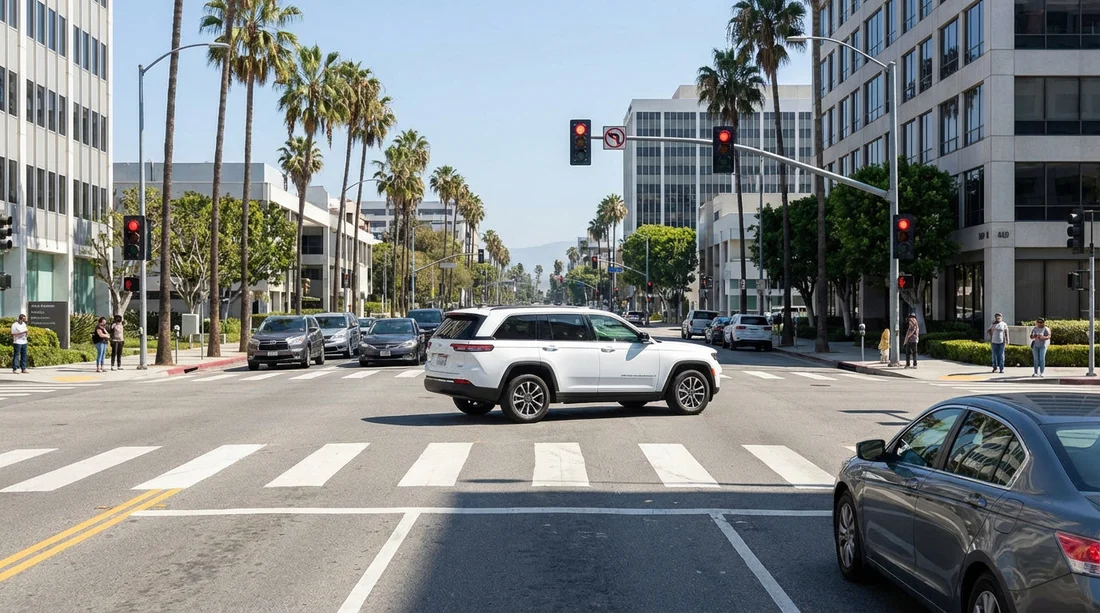
Quick Summary:
- Enter only if your exit lane has space beyond crosswalk lines.
- If traffic stops, wait behind the stop line even on green.
- Blocking any lane, crosswalk, or box-marking can trigger a citation.
- When turning, commit only when the receiving lane is clearly open.
In Los Angeles, “Don’t block the intersection” is a practical anti-gridlock rule aimed at keeping cross streets moving when traffic clogs up. If you are driving a car hire vehicle, especially around busy corridors near Downtown, Hollywood, Santa Monica, and the airport approaches, it helps to know exactly what counts as blocking, what officers look for, and how to judge whether you can clear the junction before the light changes.
The core idea is simple: do not drive into an intersection unless you can fully exit it. That includes not stopping on the painted crosswalk, not stopping on the area where vehicles would cross, and not obstructing the lane(s) that belong to the street you are cutting across. In LA, this is often enforced at predictable pinch points, and it is easy for visitors to get caught out because signals can be long and traffic can “accordion” to a halt mid-junction.
If you are collecting a vehicle at the airport, you will likely see heavy stop-start patterns quickly. When comparing options for car hire at Los Angeles LAX, factor in that your first miles may include dense junctions where patience matters more than speed.
What “don’t block the intersection” means in Los Angeles
In everyday terms, the sign means: only enter the junction when there is enough space on the far side for your entire vehicle. “Enough space” means your car can clear the intersection without any part of it remaining in the crosswalk or in the area where cross traffic needs to pass.
Because LA has many wide intersections, it can be tempting to roll forward on green and assume you will keep moving. The problem is that the queue ahead can stop suddenly, leaving you stranded in the middle when your light turns red. At that point you may block:
1) The crosswalk, preventing pedestrians from crossing legally and safely.
2) The cross street lanes, stopping cars that have a green.
3) Turning pockets, preventing left or right turns.
Even if you are only blocking for a short time, the enforcement logic is that you created gridlock. Officers and traffic enforcement personnel typically focus on whether you entered when it was not possible to clear, not whether you “meant to” or whether the driver in front stopped unexpectedly. That is why the safest approach is a simple personal rule: do not pass the stop line unless you can see an open space to land in beyond the intersection.
What counts as “blocking”, and what does not
Blocking usually means your vehicle is stopped in any part of the intersection area so that other road users cannot proceed when they have the right of way. This can include:
Stopping on the crosswalk. Even if cross traffic can still squeeze around you, standing on the crosswalk can obstruct pedestrians and draw enforcement attention.
Stopping in the through lanes of the cross street. This is the classic gridlock scenario: your light went green, you entered, the queue ahead stopped, your light turned red, and now you sit across lanes that should be moving.
Blocking a dedicated turn lane or bus lane. Many LA junctions have dedicated pockets. If your wheels end up in that space, you may block vehicles that otherwise could have turned and relieved pressure.
Box markings. Some areas use painted hatch patterns or “keep clear” style markings. Stopping in these areas is treated much like stopping in the intersection.
Not blocking means you remained behind the stop line and crosswalk until there was space. This can feel counterintuitive when your light is green and drivers behind honk, but it is the correct method. In a car hire vehicle, it also reduces risk of stressful confrontations and sudden braking.
Real LA junction situations where drivers get caught
LA’s streets are too numerous to cover exhaustively, but the same patterns repeat. Here are common real-world scenarios that cause citations or near-misses.
Scenario A: Wide boulevard, short downstream gap. You are travelling on a major road and approaching a big cross street. There is a green light, but just past the junction there is a driveway, bus stop, or merge that compresses traffic. The first few cars make it through, then the line stalls and the rest stack into the intersection. The safe move is to wait at the stop line until you can see a full car-length space beyond the far crosswalk.
Scenario B: Left turn pocket fills up mid-cycle. You enter on green intending to go straight, but a line of left-turning vehicles in the opposite direction blocks the far side because their pocket is full. Suddenly the straight-through lane you planned to use is blocked by vehicles spilling over. Again, the decision point is before you enter. If you cannot see a clear landing space, do not go.
Scenario C: Right turn into a congested lane. Right turns can be deceptive because the distance is short, and you may feel you are “not really” in the intersection. But if you turn and immediately stop, you can block the crosswalk behind you or impede oncoming traffic if you drift wide. Make the turn only when the receiving lane is open enough that you will not stop immediately across pedestrian space.
Scenario D: Near freeway ramps and airport connectors. Approaches to major ramps often back up unpredictably, especially in peak hours. Drivers push through the light to avoid missing a cycle, then get trapped when the ramp queue stops. If you are navigating after picking up from Los Angeles LAX car rental areas, treat ramp-adjacent intersections as high risk and wait for a genuine gap.
When can you be fined, and what officers look for
While specific fine amounts can change and can be affected by local surcharges, the trigger for a citation is typically your vehicle being stopped in the intersection in a way that obstructs traffic or pedestrians when the light changes. In practice, enforcement often focuses on:
Whether you had room to clear when you entered. If the lane beyond the intersection was already full, entering is hard to justify.
Whether your vehicle remained in the intersection as cross traffic started moving. If the cross street received a green and you were still sitting there, you are a clear obstruction.
Whether you blocked the crosswalk. This is visible and often easier to enforce.
Whether there were posted signs or painted “keep clear” markings. These remove ambiguity and make enforcement more likely.
Sometimes an officer will use discretion if you were forced to stop by an emergency vehicle or a sudden hazard. However, “the car in front stopped” is exactly why you are expected to check the space beyond the intersection before committing.
How to judge if you can safely clear a light
A reliable method is to use the far-side crosswalk as your reference. Before you move, decide where your car will end up. If you cannot identify a space beyond that far crosswalk where your whole vehicle fits, do not enter.
Use these checks:
Count a full car length plus a little buffer. If you only see half a space, you will likely stop with your rear in the intersection.
Watch the rhythm of the queue. If the line ahead has been stopping every few seconds, assume it will stop again.
Be cautious near driveways and bus stops. A single delivery van or bus can stall the lane and trap you.
Do not follow the car ahead blindly. Their decision might be wrong, or they might be able to accelerate faster than you can.
It also helps to plan routes with fewer complex junctions when possible. If you are arranging your California trip and comparing providers through California LAX car rental listings, consider scheduling heavier urban driving outside peak rush to reduce the pressure that leads to risky “I will just go” choices.
Turns, yellow lights, and the common misunderstanding
A frequent misconception is that you are allowed to enter on green or yellow and then “sort it out” once you are in the intersection. That approach is what gridlock rules are meant to prevent.
Yellow lights: A yellow warns that the signal is changing. If you can stop safely before the stop line, do so. Accelerating into a junction on yellow when the lane beyond is not open is a typical way to get stranded. If you are already committed and cannot stop safely, proceed, but do not compound the risk by entering when you know you will have nowhere to go.
Left turns: Many LA intersections allow left turns on a green ball, green arrow, or a permissive phase. The safe practice is to enter only when you can complete the turn into an open lane. If you are waiting in the intersection for a gap, do not keep creeping forward if the receiving lane is filling up. When the gap appears, complete the turn decisively into a space that lets you clear the intersection immediately.
Special cases: pedestrians, cyclists, and keeping crosswalks clear
Even when vehicles are not moving, pedestrians may still be legally crossing on a walk signal. Blocking the crosswalk forces them into traffic, which increases risk and draws enforcement attention. Cyclists using the edge of the lane also rely on predictable space at junctions.
Practical habit: stop with your front bumper behind the thick stop line and give the crosswalk the full space it is designed for. If you are in an unfamiliar car hire vehicle, remember the bonnet length may differ from what you drive at home. Take an extra second to confirm you are not over the line.
How to recover if you accidentally enter and traffic stops
Mistakes happen, especially in a new city. If you realise you are about to be stuck, the goal is to clear the intersection without creating a new hazard.
If you still have room to reverse, do not. Reversing in live traffic is dangerous and can cause collisions. Instead, look ahead for any small movement in the queue and be ready to roll forward the moment space opens.
Keep your wheels straight. If you are struck, straight wheels reduce the chance of being pushed into cross traffic.
Do not block pedestrians further. If you can stop short of the crosswalk, do it, even if it means leaving a larger gap ahead.
If an officer directs you, follow instructions. Hand signals override the light in these situations.
For larger vehicles, the risk of misjudging space is higher. If you are considering a bigger option for luggage or group travel, look at van hire in California at LAX and allow extra clearance when assessing whether you can fully clear the junction.
Practical driving habits that reduce gridlock risk in LA
Leave earlier and accept longer lights. Many LA signals have long cycles. Rushing one cycle often causes the next problem.
Keep your following distance in queues. If you are too close, you may be “pulled” into the intersection by habit.
Stay in the correct lane early. Last-second lane changes at junctions cause sudden stops and trap the next cars.
Be extra cautious in rain. Stopping distances increase and traffic patterns become less predictable.
Ignore pressure from behind. A horn does not create space beyond the intersection. Your responsibility is to keep the junction clear.
Finally, remember that enforcement and congestion can vary by neighbourhood and time of day. Building a little flexibility into your plans is often more effective than trying to “beat the light”. Even travellers prioritising value, such as comparing budget car rental in California at LAX, benefit most from calm, predictable driving rather than aggressive junction entries.
FAQ
Q: Can I enter an intersection on green if traffic is slow?
A: Only if there is clear space to fit your whole vehicle beyond the far crosswalk. If the lane ahead is already full, wait behind the stop line.
Q: What if I am turning left and the gap appears late?
A: Do not assume you can “store” your car in the intersection. Commit to the turn only when the receiving lane is open enough that you can complete the turn and clear immediately.
Q: Is blocking the crosswalk treated the same as blocking cars?
A: It can be enforced just as seriously because it obstructs pedestrians and creates safety risks. Keep the crosswalk clear even in heavy traffic.
Q: Are there specific places in Los Angeles where this is enforced more?
A: Enforcement is common on major arterials, near freeway ramps, and in busy commercial districts where gridlock quickly affects multiple streets.
Q: How can I avoid mistakes in an unfamiliar car hire vehicle?
A: Use the far-side crosswalk as your “must-clear” line, leave a bigger buffer than you think you need, and wait out a cycle rather than entering without space.





























































































