


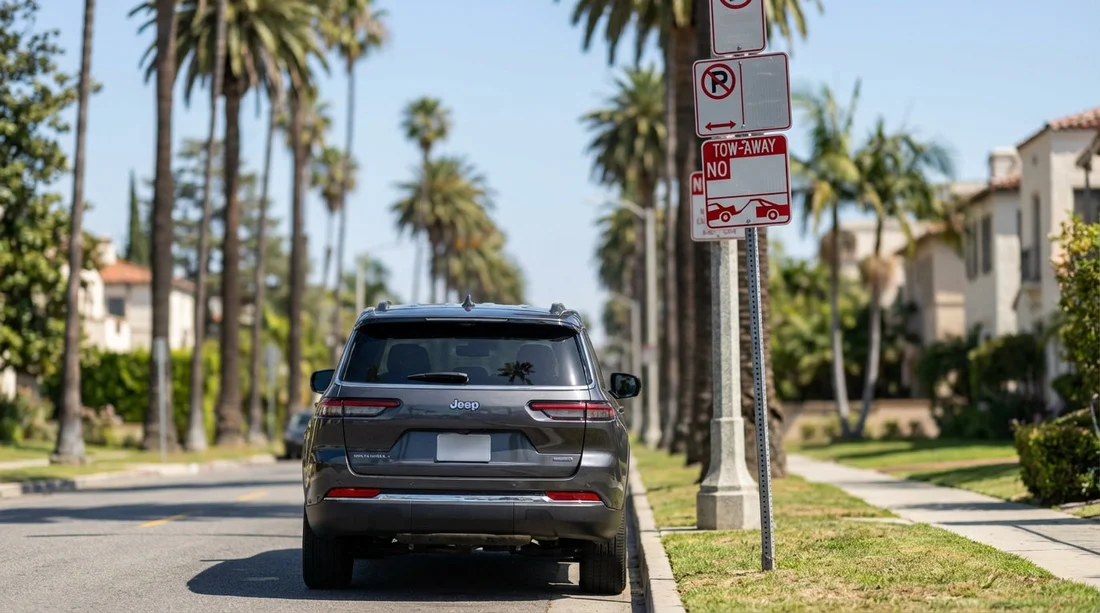
Quick Summary:
- Read every sign on the pole, and match arrows to your space.
- Street-sweeping times are strict, move before the window starts.
- Tow-away and red-kerb rules override most other permissions, always avoid.
- Use a two-minute kerb checklist, kerb colour, arrows, days, hours, meters.
Driving in Los Angeles is straightforward, parking is where visitors get stung. If you are using a car hire in Los Angeles, the quickest way to avoid fines is to treat every kerb as a puzzle made of three parts, the signs, the kerb paint, and the meter or curb markings. Miss one part and you can be ticketed even if another part looks permissive.
LA signage often stacks multiple plates on one pole, with arrows that define where each rule applies. Street-sweeping restrictions are among the most common gotchas, because they are scheduled by day and time and can apply even on otherwise free streets. Tow-away language can appear for commute-hour clearways, bus stops, or construction zones and usually means immediate risk.
If you are collecting your vehicle at the airport, it helps to get familiar with these rules early. Many travellers start from Los Angeles Airport car rental options and then head straight to neighbourhood streets where signs vary block to block. The good news is that once you know the common formats, you can decode most kerb spaces in under a minute.
How Los Angeles parking signs are organised
Most LA poles carry several rectangular signs, each with its own rule. Read them top to bottom, then left to right if there are two columns. Finally, use the arrows, if present, to work out whether that specific rule covers your exact kerb space.
Think of it like this, the pole is the index, the arrow is the boundary, and the kerb is the reality check. A common mistake is reading only the easiest line, for example “2 HR PARKING”, and missing a smaller plate beneath it that limits certain days, adds street sweeping, or turns the lane into a tow-away route during peak hours.
Another common cause of tickets is assuming the rule applies to the whole block. In LA, the legal boundary can change mid-block via arrowed signs, driveways, bus zones, or coloured kerb sections. If there is any doubt, walk to the next pole in both directions and compare.
The most common sign formats you will see
1) Time-limited parking, for example “2 HR PARKING 8AM to 6PM MON to SAT”
This means the two-hour limit applies only within the stated window. Outside that window, the restriction might not apply, but you still must check for other rules such as street sweeping, permit zones, or overnight bans. If the sign says “EXCEPT SUNDAY”, Sunday is treated differently, often more relaxed, but street sweeping can still apply if it is separately posted.
2) “NO PARKING” versus “NO STOPPING” versus “NO STANDING”
In practice, treat all three as “do not leave the vehicle there”. “No stopping” is the strictest, you cannot stop to load or wait. “No standing” usually allows active loading or passenger pickup only. “No parking” can sometimes allow brief loading, but enforcement can be unforgiving, and these zones often sit near driveways, hydrants, or clearways. If you are in a car hire and unsure, choose a different space.
3) Street-sweeping plates, often “NO PARKING TUES 9AM to 11AM STREET SWEEPING”
This is the classic ticket generator. The street is cleaned during that window and cars must be gone. It often applies once per week per side, with different days for each side of the street. Do not assume a neighbour’s schedule matches yours.
4) Tow-away signs, often “TOW-AWAY NO STOPPING 4PM to 7PM MON to FRI”
These are frequently used on commuter routes, near stadiums, or on major corridors. During the posted hours, you can be towed quickly, not just ticketed. Outside the posted hours, other signs on the pole may still restrict you.
5) Permit parking, for example “PERMIT ONLY XPM 6PM to 8AM”
Some neighbourhoods restrict overnight parking to residents with permits. You might be allowed to park during the day, then become illegal at night. This catches visitors who park at 5pm and plan to leave the car until morning. Always check if the permit restriction overlaps with your planned stay.
6) Metered parking rules and payment instructions
Meters can have separate time limits and enforcement hours, for example paid until 8pm, free after, or different rates on Sundays. If the meter says “No parking” or “Out of service”, do not assume it is free, look for the nearest posted instruction, or choose another spot. Also check the meter number and that the space is not marked for a specific vehicle type.
How to decode arrows and boundaries
Arrows matter in Los Angeles. A sign with a left arrow usually means the rule applies from that pole to the left, until the next sign changes it, or until an intersection or a clear boundary. A double-headed arrow often means the rule applies in both directions from that pole, again until changed.
If you are parked between two poles, and one sign points toward you while the other points away, the closer sign typically governs your space. If both point toward you, the stricter rule generally wins. When in doubt, do not rely on guesswork, pick a space where the signage is unambiguous.
This becomes especially important on streets with mixed rules, for example a two-hour zone, then a short loading zone, then a bus stop. You can be perfectly aligned with one sign but still partly inside another restricted segment.
Street-sweeping in LA, what the time really means
Street sweeping usually means “no parking” for the entire posted window, not just when the sweeper is visible. If the sign says 9am to 11am, you should plan to be gone before 9am. Arriving at 10:45am and hoping the sweeper has already passed is still a gamble, because enforcement is typically based on the posted rule, not the truck’s location.
Also watch for holidays or temporary changes. Some areas suspend sweeping on certain holidays, but do not assume. If the sign is posted, enforcement can still occur unless the city has formally suspended it. For travellers, the safest approach is to treat posted sweeping windows as always active.
If you are staying a few days and you need reliable parking, it can be easier to choose accommodation with off-street parking, or use paid garages for nights that overlap sweeping. When you are doing day trips outside LA, for example down to Orange County, make sure you also learn the local sign patterns. If your route takes you near Santa Ana, the pick-up and return pages like car rental at Santa Ana Airport (SNA) can be useful for planning, because parking patterns can change across cities.
Kerb colours, the fast visual clue
Kerb paint can override what you think the sign allows. In many parts of Los Angeles, the kerb colour indicates restrictions even if you missed a plate.
Red kerb generally means no stopping, standing, or parking. Treat it as off-limits at all times.
Yellow kerb is often loading or commercial access, typically time-limited. The sign will define who can use it and when.
White kerb is usually passenger loading, often with a short time limit.
Green kerb often means short-term parking, such as 15 or 30 minutes.
Blue kerb is typically disabled parking and requires the proper placard or plate.
Because kerb colours can be faded, always pair the colour with the nearest sign and any pavement markings. If you see a red segment near a driveway, do not assume you can squeeze into the unpainted inches beside it.
Tow-away zones, where people get caught most
The most common tow-away scenarios for visitors are peak-hour clearways on busy streets, temporary construction zones, and stopping near bus stops. A sign may look like a normal “No parking” plate, but the words “Tow-away” change the risk dramatically. If you are in a car hire, the cost and time of recovering a towed vehicle can outweigh any convenience of a close space.
Also beware of event-day restrictions around stadiums and venues. Even if you are not attending an event, you can encounter temporary tow-away postings that apply only on certain days and times. If a portable sign conflicts with a permanent sign, assume the temporary posting is being enforced.
If you are choosing a larger vehicle, remember that size can make it harder to stay within boundaries, especially near driveways and corners. Travellers using an SUV sometimes benefit from researching pickup details on pages like SUV hire in Los Angeles (LAX) and then prioritising off-street parking where possible.
A quick decision tree, is this kerb space safe?
Use this two-minute check before you lock the car and walk away.
Step 1: Check the kerb colour. If it is red or blue, do not park unless you are authorised for that zone. If it is yellow, white, or green, read the sign to confirm the exact allowed use and minutes.
Step 2: Read every sign on the pole. Look for “No parking”, “No stopping”, “Tow-away”, “Street sweeping”, and “Permit”. Note the days and times. If you will be there across a change, for example 5pm to 9pm, you must be legal for the entire period.
Step 3: Follow the arrows. Confirm that the sign you read actually applies to the segment where your car sits. If you cannot confidently match the arrow direction to your position, choose a different space.
Step 4: Check for a meter and its enforcement hours. Pay attention to posted maximum time and paid hours. If payment is required until 8pm, you can still be ticketed at 7:55pm even if you are within the time limit.
Step 5: Look for driveways, hydrants, corners, and bus zones. Even if signage looks fine, these features can create separate restrictions. If the kerb is cut for a driveway or there are “Bus” markings, do not risk it.
Step 6: Consider your exit plan. If street sweeping is tomorrow morning or a tow-away clearway starts at 4pm, set an alarm with buffer time. For a car hire, it is better to move the car early than deal with a fine, or worse, a tow.
Common scenarios and how to interpret them
Scenario A: “2 HR PARKING 8AM to 6PM MON to FRI” plus “NO PARKING THU 9AM to 11AM STREET SWEEPING”
You can park for up to two hours during weekday daytime, but you must not be there during Thursday 9am to 11am. Outside 8am to 6pm, the two-hour limit may not apply, but sweeping still does on Thursday morning.
Scenario B: “NO STOPPING TOW-AWAY 4PM to 7PM MON to FRI” with a smaller “2 HR PARKING” plate
The tow-away clearway overrides the two-hour permission during 4pm to 7pm weekdays. You may be allowed to park outside those hours, but you must confirm there is no other restriction, such as permits or sweeping.
Scenario C: No obvious sign, unpainted kerb, but a meter nearby
Assume the meter governs the space and check its screen or posted instructions for hours and limits. If anything is unclear or the meter is damaged, find a different spot rather than assuming it is free.
Scenario D: You are unsure between two conflicting signs
When two signs appear to conflict, enforcement usually follows the stricter interpretation. For visitors, the practical rule is simple, if you cannot explain the rule clearly to yourself, the space is not worth the risk.
Practical tips for car hire drivers in Los Angeles
Take a photo of the sign and your parked position. If you later need to confirm the time window or challenge an error, having the exact wording and arrows can help. Do not rely on memory, especially if you park at night.
Set a phone reminder for time-limited and street-sweeping windows, with at least 15 minutes of buffer for traffic and finding a new space. LA blocks can fill quickly, so plan a little extra time to relocate.
If you are comparing providers and pickup locations, knowing your likely parking situation can guide your vehicle choice. For instance, if you expect tight neighbourhood parking, a smaller car can be easier than a large SUV. Some travellers review options via pages such as Thrifty at Los Angeles LAX to understand what vehicle types are available at their dates and times.
Finally, remember that sign wording is only part of the picture. Temporary cones, folding signs, and posted notices for film shoots or roadworks can create one-day restrictions. If you see fresh cones or “No parking” notices tied to poles, treat them seriously and move on.
FAQ
Do I have to move for street sweeping if the sweeper has already passed? Yes. The posted window is the legal restriction, and tickets can be issued any time during that period.
What if the sign says “Tow-away” only at certain hours? You can usually park outside those hours if no other restriction applies, but double-check permits, street sweeping, and meter rules for the full time you will be parked.
How do arrows on parking signs work in Los Angeles? The arrow shows which direction the rule applies from that pole. Match the arrow to your kerb segment, and check the next pole for where the rule changes.
Can I rely on kerb colours alone instead of reading signs? No. Kerb colours are helpful, but the sign text sets the exact days, times, and user restrictions, and some kerbs are unpainted.
What should I do if I cannot find a clearly legal space? Use an off-street car park or a well-signed metered area rather than guessing. For longer stays, choose parking that remains legal overnight and through sweeping windows.





























































































