


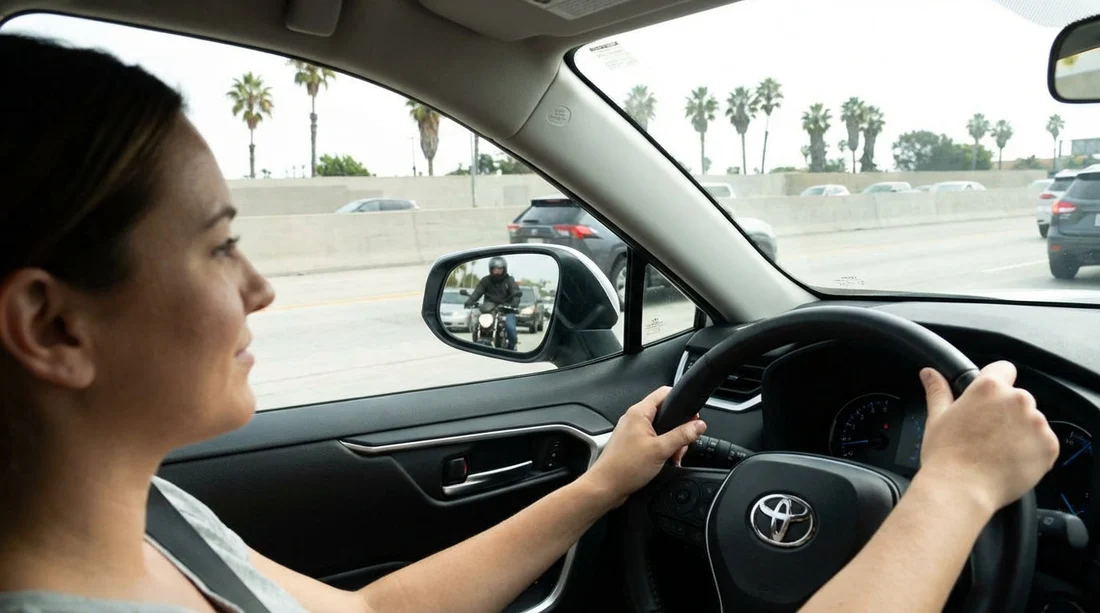
Quick Summary:
- Expect motorbikes between lanes on freeways, especially when traffic slows.
- Before changing lanes, check mirrors twice and glance over your shoulder.
- Signal early, move smoothly, and never drift towards the lane line.
- Leave space at junctions, as bikes may filter to the front.
Lane-splitting can feel unfamiliar if you are visiting from the UK and driving a rental car for the first time in Los Angeles. You may be used to motorbikes filtering in slow traffic, but California’s version often happens at higher speeds and on multi-lane freeways. The key to staying safe is understanding what is legal, where it commonly happens, and how to make predictable lane changes without startling a rider who is already alongside you.
If you are picking up a vehicle near the airport, it helps to plan for busy roads immediately. Many travellers start on the 405, 105, or 110, where motorbikes regularly move between lanes during congestion. For practical pickup context, see car hire at Los Angeles LAX or Los Angeles LAX car hire, then keep the guidance below in mind as soon as you merge into traffic.
What “lane splitting” and “filtering” look like in California
In California, “lane splitting” generally means a motorbike riding between lanes of slower or stopped traffic. You might also hear “filtering”, which is often used to describe moving between lanes to the front at signals, or moving through very slow queues. In Los Angeles, riders do both, and they do it where you may not expect it if you have only driven in the UK.
What you are likely to see:
On freeways: motorbikes travelling between the leftmost lanes, often between the fast lane and the lane next to it. This is common on the 405 and 101 when traffic is heavy. Riders may approach from behind quickly, then appear next to your rear quarter with little warning if you are not checking mirrors frequently.
On arterial roads: riders moving between lanes of queued cars, then stopping ahead of the first vehicle at a red light. They may start moving as the light changes while drivers are still looking for gaps.
Near junctions and slip roads: riders splitting around merging traffic. This is a hotspot for close calls because cars tend to drift as they prepare to exit or merge.
Even when legal, lane splitting depends on conditions. The safest assumption when driving in Los Angeles is that a motorbike could be between lanes whenever traffic is slow, and that you need to avoid sudden lateral movement.
Is lane splitting legal in California?
Yes, lane splitting by motorbikes is legal in California. That legal status is one reason you see it so often in Los Angeles. However, “legal” does not mean “anything goes”. Riders are still responsible for riding in a safe manner, and drivers are still responsible for changing lanes safely and not impeding a motorbike. For you as a visitor using car hire, the practical takeaway is simple: expect it, accommodate it, and drive predictably.
Because the rules are different from many other places, some visitors mistakenly treat a splitting rider as doing something improper and respond by tightening the gap, edging towards the lane line, or accelerating to “close the space”. Those reactions raise the risk of a sideswipe. In busy LA traffic, it is safer to hold your position, keep a steady speed, and let the motorbike pass.
The safest way to change lanes around lane-splitting motorbikes
Most collisions happen during lane changes. You reduce risk by slowing your decision-making slightly and increasing the quality of your observations. Here is a lane-change routine that works well on Los Angeles freeways.
1) Scan mirrors more often than you think you need. In dense traffic, check your rear-view mirror and side mirror every few seconds. Motorbikes can appear in the narrow space between lanes, and they are easier to spot early if you are already scanning.
2) Use a proper shoulder check. UK drivers sometimes rely heavily on mirrors alone, especially in wide US lanes where the car feels stable. Do not skip the brief glance over your shoulder in the direction you are moving. A motorbike can sit in your blind spot while also being between lanes, which makes it easy to miss in a mirror glance.
3) Signal early, then pause. Put your indicator on earlier than you might at home, then wait a moment. This gives a splitting rider time to react and pass before you move. If a motorbike is approaching, stay in your lane and let it go through.
4) Move smoothly, not gradually across the line. Drifting towards the lane line is risky because it pinches the corridor motorbikes use. When it is clear, change lanes decisively but gently, maintaining a steady speed.
5) Keep centred in your lane while waiting. In stop-start traffic it is tempting to straddle the lane line to “claim space”. Do not. Staying centred leaves a predictable path and reduces conflict with riders filtering between lanes.
6) Avoid changing lanes right before an exit split. LA interchanges can be confusing, and last-second moves are common. If you miss an exit, it is usually safer to continue and reroute than to cut across lanes where motorbikes may be splitting.
This approach also protects you from another LA reality: other cars will change lanes quickly and without much signalling. Predictable driving, good observation, and smooth inputs are your best tools.
Where lane splitting is most likely in Los Angeles
Lane splitting is most common where traffic density is high and speeds fluctuate. Expect it in these situations:
Rush hours and weekend congestion: Morning and late afternoon on weekdays, plus heavy weekend flow to beaches and tourist areas.
Freeway slowdowns: Any time you see brake lights ahead, assume motorbikes may start appearing between lanes behind you.
Approaches to major interchanges: Spots like the 405 and 10 area, the 110 into Downtown, and around LAX approaches can be chaotic, with vehicles weaving and riders threading through gaps.
Long queues at lights: Motorbikes often filter to the front. Leave space and avoid creeping forward aggressively when the light is about to change.
If you choose a larger vehicle, remember that width can change how confident you feel about staying centred. If you are comparing vehicle types, SUV hire in California may feel higher and easier for visibility, while minivan hire in Los Angeles may require extra care with mirrors and blind spots. Either way, mirror setup matters, adjust them before you leave the lot.
Common UK-to-US mistakes that increase risk
Visitors from the UK are often safe and cautious drivers, but Los Angeles has a few traps that can catch you out. These mistakes are especially relevant when motorbikes are splitting.
Mistake 1: Underestimating closing speed. In stop-start freeway traffic, you might be moving at 10 to 20 mph, while a motorbike could be moving substantially faster between lanes. A quick mirror glance may not register it. This is why you should signal, pause, and then move when you have verified it is clear.
Mistake 2: Drifting left while looking right (or vice versa). When you look over your shoulder, you may unconsciously steer slightly. In a UK right-hand-drive car you may be used to a different seating position and reference points. In a US left-hand-drive car, this can feel reversed at first. Focus on keeping the steering steady during checks, and keep your vehicle centred.
Mistake 3: Using the lane line as a guide. Some drivers “hug” the line to create space for themselves. In California, that reduces the corridor for motorbikes and can be interpreted as blocking. Keep a consistent, centred track.
Mistake 4: Late signals and last-second lane changes. LA driving punishes indecision. Late signalling invites conflict because riders rely on early cues to decide whether to pass. If you are not sure you can move safely, stay put and try again later.
Mistake 5: Stopping too close at lights. In the UK you might pull up tightly to maximise space behind. In LA, leaving a little more space can reduce the chance of a rider squeezing through your blind spot at the last moment, and it gives you room if you need to avoid a sudden merge.
Practical driving habits that help every day
Set mirrors correctly before you start. Aim side mirrors slightly wider than you might at home, reducing blind spots. You should just barely see the side of your car, not a large portion of it.
Maintain a steady speed in queues. Hard acceleration and braking create unpredictable gaps that riders may try to use. Smooth driving makes you easier to read.
Keep both hands on the wheel in heavy traffic. If you are adjusting sat nav or reaching for a drink, your car may drift towards the lane line, right where a rider might be passing.
Do not open doors into traffic. If you pull over, check mirrors for cyclists and motorbikes before opening your door. In some busy areas, a passing rider may be closer than you expect.
Know your route early. If you are navigating from LAX to a hotel, glance at the route before you set off so you are not weaving across lanes at the last moment.
What to do if a motorbike is already alongside you
If you notice a motorbike between lanes near your car, the safest move is usually to hold your lane, keep your steering steady, and avoid accelerating aggressively. Do not try to “help” by moving towards the shoulder unless you are certain it is clear. Small lateral movements can be misread.
If you had planned a lane change, cancel it and try again after the rider has passed. If you are already signalling and a rider enters the gap, keep signalling but stay put. Predictability helps them choose a safe path.
Hire car considerations for Los Angeles traffic
With car hire, you may be adjusting to an unfamiliar vehicle, different blind spots, and a left-hand-drive position. Take two minutes in the pickup area to set your seat, steering wheel, mirrors, and climate controls. Knowing where the demister and indicators are matters when you need to focus on mirror checks and smooth lane changes.
Also remember that LA drivers often expect confident merging. If you hesitate at the end of an on-ramp, you may create a ripple of braking that invites lane splitting around you. Build speed on the ramp, check mirrors early, indicate, and merge smoothly into a suitable gap.
If your trip includes driving beyond Los Angeles, you may find traffic patterns change, but lane splitting remains a possibility throughout California. For broader state driving context, California car rental info can be useful when planning routes and vehicle choice.
FAQ
Is lane splitting legal everywhere in the US? No. Lane splitting is legal in California, but many states prohibit it or have different rules. If you drive outside California, check local laws before assuming it is allowed.
Do I have to move over to let motorbikes pass between lanes? You are not expected to swerve or change lanes to create space. The safest approach is to stay centred, keep a steady speed, and avoid drifting towards the lane line.
What is the biggest danger when driving a hire car in Los Angeles traffic? Sudden lane changes and blind-spot misses. Motorbikes can approach quickly between lanes, so signal early, pause, and do a shoulder check before moving.
What should I do if I start changing lanes and see a motorbike? Return to your lane smoothly if safe, or stop the lane change and hold position. Keep your steering steady and let the rider pass before trying again.
Are motorbikes allowed to filter to the front at traffic lights in Los Angeles? You will often see it. Leave reasonable space, avoid creeping aggressively, and watch mirrors as the light changes because riders may accelerate away quickly.





























































































