


Quick Summary:
- Expect 60 to 90% charge unless your agreement promises full.
- Confirm whether return terms match the pick-up percentage or minimum.
- Check dashboard range and ensure it suits your first leg.
- Verify charging networks, cables, and app access before leaving.
Picking up an EV rental car in California can feel different from collecting a petrol vehicle, because the “fuel” is a battery percentage, not a full tank. In practice, the battery level you receive depends on the rental company, the location’s charging set-up, the time between returns, and whether the car has been moved around the lot. For car hire, the important thing is not chasing a perfect number, it is knowing what is normal, what your agreement promises, and what you need to check before you drive away.
California has excellent charging coverage, but it is also a busy rental market with quick turnarounds, especially at major airports. That means you should expect a reasonable state of charge rather than assuming 100%. The good news is that with a few checks at the counter and in the car, you can avoid surprises and start your trip with a realistic plan.
Typical state of charge at pick-up in California
Most EV rentals are handed over somewhere around 60% to 90% state of charge. Many operators aim for a level that comfortably covers local driving plus a buffer to reach a fast charger, without needing hours of charging between customers. A fully charged battery can take longer than a quick top-up, so 100% is not guaranteed unless the paperwork specifically says so.
If you are collecting at a major hub like San Francisco Airport (SFO) or Los Angeles LAX, turnover is constant and battery levels can be more variable. At smaller airports or city locations, staff sometimes have more time to bring vehicles closer to a preferred level, but it still depends on the day.
What the rental agreement should say about charging
For EV car hire, the agreement is your source of truth. Before leaving the car park, look for the section that describes how the vehicle should be returned. Common policies include “return at the same charge level as collected”, a minimum percentage, or a paid option where the company recharges it for you. Each approach changes what you should accept at pick-up.
If the policy is “same as received”, make sure the starting percentage is written down accurately. If it is not shown on the paperwork, ask for it to be added or noted, because a dispute later usually comes down to the documented number. If the policy is a minimum return level, check what that minimum is and whether there are fees if you return below it.
Also scan for charging related fees, such as an administrative fee plus the cost of energy, a flat recharge fee, or a penalty if you return very low. These details matter because an EV can look “fine” at 55% when you pick it up, but if the policy expects you to return at 80%, you will need to plan a charge near the end of your trip.
How much battery do you actually need to leave with?
Rather than focusing on a single percentage, calculate what you need for the first leg of your journey. Consider distance, speed, elevation, weather, and how heavily you will use heating or air conditioning. In California, highway speeds and warm days can increase consumption, and mountain routes can cut range faster than expected.
As a quick sense check, compare three things before you exit the lot: the displayed battery percentage, the range estimate in miles, and your next destination. If you are driving from the Bay Area straight to Monterey, Napa, or Yosemite gateway towns, make sure you have a comfortable buffer, not a “just enough” estimate. Range estimates can change once you get on the motorway.
When picking up near Silicon Valley at San Jose (SJC), you might be tempted to assume charging will be effortless. It is generally good, but busy stations and peak pricing can still affect your plan. Build in time for your first charge stop if your starting level is below what you would prefer.
What to check on the car before you leave the car park
Beyond the battery percentage, there are a few practical checks that prevent headaches later.
Confirm the charging port type and where it is located. Most modern EVs in the US use CCS for rapid charging, and many also accept Tesla NACS depending on the model and adapter availability. Do not assume you can use any fast charger without checking compatibility.
Check the included charging equipment. Some rentals provide a basic cable for slower charging, some provide an adapter, and some provide neither. If your accommodation offers charging, knowing whether you have the right cable can save you from hunting down equipment later.
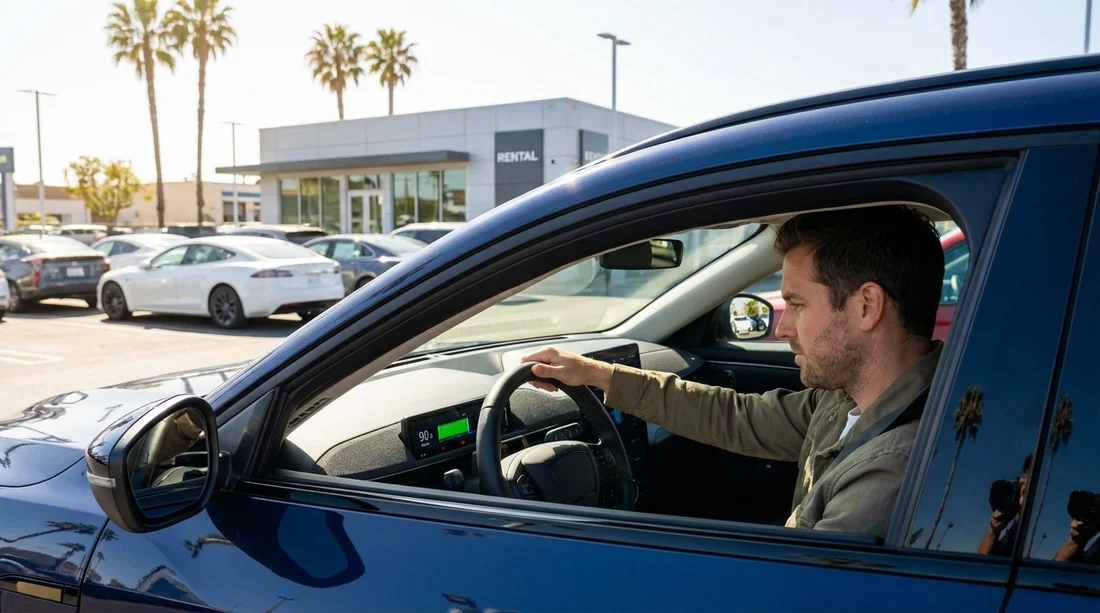
Match the paperwork to reality. Photograph the dashboard showing battery percentage and estimated range at pick-up, along with the time and location. This is helpful if the agreement lists a different value.
Charger access, networks, and apps, what matters for travellers
California’s charging landscape includes several major networks, plus destination chargers at hotels, car parks, and attractions. Your rental company may not give you a universal access card, so plan to rely on your own phone for app-based activation and payment.
If you are starting from San Diego Airport (SAN) and heading towards coastal destinations, you will likely be fine with a moderate starting charge. If you are heading straight into more remote areas, ensure your first planned charging stop is realistic and not dependent on a single site.
What to do if the battery level is lower than expected
If the car is handed over with a level that does not fit your journey or seems inconsistent with what you were told, address it before you leave. Ask the staff to note the actual percentage on the agreement and confirm the return policy. In some cases they may be able to swap vehicles, or advise the nearest fast charger and the expected time to top up.
For travellers flying into inland hubs like Sacramento, it can help to think about your first charging stop as part of your arrival routine. If you are collecting via Sacramento (SMF), check your first route for chargers that are easy to access with luggage and do not require complicated parking rules.
Setting realistic expectations for EV car hire in California
A sensible expectation is that your EV will be handed over with a “usable, trip-ready” charge rather than a perfect full battery. If you see 60% to 90%, that is common. What matters most is that the documented starting charge matches what you receive, that you understand the return requirement, and that you have a clear plan for charging access.
With those boxes ticked, EV car hire in California can be straightforward. You will spend less time worrying about the number on the dash, and more time enjoying the drive, knowing you can reach your first destination or charger without stress.
FAQ
Q: Should I expect a fully charged EV when I pick up in California? A: Not necessarily. Many rentals are delivered around 60% to 90% unless your agreement specifically promises a full charge.
Q: What is the most important charging detail to confirm on the agreement? A: The return requirement. Confirm whether you must return at the same percentage as collected, above a minimum level, or pay a recharge fee.
Q: If the paperwork does not show the pick-up battery percentage, what should I do? A: Ask staff to note it, and take a photo of the dashboard percentage and range before you leave the lot.
Q: Do EV rentals in California include charging cables or network access cards? A: It varies. Check the boot for cables or adapters, and be prepared to use charging apps with your own payment method.
Q: Why did my estimated range drop quickly after I left the airport? A: Range estimates adjust to speed, hills, temperature, and air conditioning. Use battery percentage and planned chargers to manage the trip.































































































