


Quick Summary:
- Check the boot for a spare wheel, jack, and wheel brace.
- Confirm whether the car has an inflator kit and tyre sealant.
- Ask where the locking wheel nut key is stored.
- Review roadside assistance rules before leaving the Los Angeles pick-up area.
When you collect a car hire in Los Angeles, it is sensible to assume that tyre support varies by vehicle type and rental partner. Some cars come with a full-size spare, others have a smaller space-saver wheel, and many newer models provide only an inflator kit with tyre sealant. The key is not to guess. A quick inspection at the pick-up location can save hours of frustration later, especially if you are heading onto freeways, into the hills, or out towards the desert.
In Los Angeles, rental fleets turn over quickly, and equipment can go missing between hires. Even when a spare wheel or inflator kit is supposed to be present, it may have been removed after a puncture or not returned after a previous customer used it. That is why the most reliable approach is to check the vehicle yourself before you leave the lot and to have any missing items documented straight away.
If you are collecting at the airport, it helps to plan a few extra minutes for these checks. You can compare vehicle options and pick-up arrangements via car hire at Los Angeles LAX, then treat the inspection as part of a safe handover rather than an inconvenience.
What is usually provided in Los Angeles rentals
There is no single rule that every rental car in Los Angeles will have a spare tyre. Provision depends on the vehicle’s original manufacturer setup, the rental company’s policy, and the specific model you receive. Many compact and mid-size cars now ship from the factory with no spare, replacing it with a tyre inflator kit to save weight and improve fuel economy.
Full-size spare: Less common in standard saloons and compact cars, more common in larger SUVs and some older models. If present, you should still confirm that it is inflated and that the tools are included.
Space-saver (temporary) spare: Quite common where a spare is provided, but it is designed for short distances and lower speeds. You need the jack and wheel brace, plus any locking wheel nut key.
Inflator kit with sealant: Very common in newer vehicles. This usually includes a small compressor and a sealant canister. It can help with small tread punctures, but it will not fix sidewall damage, larger holes, or a tyre that has come off the rim.
No usable equipment: Rare, but it happens when an inflator kit is missing or the sealant has expired. Sometimes the spare exists but the tools are not in the car. This is exactly what you want to catch before you drive away.
Why you should not assume a spare tyre is included
Even if you have hired cars before, Los Angeles car hire is particularly variable because of the mix of manufacturers in local fleets and the high utilisation rates around LAX. Equipment is easy to misplace, and some vehicles are not designed to carry a spare at all.
If you want to compare different categories that may be more likely to include a spare or more robust tyre setup, you can review Los Angeles options such as SUV hire at Los Angeles LAX or minivan hire at Los Angeles LAX. The exact equipment still varies by model, but larger vehicles sometimes have more storage for a spare and tools.
What to check before you leave the pick-up area
Do your checks while you are still in the pick-up area, where staff can confirm what should be in the car and can swap vehicles if needed. Focus on these practical points:
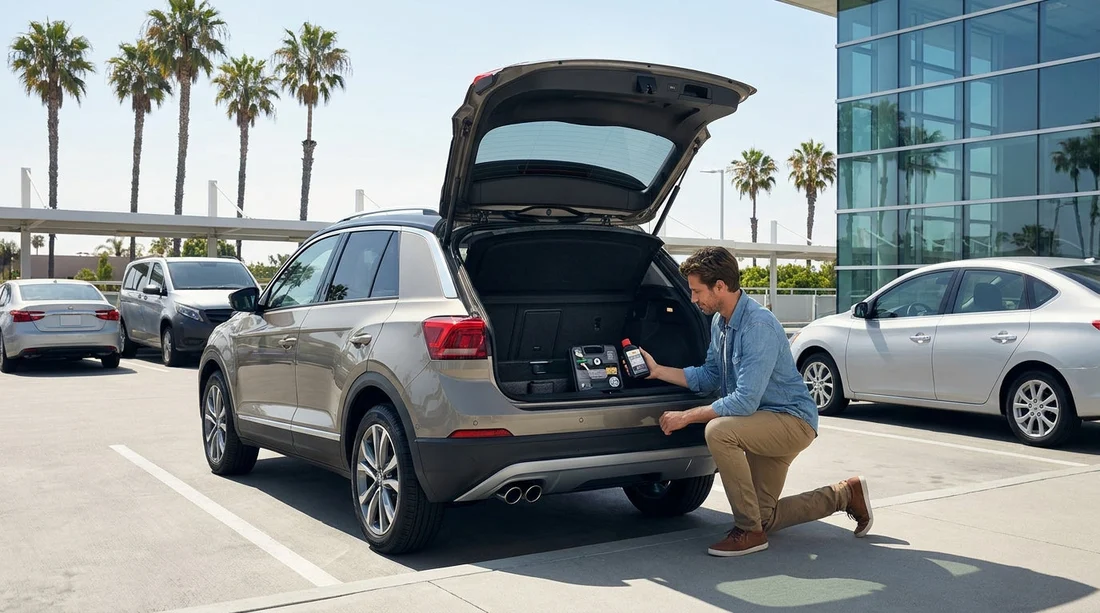
1) Look for the tyre solution first. Open the boot and lift the floor panel. If there is a spare wheel, check that it is present and appears inflated. If there is an inflator kit, locate the compressor and sealant, and ensure the sealant canister is within date if a date is printed.
2) Confirm the tools are actually there. A spare wheel is not useful without a jack and wheel brace. Check for the jack, the brace, the towing eye (sometimes stored near the tools), and any adaptors that fit the wheel bolts.
3) Ask about a locking wheel nut key. If the wheels use locking nuts, you need the matching key. It may be in the glovebox, tool compartment, or a small pouch. If it is missing, a roadside tyre change can become impossible.
4) Check the tyre pressure warning system. Turn the ignition on and look for any tyre pressure warning light. If it is illuminated at pick-up, ask for it to be addressed before you depart. Do not accept “it will reset later” without confirmation, since it can mask an actual low tyre.
5) Understand the policy for punctures. Clarify whether you are expected to call roadside assistance, arrange a repair yourself, or return the car for a swap. Policies differ, and it is easier to understand them when you are not stranded at the roadside.
How an inflator kit works, and its limitations
Inflator kits can be effective, but they are not a universal fix. Typically, you connect the sealant bottle and compressor to the tyre valve, inflate to the recommended pressure, then drive a short distance so the sealant can coat the inside of the tyre. After that, you recheck pressure and proceed cautiously.
Sealant may not work on sidewall damage. If you clip a kerb or hit debris on the freeway, the sidewall can tear, and sealant will not help.
Sealant can complicate repairs. Some tyre shops will charge more to clean sealant from the tyre and wheel, and some tyres cannot be repaired after sealant use.
Sealant expires. A kit that looks complete might be unusable if the sealant is out of date or missing. That is why a quick check at pick-up is worthwhile.
Not ideal for long distances. If you are planning a longer drive out of the city, confidence in the tyre solution matters more. You can view broader California pick-up options through car hire in California via LAX and decide whether your route warrants extra caution about tyre support.
What to do if there is no spare and no inflator kit
If you find that the vehicle has neither a spare wheel nor an inflator kit, do not leave the pick-up area hoping it will be fine. Ask staff to confirm what the vehicle is supposed to have. In some cases, the model is designed without a spare, but it should then have an inflator kit or a clear roadside support process.
If equipment is missing, request that it is provided, or ask for a different vehicle. If the rental company cannot supply the missing equipment, ensure the situation is documented on your rental paperwork or in the check-out notes, and confirm what to do if you get a puncture.
FAQ
Do rental cars in Los Angeles always come with a spare tyre? No. Many vehicles have no spare and instead provide an inflator kit, and some rely on run-flat tyres and roadside assistance procedures.
How can I tell if my rental has a spare, a space-saver, or an inflator kit? Check under the boot floor or in the side compartments for a wheel and tools, or look for a compressor and sealant canister in a dedicated kit bag.
What should I do if the inflator kit sealant is missing or expired? Raise it at the desk before leaving the pick-up area and ask for a replacement kit or a different vehicle, and ensure any missing items are noted.
Will I be charged if I use the inflator kit? It depends on the rental partner and the damage. Using sealant can make repairs more complex, so confirm the puncture and tyre policy at pick-up.
Is it safe to drive far in California with only an inflator kit? It can be, but it is not ideal for every puncture type. If you are planning long drives, confirm your roadside assistance coverage and keep the support number accessible.































































































