


Quick Summary:
- Confirm your child seat uses LATCH or ISOFIX and check weight limits.
- Find both lower anchors in the seat bight and verify spacing.
- Locate the top tether anchor for forward-facing seats and inspect it.
- Test installation tightness at the belt path, keeping movement under 2.5 cm.
When you collect a car hire in New York, you often have limited time at the kerb, a queue behind you, and a child seat to fit correctly before traffic stress begins. LATCH is the US term for lower anchors and top tether, while ISOFIX is the common international label for the same style of lower anchors. The goal before leaving is simple: confirm the anchor points exist where you expect them, confirm they are intact and accessible, and confirm your child seat can be installed tightly using them.
This guide is written as a quick, counter-side checklist you can follow at the vehicle, even if you have not seen the exact make and model before. It focuses on what to look for, where anchors are commonly hidden, and how to verify you are connected to the anchors, not to a cargo hook or a random bracket.
If you are picking up near major hubs such as car rental at New York JFK or arriving through New Jersey and driving into the city from car rental at Newark EWR, the same anchor checks apply. The specifics vary by vehicle type, so allow a few minutes to confirm the details instead of guessing.
Know what you are looking for: lower anchors and top tether
A LATCH/ISOFIX setup usually includes two lower anchors located in the crack where the seat back meets the seat cushion, plus a top tether anchor for forward-facing seats. Rear-facing seats may not use a top tether in the US, depending on the seat design. Some convertible seats allow rear-facing tethering with a specific method, so follow the child seat instructions exactly.
Before you touch the anchors, check your child seat label for weight limits when using lower anchors. Many seats require switching to the vehicle seat belt installation above a certain child weight. That is not a failure of the system, it is normal. The point of this check is to avoid driving off with a partially latched connector or a top tether attached somewhere unsafe.
Kerbside checklist: finding the lower anchors fast
1) Start with the safest seating position for your situation. Many families choose the rear outboard seats for easier access, but the centre rear can be safest if you can install tightly and the vehicle provides anchors there. Not all vehicles have centre lower anchors, so do not assume.
2) Look for visual cues first. Some vehicles mark anchor locations with small icons on the seat fabric, a tag near the seat bight, or plastic guides. If you see “ISOFIX” or a child-seat symbol, it usually points to the lower anchor position.
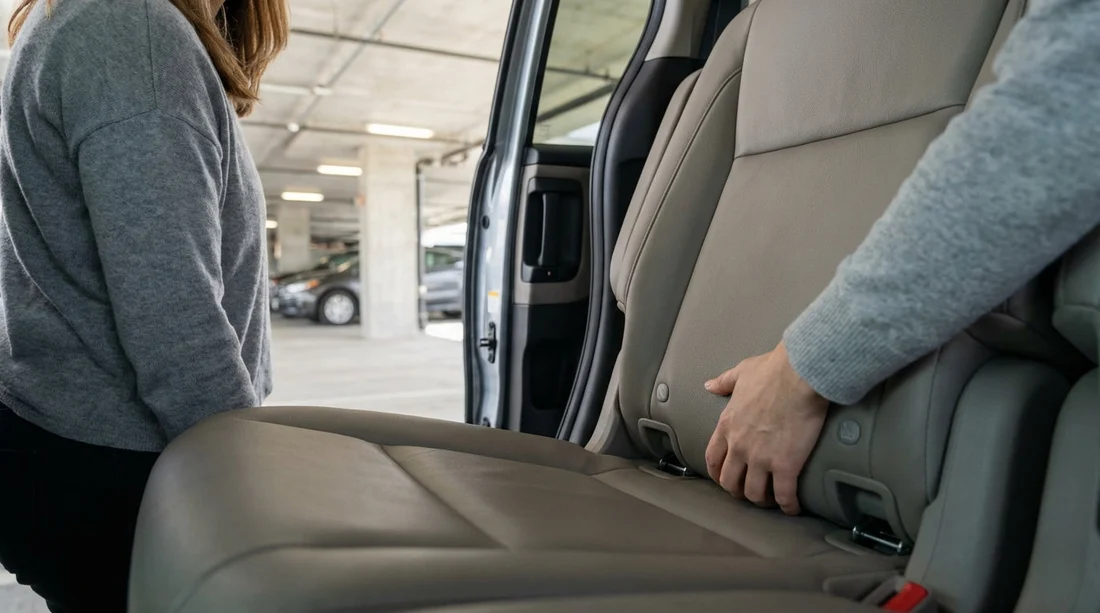
3) Feel in the seat bight. With your fingers, press into the crack between seat cushion and seat back. A true lower anchor feels like a sturdy metal bar, fixed and horizontal, about a finger-width thick. If you feel soft material only, push deeper and slightly sideways.
4) Clear the path. Ensure you are not trying to latch through a seat cover flap that blocks access. If the vehicle has plastic guides, align your connectors with the guide to avoid digging and to reduce the risk of false latching onto upholstery seams.
5) Verify you have two anchors spaced correctly. Lower anchors are typically spaced about 28 cm apart. If you find one anchor but cannot find its pair, stop and reassess. Do not clip to a single anchor or to an adjacent seat’s anchor unless the vehicle manual explicitly permits centre installations using inner anchors, which many do not.
6) Check for damage, obstruction, or looseness. You are checking the anchor bar is rigid and not bent, and that no debris, coins, or hardened dirt are preventing full connector engagement. Also scan for seat belt buckles trapped underneath your child seat base, which can create hidden slack.
Finding the top tether anchor in SUVs, saloons, and vans
For forward-facing installations, the top tether greatly reduces forward movement in a crash. In New York car hire fleets you might receive anything from a compact saloon to a larger SUV or people carrier. Tether anchor locations vary widely, so do a deliberate search instead of clipping to the first metal loop you see.
Common tether anchor locations include: the rear shelf behind the rear seat in many saloons, the back of the rear seat (often a metal bar or ring) in some SUVs, the floor or cargo area behind the rear seat, or the ceiling or upper trim in some vans. If you have a van or larger vehicle from a fleet such as van rental at New York JFK, tether points may be in the cargo area or on the seat frame.
How to confirm it is a tether anchor: look for the tether anchor symbol, a labelled anchor cover, or a clearly reinforced metal bracket bolted to the vehicle structure. Cargo tie-down loops are often larger, placed for luggage, and may be rated differently. If it is not clearly an anchor, consult the vehicle manual in the glove box or the infotainment screen.
Practical check: route the tether strap exactly as directed, ensure it is not twisted, then tighten until snug. The strap should pull straight without rubbing on sharp edges. If the tether must pass through a headrest or under it, follow the vehicle and seat instructions. Incorrect routing can leave slack or create a cutting edge in a crash.
Confirming the connectors actually latched
Many modern child seats use push-on LATCH connectors that click when attached. Others use hook-style connectors. Either way, do not rely on sound alone in a noisy pickup area.
Do a tactile pull test: after connecting each side, pull firmly on the connector near the anchor. It should not pop off. Then pull the seat base side-to-side at the belt path, not at the top of the seat.
Movement rule of thumb: with a correctly installed seat using either LATCH/ISOFIX or the vehicle belt, you want less than 2.5 cm of movement side-to-side and front-to-back at the belt path. If it slides more than that, it is not tight enough. Recheck that the connectors are on the anchor bars and that you have removed slack from the strap or belt.
Watch for these common New York pickup mistakes: clipping to the seat belt buckle stalk or a hinge instead of the anchor, routing the lower strap over an armrest, leaving the seat belt locked and creating an awkward angle, or trying to use lower anchors in a seating position that does not have them.
What to do if you cannot find anchors or they look wrong
If you cannot confidently identify the anchors, do not guess. Use the vehicle manual’s child restraint section, which often includes diagrams. If the manual is missing, check the infotainment “Vehicle” settings or quick guide, if available. If you still cannot confirm, install the child seat with the vehicle seat belt following the child seat instructions. A correctly done seat belt installation is safe and common.
Finally, if your child seat has been checked as luggage and is missing parts, or if the connectors are damaged, stop and resolve it before travel. Broken connectors or frayed straps are not a make it work situation.
If your trip involves crossing into New Jersey, you may find similar vehicle categories and anchor layouts when collecting through car rental in New Jersey EWR. Regardless of location, your safest approach is consistent: locate, inspect, latch, tighten, and test before driving.
FAQ
Q: Are LATCH and ISOFIX the same thing in a New York rental car?
A: They refer to the same lower anchor concept. In the US it is usually called LATCH, and it includes lower anchors plus a top tether for forward-facing seats.
Q: Where are the lower anchors usually located?
A: Typically in the seat bight, the crack between the seat cushion and seat back, in the rear outboard seats. Some vehicles also provide them in the centre, but many do not.
Q: How can I tell I latched onto the correct metal bar?
A: A correct lower anchor is a fixed, sturdy horizontal bar. After attaching, do a firm pull on each connector, then test for less than 2.5 cm movement at the belt path.
Q: Do I always need to use the top tether?
A: Use the top tether for forward-facing installations when the seat and vehicle provide it. It reduces forward movement. For rear-facing seats, follow your child seat instructions, as tether use varies.
Q: What if the anchors are hard to access or I cannot find them?
A: Check the vehicle manual for diagrams, try another seating position, or install using the vehicle seat belt according to the child seat instructions. Avoid attaching to cargo hooks or unlabelled loops.































































































