


Quick Summary:
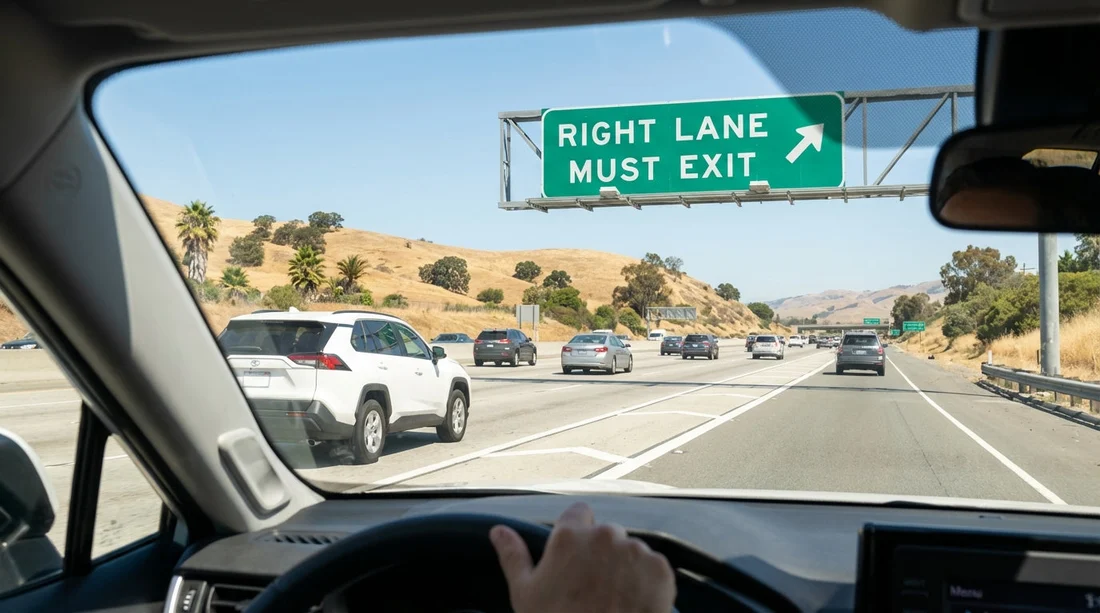
- “Right Lane Must Exit” means that lane becomes an off ramp.
- Scan ahead for exit-only panels, arrows, and broken-to-solid lane lines.
- Merge early, match speed, and use one clear signal gap.
- If forced off, follow signs, re-route calmly, and rejoin safely.
On California freeways, “Right Lane Must Exit” is a plain-English warning that the rightmost lane will stop being a through lane and will become an exit-only lane. If you stay in it, you will be guided onto an off ramp whether you intended to leave the freeway or not. For visitors on car hire, this can feel sudden because traffic is fast, signage is frequent, and exits can arrive close together.
The good news is that California’s road system is consistent. Once you know the visual cues and the safest way to change lanes in dense traffic, you can avoid unwanted exits, and you can recover calmly if it still happens. This guide focuses on spotting must-exit lanes early, planning merges, and handling an unfamiliar exit without panic.
What “Right Lane Must Exit” actually means
When a sign says “Right Lane Must Exit”, it indicates a lane drop for through traffic. The lane continues physically, but it peels away to form an off ramp. This differs from a normal exit where the right lane continues straight and an additional lane splits off. In a must-exit setup, through drivers need to merge left before the split.
You will also see related wording and designs, including “EXIT ONLY” panels on the sign, downward arrows that point to specific lanes, and sometimes “Lane Ends” warnings. The key point for car hire drivers is that the instruction is about lane choice well before the ramp, not about your destination. If you are not exiting there, you must relocate one lane left in good time.
How to spot a must-exit lane early
Early detection makes everything easier. Instead of reacting at the gore point, the goal is to identify the must-exit pattern 30 to 60 seconds ahead, then merge when gaps are still available.
1) Look for “EXIT ONLY” on overhead guide signs. On many freeways, the sign will show the route number and destination, with a yellow “EXIT ONLY” banner beneath the lane that becomes the ramp. If the rightmost arrow sits above that yellow panel, the right lane is not a through lane.
2) Read the lane arrows, not just the destination. Overhead signs use downward arrows to show which lanes go where. If you are following a navigation instruction like “continue on I-405”, confirm that your lane arrow points to the through route. In complex interchanges, it is common for the right lane to be exit-only for a connector, even though the freeway continues.
3) Watch the lane line pattern. A typical cue is the separation line between the exit lane and the through lane changing character as you approach the split. You may notice a longer dashed line, then a solid white line. As a rule, do not cross a solid white line near the ramp split. Treat the moment it turns solid as the end of easy, low-stress merging.
4) Notice widening shoulders and ramp geometry. The pavement may start to curve slightly right, the shoulder may widen, and the right lane may feel like it is drifting away from the main flow. If the road surface “funnels” toward an exit signpost, assume you are in an exit-only lane and confirm quickly with the overhead signs.
5) Expect must-exit lanes near airports, downtown approaches, and major interchanges. These designs are common where many drivers need to leave quickly. If you are driving after collecting a vehicle at Los Angeles Airport car hire or heading toward a major connector, plan for more lane-specific signage and earlier decisions.
How to avoid the exit-only trap in heavy traffic
In California, the safest merge is usually the earliest reasonable one. Waiting until the last few seconds forces sharp braking or aggressive moves, and it increases the chance that another driver will close a gap. Use a simple routine: scan, decide, signal, match speed, move once, and then cancel your signal.
Choose your “decision point”. When you first see “Right Lane Must Exit” or an “EXIT ONLY” panel, decide immediately whether you are exiting. If you are not, treat that sign as a prompt to start your merge plan, even if the ramp is still far ahead.
Build space ahead of time. If you are in the must-exit lane, gently adjust your speed to create a gap in the lane to your left. In steady traffic, easing off slightly can open a slot behind a vehicle. Avoid sudden braking, and avoid accelerating hard to “shoot” into a small gap.
Signal earlier than you think you need to. In dense flow, signalling for a second is not enough. Signal, keep your wheels straight, and let drivers understand your intent. Many California drivers will accommodate a predictable merge, especially when you are moving smoothly with traffic.
Match the speed of the lane you are entering. A common visitor mistake is trying to merge while going notably slower than the lane to the left. If safe, match pace first, then change lanes. Differences in speed are what trigger horn use, harsh braking, and near-misses.
Take one clean lane change, not a series of rapid swerves. If you need to move left multiple lanes, do it progressively. Move one lane, stabilise, reassess mirrors and blind spot, then move again if needed. Multi-lane “dives” are risky and can surprise drivers in adjacent lanes.
Be cautious around lorries and large vans. Their blind spots are larger, and their braking distance is longer. If you are using a bigger vehicle, similar principles apply, and you may appreciate the extra mirrors and space when driving away from van hire in California locations where traffic can be intense.
Lane markings and sign details that matter most
Visitors often focus on the words “must exit”, but the most reliable cues are the lane-level instructions. Here is what to prioritise while you drive.
Overhead sign arrows: They map lanes to outcomes. If an arrow is over your lane and points to an exit destination, that lane is committed.
Yellow “EXIT ONLY” panels: Yellow is used to highlight lane drops and exit-only status. If you see it above your lane, plan to leave that lane unless you are taking that exit.
Solid white lines near the split: Treat them as “do not cross” guidance. Even where it is technically permitted in some contexts, crossing late is unsafe and can be illegal depending on conditions and markings.
Gore area markings: The triangular zone with white chevrons at the start of the ramp is not a driving surface. Do not enter it to “save” a missed merge. Continue on the committed path and re-route.
HOV and express lanes: In some corridors, special lanes have restricted entry points and double lines. Do not cross double solid lines. If you need to move away from an exit-only lane, do it into the nearest general-purpose lane where entry is permitted.
How to recover calmly if you are forced off
Even experienced drivers occasionally end up in an exit-only lane with no safe gap. The safest recovery is mental, not mechanical: accept the exit, stay predictable, and let navigation re-route.
1) Commit to the ramp early and reduce workload. Once you are past the point where the split begins, stop trying to fight your way back. Keep a steady speed, follow the curve, and focus on the vehicles in front. This removes the temptation to cut across the gore area or brake abruptly in a live lane.
2) Follow ramp signs for “Re-enter Freeway” or a parallel route. Many California exits feed into a surface street with clear signage back to the freeway in both directions. If you are near a major airport approach, exits can be frequent, but so are on-ramps. If you are driving around the Bay Area after picking up at San Francisco Airport car hire, you will often find a re-entry within a short distance.
3) Use the next safe place to reassess. If the ramp leads to a traffic light, use the stop to check your route calmly. If you are unsure, choose a well-lit fuel station or a safe parking area, then review the map with the car stationary.
4) Rejoin the freeway like a planned merge. On-ramps can be short. Accelerate along the ramp to match freeway speed, signal, find a gap, and merge once. Avoid stopping at the end of the ramp unless traffic is fully stopped and there is no safe alternative.
5) Expect re-routing rather than “undoing”. Navigation apps in California usually offer a quick alternate that may be just as fast. You might not need to return to the exact freeway segment you left. If you are unfamiliar with interchanges around Silicon Valley after San Jose Airport car hire, trusting the re-route can reduce stress.
Defensive driving habits that prevent last-second merges
A few habits make exit-only lanes far less disruptive, especially when you are adapting to a new vehicle from a car hire counter and learning local traffic rhythm.
Keep a “lane buffer” when you can. If you do not need to exit soon, consider staying one lane left of the far-right lane. The far-right lane is where many must-exit and merge conflicts occur.
Scan signs two steps ahead. Instead of reading only the next exit, look for the sign after it. Complex areas often show two exits in quick sequence, and the first one may require lane placement that affects the second.
Use earlier “lane selection” prompts from navigation. If your navigation says “keep left to stay on” or “keep right for exit”, act early. Waiting until the spoken instruction repeats is usually too late in heavy traffic.
Know the “polite merge” rhythm. In busy California traffic, a steady indicator and consistent speed often works better than forcing eye contact or making abrupt moves. Give other drivers time to adjust.
Avoid distractions at decision points. If you are nearing an interchange, pause conversation, keep both hands ready, and do not adjust settings. Many wrong-lane moments happen because attention shifts right when lane commitments begin.
Common situations where visitors misread “must exit” lanes
Parallel exits and collectors. Some freeways have a parallel collector lane that serves multiple exits. It can look like a normal right lane at first, then it becomes exit-only for the collector. Watch for repeated “EXIT ONLY” panels that apply to the same lane.
Airport approach lanes. Lanes leading to terminals can become committed quickly, with multiple splits. If you are approaching an airport drop-off, confirm the exact terminal and approach road early, and avoid last-minute lateral moves.
Multi-freeway interchanges. A “right lane must exit” may send you onto a connector to another freeway, not a surface street. That is still an exit in signage terms. If your destination requires staying on the current freeway, treat connector exits as exits and merge away early.
Night driving and glare. Reflective signs are clear, but lane markings can be harder to read in rain or glare. Increase following distance so you have more time to interpret arrows and panels.
FAQ
What should I do if I realise I am in an exit-only lane at the last second? Prioritise safety and predictability. If you cannot merge with a clear gap before the split, take the exit, then re-route on surface streets back to the freeway.
Is it legal to cross the solid white line to escape an exit ramp? Solid white lines are guidance to discourage lane changes, and crossing them near a split is unsafe and can be cited depending on circumstances. It is better to accept the exit than make a sudden cross.
How early should I move left when I see “Right Lane Must Exit”? Start planning immediately, and aim to merge while the lane line is still dashed and gaps are larger. In heavy traffic, earlier is almost always safer than later.
Does “Right Lane Must Exit” mean the freeway ends? No. It means the right lane ends as a through lane and becomes an off ramp. The freeway continues in the lanes to the left.
Are exit-only lanes common on California freeways? Yes, especially near major interchanges, downtown approaches, and airports. Knowing the sign and arrow conventions makes them predictable rather than surprising.































































































