


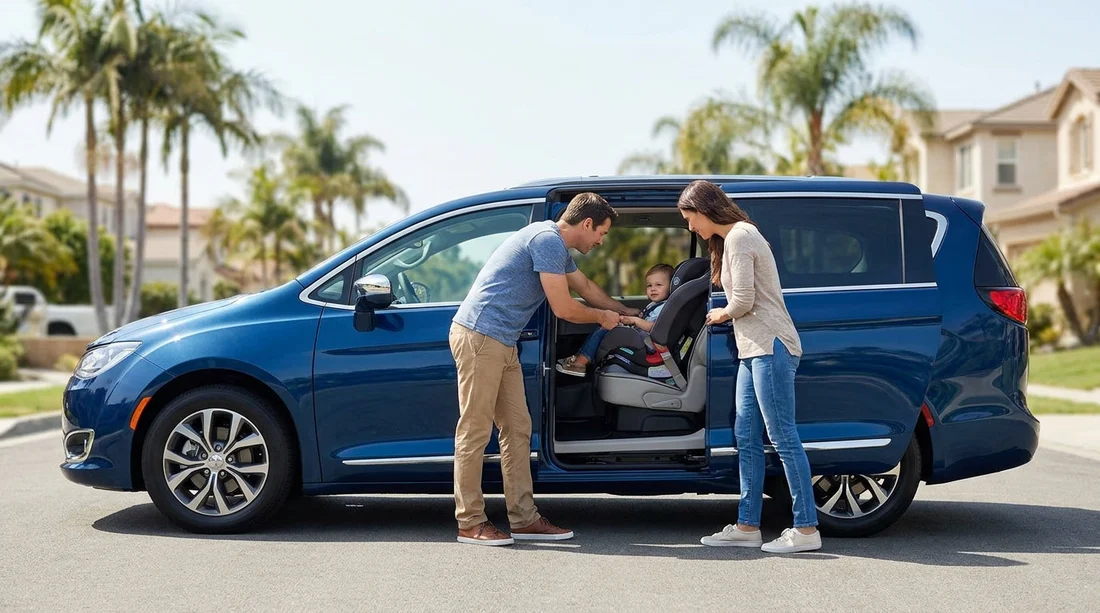
Quick Summary:
- Under 8s need a suitable child restraint, usually a car seat or booster.
- Children under 2 must ride rear-facing unless they meet legal exceptions.
- At 4 feet 9 inches tall, many children can use seat belts safely.
- Share ages, heights, and weights with your provider to reserve correctly.
When you are arranging car hire in California with children, local restraint rules affect more than just what you bring in your suitcase. They also shape which child seat type you may need to add to your rental, how long pick-up could take, and whether everyone can travel legally the moment you leave the car park.
California’s rules are straightforward in principle, but there are a few points that commonly trip up visitors, particularly families with children close to the cut-offs. The practical approach is to think in terms of age, height, and fit, then choose the restraint that matches your child and your itinerary.
California’s key child seat rules in plain English
California requires children to be properly secured in an appropriate child passenger restraint system. The two headline thresholds most travellers remember are “under 2” and “under 8”. In practice, you should consider four stages: rear-facing seats, forward-facing seats, booster seats, then the adult seat belt.
Under 2 years: Children under two must ride in a rear-facing car seat. There is an exception if a child is at least 40 pounds or at least 40 inches tall, in which case a forward-facing seat is permitted. Many toddlers do not meet these thresholds, so plan on rear-facing for most under-twos.
Age 2 to 7: Children in this range must ride in a car seat or booster seat in the rear seat. Which one is appropriate depends on size and the seat’s limits. A smaller child may still need a harnessed forward-facing seat, while a bigger child may be ready for a booster.
Under 8 years: The general rule is that children under eight must be secured in a child passenger restraint system, typically a car seat or booster, in the rear seat. This is the rule that affects most families planning airport pick-up, because it means you cannot rely on the vehicle’s seat belts alone for younger children.
8 years and older: At eight, the child may use an adult seat belt, provided it fits correctly. Many children are not comfortable or well protected in a seat belt until they are taller, which is why many families keep a booster beyond the legal minimum.
Height 4 feet 9 inches: This is the common benchmark at which many children can safely use an adult seat belt. It is not the only factor, but it is a helpful planning line when deciding whether to reserve a booster for a child who is around eight to ten.
How these rules affect what you should reserve for car hire
The biggest decision for car hire is whether you need a rear-facing seat, a forward-facing harnessed seat, or a booster. Each has different practical implications for supply, installation time, and fit.
Rear-facing seat: If you have a child under two, assume you need a rear-facing seat unless you are certain they meet the height or weight exception. Rear-facing seats can take more time to install correctly, and some families prefer to travel with their own seat for familiarity.
Forward-facing harnessed seat: If your child has outgrown rear-facing limits but is not ready for a booster, this is typically the right option. It is common for younger children in the 2 to 4 range, but the deciding factor is size relative to the seat’s harness limits.
Booster seat: If your child is under eight and has outgrown a harnessed seat, a booster is often the most practical. The key is ensuring the vehicle’s seat belt routes correctly across the shoulder and hips.
If you are collecting at Los Angeles International Airport, it can be useful to review options on car hire California LAX to understand typical fleet categories and what might suit a family loadout. For those who prefer a US English page variant, the car rental Los Angeles LAX page can also help when comparing vehicle sizes for child seat compatibility.
Age is not enough, you need height and weight too
Many travellers provide only a child’s age when arranging car hire. In California, that is rarely enough to select the correct restraint, because the under-two exception is based on height and weight, and seat selection is always dependent on manufacturer limits.
Before you finalise your reservation, note each child’s current height and weight. If you are travelling weeks from now, use the most recent values and err on the side of a slightly larger capacity seat, within safe limits.
Rear seat expectations and when front seats are allowed
California law prioritises the rear seat for children in car seats and boosters. In general, plan for all children in restraints to ride in the back. This matters when you are choosing a vehicle class, because not all cars have equal rear-seat space, and some have fixed headrests or seat contours that complicate booster positioning.
Front seating can become a question in two scenarios: a vehicle with no rear seat, or a situation where all rear seating positions are already occupied by children in restraints. If a child must sit in the front, airbag safety becomes critical. A rear-facing car seat should never be placed in front of an active airbag. If you are travelling with three children in restraints, consider a larger vehicle category to avoid awkward seating plans.
If you are flying into Northern California, pages such as car hire airport Sacramento SMF can help you think about airport arrival flow and vehicle suitability, especially if you expect to fit multiple restraints alongside luggage.
What to check at pick-up to stay compliant
The rules are only half the battle. The other half is making sure the restraint is installed correctly and that every child is positioned safely before you drive away.
Confirm the seat type: Check you have the right category, rear-facing, forward-facing harnessed, or booster. If you requested a booster, confirm whether it is high-back or backless and whether it suits your child’s height and the vehicle’s headrest.
Check labels and condition: Make sure the seat looks clean, intact, and has readable labels. While you do not need to become a child seat expert overnight, avoid using a seat that appears damaged or missing key parts.
Practice the belt path: For harnessed seats, ensure the belt routing is correct and the seat is tightly installed. For boosters, ensure the lap belt sits low across the hips, not the stomach, and the shoulder belt crosses the centre of the chest and shoulder.
If you expect a larger group or want more room for three-across seating, looking at a people-carrier option like van rental Sacramento SMF can be useful for planning, because wider rear seating often makes restraint installation easier.
Common planning mistakes families make with car hire in California
Assuming an eight-year-old never needs a booster: Legal minimums are not the same as best fit. Many eight and nine-year-olds are still under 4 feet 9 inches, and a booster can improve belt fit significantly.
Not planning for three children in restraints: Three-across can be tricky in standard saloons. If you have three children who need seats or boosters, vehicle width and seat belt placement become as important as the restraint itself.
Leaving no time for installation: After a long flight, it is tempting to rush. Build in time at pick-up to fit seats and adjust straps properly, especially for rear-facing seats.
FAQ
Do children under 8 have to use a car seat or booster in California? Yes. Children under eight must be secured in an appropriate child passenger restraint system, typically a car seat or booster, and usually in the rear seat.
What is the rule for children under 2 in California? Children under two must ride in a rear-facing car seat, unless they are at least 40 pounds or at least 40 inches tall, which can allow forward-facing.
Can my child use the normal seat belt if they are 8? They can legally, but seat belt fit is what matters. If the belt sits on the neck or the lap belt rides up, a booster is usually the safer choice.
Should I provide height and weight details when arranging car hire? Yes. Age alone can lead to the wrong seat type. Height and weight help ensure the seat provided matches legal requirements and manufacturer limits.
Is it easier to fit multiple child seats in a larger vehicle? Usually, yes. Wider rear seats, more belt anchoring points, and extra space can make correct installation simpler, especially for three children.






























































































