


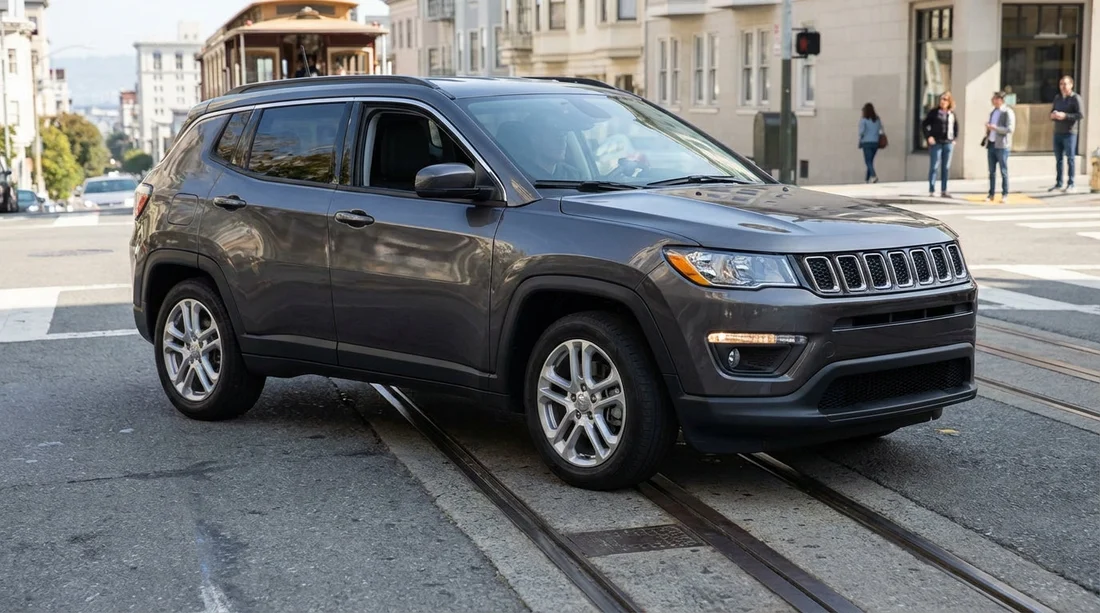
Quick Summary:
- Cross rails at 45–90 degrees, never drift along grooves.
- Slow early on wet streets, braking distances rise sharply.
- Avoid tram lanes on Market Street, and steep track crossings.
- If stuck in a groove, straighten, then gently power out.
San Francisco is famous for cable cars, streetcars, and steep streets, but those same rails can surprise drivers unfamiliar with running on mixed traffic roads. With car hire in San Francisco, the goal is simple: keep your tyres out of track grooves, avoid sudden steering or braking on metal, and know what to do if a wheel drops into the channel next to the rail. This guide covers the track hotspots where wheels get caught, the safest crossing angles, wet weather stopping distance, and practical recovery steps if you feel the steering tug.
If you are collecting a vehicle after flying in, it helps to factor track-heavy routes into your first drives. Hola Car Rentals has San Francisco airport pages that can help you compare options before you arrive, such as San Francisco SFO car rental and San Francisco SFO car hire. Once you are on the road, the techniques below apply whether you are driving downtown, through the Embarcadero, or across neighbourhoods with embedded rails.
Why tram and cable car tracks can damage tyres and wheels
Street-running rails sit slightly proud of the road surface, and are paired with a narrow groove, called a flangeway, that guides the tram wheel. A car tyre can drop into that channel, especially if the tyre is turned slightly while rolling parallel to the rail. When that happens, the car can “tramline”, meaning the steering feels pulled by the groove and your wheel angle changes less than you expect.
Wheel and tyre damage typically comes from three scenarios. First, a tyre strikes the rail edge at speed, which can pinch the sidewall. Second, a wheel rides up and then drops off the rail abruptly, risking a bent rim on low profile tyres. Third, a driver over-corrects while trapped in the groove and hits a kerb, another car, or street furniture. Good technique avoids all three by managing speed, steering angle, and where you position the car.
Track hotspots: streets where grooves catch tyres in San Francisco
Not every embedded rail is equally risky. The biggest issues show up where tracks run along your direction of travel, where lanes force you to straddle rails, or where traffic pressure encourages late lane changes.
Market Street and adjacent blocks are the classic example. The streetcar and light-rail corridors create long stretches of rails that you can end up driving alongside. Even if you are not meant to drive in certain sections, navigation apps can still route you near the rail alignment. If you must cross Market, aim for a deliberate, near-perpendicular crossing at low speed, and avoid last-second turns across rails.
The Embarcadero has rail segments near the waterfront and busy junctions. Here, the risk is not only grooves, but also polished metal from frequent use, which is slick when damp. Plan your lane early, and treat metal like a painted line in rain.
Downtown turns and intersections are where most “wheel in groove” incidents start. Turning across a rail at shallow angle can drop a front tyre into the channel, then the rear tyre follows. If you feel the steering lock into a path you did not choose, assume a groove has captured the tyre and do not fight it with a sharp yank.
Steep streets with track crossings add another complication. On a hill, weight shifts forward when braking and rearward when accelerating. If you combine slope plus rail plus braking, you reduce grip precisely when you need it. Use a lower speed before the rails, keep inputs smooth, and keep more distance to the vehicle in front.
If your trip includes picking up outside San Francisco, you may also see embedded rail in parts of the wider Bay Area. Hola Car Rentals also lists nearby airport and brand pages such as San Jose SJC car hire and National car hire at San Francisco SFO, which can be useful when comparing vehicle sizes and tyre profiles.
Safe crossing angles: the simplest rule that prevents most problems
The best way to cross a rail is to do it decisively. Aim to cross at an angle between 45 degrees and 90 degrees wherever road layout allows. The closer you are to perpendicular, the less time the tyre spends on the metal and the less chance it has to drop into the groove.
What to avoid is a shallow approach, such as 10 to 20 degrees, where the tyre can track along the groove instead of hopping across it. Shallow angles happen when you drift across lanes late, or when you turn while still partially aligned with the rail. If you need to turn across tracks, slow down earlier, straighten your approach as much as possible, then turn smoothly after the front wheels have crossed cleanly.
Steering input matters as much as angle. A steady wheel with small corrections is safer than a sharp, abrupt steering change on metal. In practice, you want to set your line before the track, hold it across the metal, then make any fine correction once you are back on asphalt.
Speed and spacing: how fast is “safe” on embedded rails?
There is no single safe speed because it depends on traffic, the depth of the groove, tyre condition, and whether the road is wet. However, two principles work in all conditions.
First, slow down before the rail, not on it. Braking on metal reduces grip and can trigger ABS sooner, which lengthens your stop. On a dry day, you can often roll over a crossing at a controlled city speed. In rain or fog, treat the rail like a slick surface and reduce speed further, keeping the car balanced.
Second, increase following distance when tracks are present. This gives you time to brake on asphalt before the rails rather than doing a hard stop on metal. It also stops you being pressured into a rushed lane change that creates a shallow crossing angle.
Wet-weather braking distance on San Francisco streets
San Francisco can be damp, especially with coastal fog and mist that leave roads shiny even when it is not raining. Metal rails become particularly slippery, and painted lane markings can be slick too. The key adjustment is to assume that stopping distances rise materially.
As a practical guide, allow at least double the normal following gap in wet conditions around track corridors, and be ready for even longer distances downhill. If you would usually leave a two-second gap in city traffic, aim for four seconds when it is wet and you are approaching rails, junctions, or steep grades.
When you do need to brake, brake earlier and more gently. Smooth braking keeps weight transfer predictable and helps the tyres keep grip. If you must stop with tyres on the rails, keep the steering straight and avoid sudden turns from a standstill.
What to do if you feel the tyre drop into a groove
The moment a tyre is caught, many drivers instinctively yank the wheel. That is what creates the bigger danger. Use this sequence instead.
1) Stay calm and reduce speed gently. Ease off the accelerator. Do not slam the brakes on the rail.
2) Straighten the steering wheel. The tyre is more likely to climb out when the wheel is aligned straight ahead. If you are already turning, unwind slightly to reduce the angle.
3) Create a safe crossing angle. Signal, check mirrors, and position so you can cross the rail rather than run along it. You may need to wait for a gap in adjacent traffic so you can angle across.
4) Apply light, steady power. A gentle throttle helps the tyre climb out. Avoid a burst of acceleration that could spin the wheels on metal, especially in rain.
5) Once free, slow and reassess. If you felt a hard impact or hear a new vibration, pull over somewhere safe and inspect tyres and wheels.
If you cannot get out because traffic blocks you from creating an angle, prioritise safety. Keep the wheel as straight as possible, roll slowly, and wait for space. Many “stuck” moments resolve once you can cross at 45 degrees or more.
Turning across rails on hills: a San Francisco-specific hazard
Hills change everything because gravity adds or subtracts load as you brake and accelerate. When descending, your front tyres are already working hard. If you add rail crossing and braking together, the front can lose grip and slide slightly, increasing the chance of catching the groove at a poor angle.
Use a lower speed earlier on the descent, and avoid braking right on the track. On steep uphills, be careful not to stop with tyres positioned on metal, because moving off can spin the wheels in wet conditions. If you must stop on a rail, pull away smoothly and keep steering straight until you are back on asphalt.
Avoiding wheel damage: simple vehicle checks and driving habits
With car hire, you may not know the tyre history. Before you drive into track-heavy areas, do a fast check. Look for obvious tyre sidewall bulges, cuts, or very low tread. Ensure the tyre pressures are correct if the vehicle has a display, and note whether you have low-profile tyres, which are more vulnerable to rim damage from rail impacts.
On the road, avoid straddling a rail for long periods. If you notice you are running parallel to a track, shift your position within the lane to keep tyres away from the groove, but only when it is safe and legal. At junctions, anticipate your lane early so you are not forced into a late diagonal drift across rails.
If you do hit a rail hard, do not ignore it. A bent rim can cause vibration at speed, and a pinched tyre sidewall can fail later. Find a safe place to stop, visually inspect, and report any concerns according to your rental terms.
Navigation tips: planning routes that reduce track exposure
Many track encounters happen because drivers follow sat-nav prompts without considering road layout. In San Francisco, it is worth choosing routes that minimise complicated track corridors, especially in rain or at night.
Before setting off, zoom into the first few turns and look for long rail alignments. If the route follows Market Street for multiple blocks, consider an alternative parallel street where permitted. When approaching the waterfront, be prepared for lane guidance near the Embarcadero and allow extra time so you do not rush a crossing.
If you are new to US road rules, remember that turning on red is often permitted after stopping, unless signed otherwise. Where rails are present, treat that turn as a higher-risk manoeuvre. Make a full stop on asphalt if possible, then turn smoothly and avoid cutting across metal at a shallow angle.
FAQ
Is it legal to drive on tram or cable car tracks in San Francisco? It depends on the street segment and signage. Some corridors restrict general traffic, while others are shared. Always follow posted signs and lane markings, and avoid rail-only sections.
What is the safest angle to cross tram tracks with a hire car? Aim for 45 to 90 degrees whenever possible. A near-perpendicular crossing reduces the chance of the tyre dropping into the groove and limits impact on the wheel.
Why do rails feel slippery in fog or rain? Metal has less friction than asphalt, and it can be polished by tram wheels. In damp conditions it becomes very slick, so brake earlier, steer smoothly, and increase following distance.
If my wheel gets stuck in the groove, should I accelerate hard to escape? No. Ease off, straighten the wheel, wait for space to create a better crossing angle, then use light, steady power. Hard acceleration can spin tyres on metal and reduce control.
What should I check after crossing tracks if I felt a hard bump? When safe, inspect the tyre sidewalls for cuts or bulges and look for rim scrapes or bends. If you notice vibration or a warning light, report it and seek guidance before continuing far.






























































































