


Quick Summary:
- Look for “Express Lanes” signs showing FasTrak required and current toll.
- Observe posted enforcement hours, rules change by freeway and direction.
- Stay out of express lanes if your rental has no toll option.
- Expect tolls plus an admin fee, billed later to your rental card.
Driving in and around San Francisco can feel straightforward until you spot a fast-moving lane marked “Express Lanes” with electronic price boards. If you are visiting on car hire, the key question is practical: can you use those lanes, when do the rules apply, and how will charges show up after you return the vehicle?
This guide focuses on the Bay Area FasTrak express lanes you are most likely to encounter on US-101, I-880 and I-80. You will learn how they are signed, how enforcement windows work, and what “normal” rental billing looks like so you can avoid surprise costs.
If you are collecting at the airport, it helps to know the toll setup before you pull away from the car park. See Hola’s local pickup pages for context on San Francisco options such as car hire at San Francisco Airport (SFO) and vehicle types like SUV hire at SFO. If your trip includes the South Bay, you may also be comparing car hire in San Jose (SJC) for different flight routes and driving patterns.
What FasTrak express lanes are, in plain terms
FasTrak is the Bay Area’s electronic tolling system. An “express lane” is a managed lane on a motorway where access is restricted and pricing can change to manage congestion. In the Bay Area, many express lanes are “FasTrak only”, which means a transponder or valid toll account recognition is required for that lane when it is operating.
Some express lanes are also carpool lanes. That is where it gets confusing for visitors: the lane can be free or discounted for qualifying carpools, but only if the vehicle is correctly detected and, in many cases, set to the right occupancy mode on the transponder. In a rental, you usually do not have full control over occupancy settings unless the hire company provides a compatible switchable transponder.
How express lanes are signed on US-101, I-880 and I-80
In the San Francisco Bay Area, the most useful thing to watch for is the combination of lane markings and overhead signs.
1) “Express Lanes” and FasTrak requirement
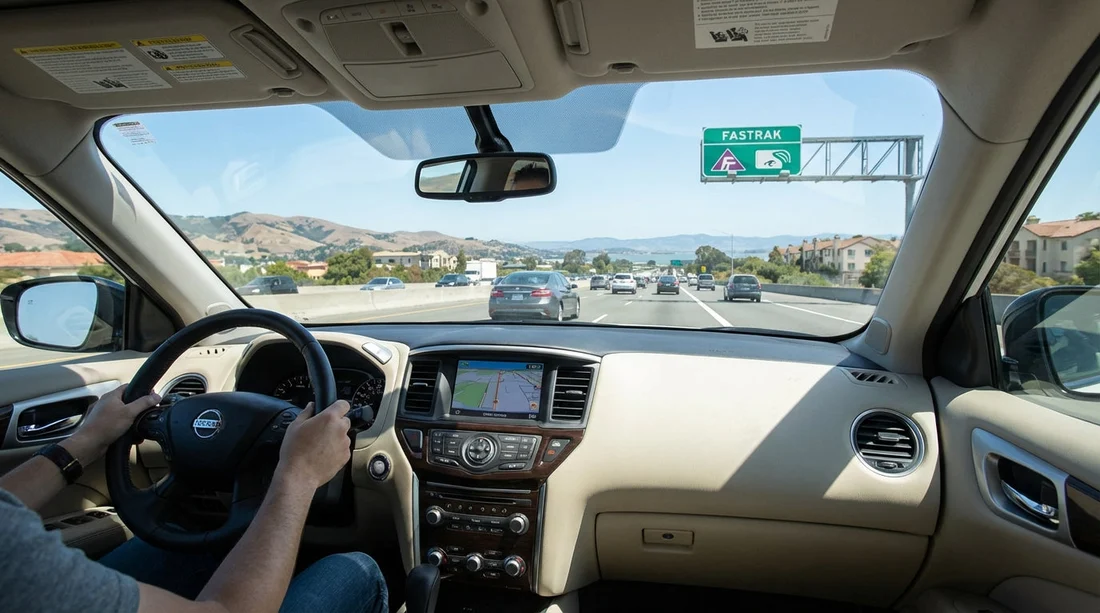
Look for overhead signs that literally say “Express Lanes” and mention FasTrak. You may see “FasTrak Only” or a FasTrak logo. If the sign indicates FasTrak is required, assume you should not enter without the rental’s toll solution enabled.
2) Electronic toll pricing boards
Many corridors show a price for the express lane to a named destination. The display is typically an electronic board. If a price is shown, the lane is operating and a toll is likely to apply unless you qualify for a free or discounted carpool rate and the system can verify it.
3) Hours and rule panels
Some signs show operating hours, such as morning and evening peak windows. Outside those hours, the lane may revert to general use or remain restricted depending on the corridor. Treat the posted hours on the sign as the rule for that specific stretch of road.
4) Entry points and lane separation
Unlike fully barrier-separated toll lanes, Bay Area express lanes often have designated entry and exit areas marked by dashed white lines. In between, there may be double solid white lines. Crossing a double solid line is not allowed, so plan your entry and exit at the marked zones.
5) Diamond symbols and “HOV” wording
A diamond on the road surface often indicates high occupancy vehicle use. However, on these corridors it may coincide with express lane rules rather than a traditional free carpool lane. Always defer to the overhead sign, not just the diamond symbol.
When they are enforced: what “operating hours” means
“Enforced” or “operating” hours are the times when the express lane access rules are active. During those windows, you can be cited if you enter the lane without the required toll account or if you violate carpool rules.
What matters in practice is that enforcement can vary by freeway, direction, and segment. US-101, I-880 and I-80 do not all follow one universal schedule, and a corridor can change rules as you move between cities. That is why the safest approach in a rental is to read each overhead sign as you approach the lane and treat it as the current instruction.
Outside operating hours, one of three things typically happens, depending on the section:
First, the lane may become a general-purpose lane where anyone can drive without tolling. Second, it may remain restricted but with different pricing or requirements. Third, it may be signed in a way that still expects FasTrak even if pricing looks inactive. If you are unsure, do not enter, especially if your rental does not have a toll option set up.
How tolling works without stopping, and why rentals matter
Bay Area tolling is cashless. There are no toll booths for these express lanes. Instead, sensors read a transponder or capture number plates. If the system associates the plate with a rental vehicle, charges are routed through the rental company’s toll programme.
For a car hire driver, this usually means you have two broad scenarios:
Scenario A: Your rental has a toll solution enabled
The hire company has a transponder in the vehicle, a licence plate tolling arrangement, or both. You can use FasTrak facilities, and tolls are billed to you later, normally with an admin fee.
Scenario B: Your rental has no toll solution enabled
You can still drive on non-tolled lanes. However, entering FasTrak-only express lanes during operating hours can lead to toll violations or higher post-trip charges. In this scenario, it is best to avoid the express lanes entirely.
Because policies vary by provider and vehicle category, it is sensible to check the toll policy terms at pick-up, especially if you are choosing between categories. For instance, a larger vehicle may suit family luggage, but your toll expectations stay the same whether you pick a compact or SUV rental at SFO.
Typical rental billing: what you will see and when
Many visitors expect tolls to be charged immediately. With Bay Area tolling and rentals, billing is often delayed. A common pattern is:
1) You drive through the express lane
The toll is assessed based on time of day, congestion level, and any carpool status the system recognises.
2) The toll operator posts the charge
Posting can take days, sometimes longer, because it relies on back-office processing and plate matching.
3) The hire company invoices you
Charges often appear after you return the car. They may show as a separate line item or a follow-up card charge. In addition to the toll amount, an admin or convenience fee is common.
How it may appear on your statement
Expect wording that references tolls, a toll programme name, or an administrative processing fee. The toll line items may aggregate multiple crossings, or list them individually. If you used several tolled facilities in one day, the charges can be batched.
What to keep
If you want to reconcile charges, note the day, approximate time and corridor where you used an express lane. You will not receive a paper receipt at the roadside, so your own notes can help if anything looks incorrect later.
Practical driving tips to avoid mistakes on US-101, I-880 and I-80
Use the correct lane early
Express lanes are often on the far left. If you are not using them, stay in the general lanes and avoid last-minute weaving. Remember that double solid white lines mean you must not cross.
Treat “FasTrak Only” as a hard rule
If you are uncertain whether your car hire includes toll coverage, do not enter a FasTrak-only lane during operating hours. The cost of a mistake is typically higher than the time saved.
Do not assume HOV is free in a rental
Even if you have enough occupants, the system may require a switchable transponder set to the correct occupancy. Many rentals do not give you a user-adjustable device, so relying on a free carpool setting is risky.
Watch for segment-by-segment changes
On longer drives, the rules can change as you cross county lines or move between interchanges. The sign above the lane you are about to enter is the one that matters.
If you accidentally enter, exit at the next legal point
Do not cross double solid lines. Continue until the next dashed entry or exit zone and move back to the general lanes safely.
Common situations for visitors starting in San Francisco
Airport departure and hotel runs
If you pick up near SFO, you may merge onto US-101 quickly. In the first 20 to 30 minutes of driving, focus on staying in general lanes until you are comfortable reading the signs. If you are still choosing a provider, Hola lists different options, including budget car hire at SFO, which can be useful when you are comparing total trip costs such as fuel and tolls.
Day trips to Silicon Valley and the East Bay
Trips towards San Jose often involve US-101 or I-880. These are exactly the roads where express lanes can offer time savings in peak traffic, but also where rules are strict during operating hours. If you fly into San Jose instead, note that driving patterns change, and so does how soon you encounter express lanes after leaving the airport.
Cross-bay travel
I-80 is a common route for reaching the East Bay and beyond. You may see express lane signage on approaches and busy segments. Again, read the overhead boards and assume cashless billing through the rental if you use them.
Should you use FasTrak express lanes in a rental at all?
It depends on your priorities and your rental’s toll arrangements. Express lanes can be genuinely useful during weekday peaks, especially when a 15-minute delay becomes a 45-minute delay. However, the simplest low-stress approach for many visitors is to avoid FasTrak-only express lanes unless you have confirmed your rental’s toll programme and you are comfortable with delayed billing.
If you do choose to use them, do it intentionally: enter only at marked points, follow the posted hours, and expect a toll plus a processing fee later. That mindset keeps express lanes a convenience, not a surprise.
FAQ
Can I drive in Bay Area FasTrak express lanes with a rental car?
Yes, provided the rental is covered by a toll programme or transponder arrangement. If you are unsure, avoid FasTrak-only lanes during operating hours.
How do I know when an express lane is active?
Check the overhead signs for operating hours and any electronic toll price display. If the sign shows FasTrak requirements and a price, assume it is active.
Will I be charged immediately for using an express lane?
Usually not. Tolls are processed electronically and rental billing often appears days after return, commonly as tolls plus an admin fee.
What happens if I enter an express lane by mistake?
Stay calm, do not cross double solid lines, and exit at the next legal dashed section. You may still be charged a toll for the segment used.
Are carpool discounts guaranteed in a rental?
No. Discounts may require a switchable transponder set to the right occupancy, and many rentals do not provide user-adjustable settings. Assume you will pay the posted toll unless confirmed otherwise.






























































































