


Quick Summary:
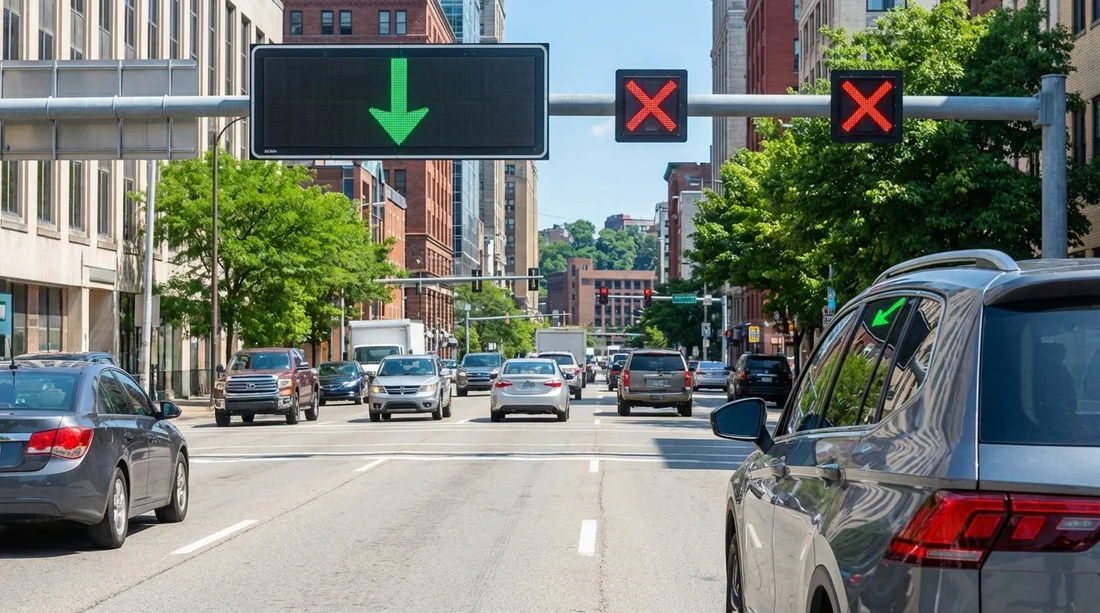
- Follow overhead lane-control signals, green arrow means open, red X means closed.
- Expect reversals at key Pittsburgh approaches, especially during weekday peak commuting periods.
- Never enter a lane showing a red X, even if road looks clear.
- If you are in the wrong lane, exit at the next opportunity.
Reversible lanes can feel unfamiliar if you are visiting Pennsylvania on car hire, especially around Pittsburgh where some approaches change direction to match commuter demand. The principle is simple, road space is limited, traffic demand changes by time of day, and lane direction is controlled using signals and barriers. The challenge for visitors is learning what the signals mean, recognising the corridors where reversals are common, and knowing what to do if you realise too late that you are positioned incorrectly.
This guide focuses on practical reading of lane-control signals, what “flip” means in real driving terms, and how to make safe decisions when the direction is about to change. It is not a route planner, and it cannot replace posted signs or instructions from police or incident management crews. In Pennsylvania, the sign you can see now is the rule that matters.
If you are collecting a vehicle for Pennsylvania driving and want to get comfortable with local rules before joining city traffic, Hola Car Rentals has information pages that help you compare pick-up options and vehicle types, for example Philadelphia Airport car rental and SUV rental in Philadelphia. Even if your trip is centred on Pittsburgh, it is useful context for how rental fleets and road types vary across the state.
What are reversible lanes and why does Pittsburgh use them?
Reversible lanes are traffic lanes whose permitted direction changes at set times or in response to traffic conditions. Instead of building extra road space that sits underused off-peak, transport authorities use signals, barriers, and clear markings to allocate more lanes to the dominant flow. The concept is common on bridges, tunnels, and constrained approaches where there is limited room for widening.
Pittsburgh’s topography pushes major routes into valleys, across rivers, and through tunnels, which creates pinch points. Reversible setups can add inbound capacity in the morning and outbound capacity in the evening. For someone in car hire, the key takeaway is that you cannot rely on memory from the previous day. Lane direction may be different depending on time and day.
How to read lane-control signals in Pennsylvania
The most important skill is reading overhead lane-control signals and pairing them with what the pavement markings and physical separators are telling you. In many reversible systems, the signal is the legal control, and the markings provide reinforcement.
Green arrow, the lane is open in the direction you are travelling. Keep scanning ahead because signals can change over different segments.
Red X, the lane is closed to your direction. Do not enter. If you are already in the lane, look for the next safe place to move out where the lane is still open to you. A red X can mean the lane is open to oncoming traffic or is temporarily closed for safety.
Yellow X or yellow diagonal arrow, prepare to leave the lane. This is an advance warning. Move over as soon as you can do so safely, without sudden braking or swerving.
Flashing signals are used during transitions. Treat a flashing yellow or transition phase as a strong prompt to move out early. The precise sequence varies by facility, so prioritise the instruction on the signal head you are directly under.
Lane-use control signs sometimes supplement signals with words like “reversible lane” or time windows. Use these for planning, but treat the live signals as definitive.
Physical cues matter. If you see movable barriers, cones, or gate arms, they indicate a controlled changeover. Never drive around a barrier. If the system uses overhead signals without a hard barrier, your attention to the signals must be even sharper.
What does “flip” mean and when do lanes usually change?
When a reversible corridor “flips”, it goes through a managed process: lanes are cleared, signals change, and direction is reassigned. The flip itself is not a moment you want to be near the decision point. If you are approaching close to a changeover time, plan for extra delay and be ready to take an alternative route if signs instruct.
In Pittsburgh, reversible operations are most commonly associated with weekday commuter peaks. Many facilities aim to provide extra inbound capacity in the morning and extra outbound capacity in the late afternoon or early evening. Outside peaks, operations may return to a neutral arrangement or a fixed split. Special events, major incidents, weather, or roadworks can also trigger temporary adjustments.
Because exact times can change, visitors should not memorise a schedule from a third-party source. The safe approach for car hire drivers is to assume the lane could be different from yesterday and to decide based on the signals and signs you can see today.
Corridors where you may encounter reversals around Pittsburgh
Pittsburgh drivers often refer to “reversible lanes” in the context of major approaches and constrained links where traffic management is needed. You may encounter reversible operation on some tunnel approaches and inbound or outbound corridors used heavily by commuters.
Rather than relying on a list that could be outdated, use these practical identifiers to recognise a reversible corridor as you approach it:
Overhead signal gantries at regular spacing over each lane, especially where you would not expect them on a typical motorway.
Signs mentioning lane control, peak-period direction, or restrictions for certain vehicle types.
Unusual median treatments, such as buffer zones, gates, or movable barrier tracks.
Frequent “do not enter” signing visible for opposing flows, often combined with red signal aspects over lanes.
If you are using navigation, treat it as a suggestion, not a guarantee. Some sat-nav systems handle reversible lanes well, others do not. When a device instruction conflicts with a red X or posted lane-control signage, ignore the device and follow the road controls.
Step-by-step: approaching a reversible section safely
For visitors driving in Pennsylvania, the safest routine is to start reading the lane-control system before you reach the commitment point.
1) Look early, then confirm. Scan for gantries two or three sets ahead. A green arrow over your lane now is helpful, but an upcoming yellow arrow may indicate you need to move.
2) Avoid last-second lane changes. If traffic is dense, your safest move is an early, gentle lane change when you have space.
3) Keep a buffer. Leave extra following distance so you can respond smoothly if vehicles ahead shift lanes when they notice a change.
4) Watch for enforcement and safety vehicles. During changeovers, you may see police or maintenance vehicles. If you are directed by an officer, follow those instructions even if they differ from what you expected.
5) Do not stop in a live lane to reconsider. If you have missed your preferred lane, keep moving and correct your route later.
What to do if you realise you are in the wrong lane
This is the situation most visitors worry about, and it is where calm decision-making matters most. The right response depends on what you are seeing above your lane.
If your lane shows a green arrow but you are headed the wrong way for your route, stay in the lane until you can move over safely. Then take the next exit or turn option and let your navigation reroute. A “wrong lane” for your destination is inconvenient, but it is not a safety emergency.
If you see a yellow instruction to move out, treat it as an early warning. Signal, check mirrors and blind spots, and merge when there is a safe gap. Avoid braking sharply to force a merge.
If the lane shows a red X, you must leave the lane as soon as safely possible. Do not accelerate to “beat” the system, and do not drive past a gate or barrier. If traffic prevents you merging immediately, slow gently, keep your indicator on, and look for the first safe opening. The goal is to exit the closed lane without creating a secondary incident.
If you have crossed into a lane you now suspect is about to reverse, do not attempt a U-turn or reverse your vehicle. Continue forward to a point where you can legally exit or where staff direct you. If you are forced to stop because the lane is physically blocked, remain in your vehicle unless instructed otherwise.
These principles are especially important in unfamiliar car hire vehicles. Take a moment before setting off to adjust mirrors, seat position, and navigation audio so you are not tempted to look down at the screen when overhead signals require your attention.
Common mistakes visitors make and how to avoid them
Assuming painted arrows always match the current direction. In reversible corridors, pavement arrows can be limited or generic. Rely on overhead lane-control signals and signs.
Following the vehicle ahead without checking the signal. Local drivers sometimes know a corridor well, but traffic can still make mistakes. You are responsible for the signal over your lane.
Trusting sat-nav over a red X. A navigation system may not account for temporary closures or flip transitions. Signals and signs are authoritative.
Late merges at the commitment point. The earlier you respond to a yellow instruction, the smoother and safer it will be.
Planning tips for car hire drivers in Pennsylvania
Reversible lanes are easiest when you build a small time buffer into your schedule, particularly around weekday peaks. If you have a flight, appointment, or event, aim to arrive earlier than you think you need. That margin reduces the temptation to rush or to make risky lane changes.
Vehicle choice can also affect comfort. If you expect urban driving with heavy merges, you may prefer a car with good visibility and driver-assistance features. Hola Car Rentals pages can help you compare options, such as car rental in Philadelphia, Alamo car rental Philadelphia, National car rental Philadelphia, and Payless car rental Philadelphia. Even if you are not driving in Philadelphia, these pages outline fleet categories and what to look for when you want stress-free lane positioning.
Finally, if you are not confident, choose the simpler option. Staying in a clearly signed non-reversible lane and taking a longer route is often safer than trying to optimise your journey through a complex approach during a flip window.
FAQ
How do I know a lane is reversible in Pittsburgh? Look for overhead lane-control signals above each lane, frequent gantries, and signs indicating lane control or reversible operation. If you see red X and green arrows governing lanes, treat it as a managed corridor.
Do Pittsburgh reversible lanes change direction every day? Many are tied to weekday commuter patterns, but operations can vary due to incidents, weather, roadworks, or events. Always follow the live signals rather than expecting a fixed daily timetable.
What should I do if my sat-nav tells me to use a lane showing a red X? Ignore the sat-nav and follow the lane-control signal and posted signage. Stay in or move to a lane with a green arrow, then allow your navigation to reroute.
Is it illegal to drive in a lane with a red X if no cars are coming? Yes. A red X means the lane is closed to your direction, even if it appears empty. The lane may be reserved for oncoming traffic or for transition and safety operations.
What is the safest response if I realise too late I am in the wrong lane? Keep moving, avoid sudden braking, and take the next safe opportunity to change lanes or exit. Do not stop in a live lane, do not reverse, and do not drive around barriers.






























































































