


Quick Summary:
- U-turns are generally allowed unless a sign, curve, or visibility limit forbids.
- At signals, make a U-turn only from the far-left lane.
- Business districts and near schools often restrict U-turns, watch for posted signs.
- On busy arterials, avoid U-turns without clear sight lines and openings.
Driving in Los Angeles can feel like a constant negotiation between pace and legality, especially when you miss a turn and instinctively look for a quick U-turn. If you are visiting on car hire, knowing California’s defaults and the signs that override them can save you from a ticket, a collision, or a stressful interaction with traffic behind you.
California law is relatively permissive compared with some states: a U-turn is often legal unless something specifically makes it illegal or unsafe. The practical challenge in Los Angeles is that many corridors add extra restrictions with signs, lane markings, medians, and turn controls. The safest approach is to treat a U-turn as a manoeuvre you do only when it is clearly permitted and clearly safe, not merely convenient.
If you picked up your vehicle at Los Angeles car rental at LAX, you will likely encounter heavy multilane roads right away. That makes it worth learning how U-turn permissions change at traffic lights, in business districts, near schools, and on busy arterials.
California baseline: when a U-turn is legal by default
As a rule of thumb, a U-turn is legal in California when it can be completed safely and there is no sign or marking prohibiting it. “Safely” matters, because even if there is no sign, you can still be cited if the turn creates a hazard or forces other drivers to brake hard.
Practical default checks before you commit:
1) Visibility: Do you have a clear view of oncoming traffic long enough to complete the turn without causing anyone to slow suddenly? Limited sight lines from a hill crest, curve, parked vans, or landscaping can make a U-turn effectively illegal because it is unsafe.
2) Space: Can your vehicle make the turn in one smooth movement without mounting a kerb, sweeping into adjacent lanes, or stopping mid-turn? Larger vehicles, even some SUVs, may need more radius. If you are in an SUV from SUV hire in California at LAX, you still must stay within the correct lanes and avoid the kerb.
3) Control devices: Signs, lane arrows, and painted or raised medians can override the default. In Los Angeles, you will see frequent “No U-Turn” signs at signalised intersections and “No Left Turn” signs that also block U-turns from that approach.
4) Right of way: Even if permitted, you must yield to oncoming traffic and pedestrians. If pedestrians are in the crosswalk, wait. A rushed U-turn across a crosswalk is a common cause of close calls.
U-turns at traffic lights and intersections
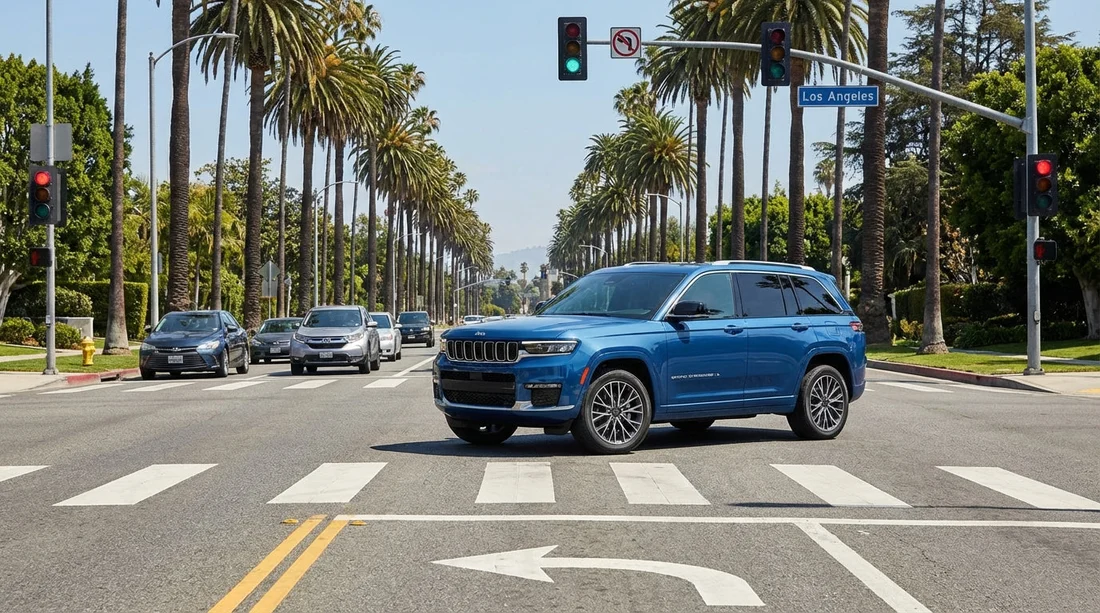
Many U-turns in Los Angeles happen at signalised intersections. The usual permitted pattern is from the far-left lane, using the same positioning you would for a left turn, and then continuing the arc into the far-left lane of the road you are entering. The key is lane discipline: start in the correct lane and finish in the correct lane without drifting wide.
Use this step-by-step check at lights:
Confirm the sign situation. If there is a “No U-Turn” sign, do not do it, even if other drivers do. Signs override any permissive default.
Use only the far-left lane unless directed otherwise. A U-turn from a non-left lane is rarely legal and is often unsafe. If the intersection has multiple left-turn lanes, follow posted lane arrows. If one lane is marked for left turns only and another explicitly for U-turns, obey the markings. If U-turns are not clearly accommodated, assume you should not do one from a multi-left layout unless you can keep the turn within your lane path.
Watch for protected versus permissive phases. A green arrow generally gives you a protected movement, but you still yield to pedestrians. A solid green without an arrow can be permissive and may require you to yield to oncoming traffic. Los Angeles intersections can be busy enough that a permissive U-turn is impractical even if it is legal.
Be alert to right turns on red from the cross street. Drivers turning right may not expect a U-turning vehicle to appear quickly. If you see vehicles creeping for a right-on-red, anticipate their movement and do not accelerate into their path.
One more nuance for visitors: intersections near major visitor routes often have strict turn controls to keep traffic flowing. Around the airport area, on boulevards that feed freeways, U-turns are commonly signed out. If you are travelling between the airport and Orange County, you might also start from car hire at Santa Ana Airport (SNA) and experience similar sign-heavy intersections on the way into Los Angeles.
Where U-turns are banned: signs, markings, and common Los Angeles patterns
The simplest answer to “where is it banned?” is: anywhere a traffic control device bans it. California and city authorities rely heavily on signs and markings because the “default allowed” idea would otherwise create too many unpredictable turning movements.
Look out for these sign and marking patterns that typically ban or block U-turns:
“No U-Turn” signs. These are decisive. In Los Angeles they are common at high-volume intersections, near freeway ramps, and where turning traffic would block through lanes.
“No Left Turn” signs. If a left turn is forbidden from your approach, then a U-turn is also effectively forbidden because it is a type of left turn movement.
Raised or painted medians without a turn pocket. If there is no break in the median, you cannot legally cross it. Even if the median is only paint, crossing double yellow or solid lines to reverse direction can be illegal and is a major enforcement focus on arterials.
Lane arrows that do not support the manoeuvre. If your lane is marked straight-only, do not swing into a U-turn from it. Likewise, if there are two left-turn lanes but the geometry does not provide room for a legal U-turn, you should follow the marked left turn and reroute instead.
Intersection-specific restrictions during certain hours. Some corridors post time-based turn restrictions for peak commuting. If a sign shows time windows, treat it literally. A manoeuvre that is legal at midday may be illegal during the afternoon peak.
If you are driving a larger vehicle, such as a people carrier or van, the “space” factor becomes a practical ban even when signs do not prohibit it. Wide U-turns that drift into adjacent lanes can put you at fault. Drivers opting for van hire from Santa Ana (SNA) should be especially cautious about turning radius on narrow urban streets.
Business districts: the 200-foot rule and what it means in practice
California includes a commonly cited restriction in business districts: you should not make a U-turn in a business district except at an intersection or when allowed by a traffic control device. Visitors often misunderstand this and attempt mid-block U-turns on commercial streets lined with shops and driveways.
In practical Los Angeles terms, treat a “business district” as a street segment with frequent commercial frontage, lots of entrances, and a steady flow of vehicles pulling in and out. Even if the statute language is unfamiliar, the safety logic is clear: mid-block U-turns in these areas create conflicts with cars turning into driveways, delivery vehicles, and pedestrians stepping off the kerb.
Actionable rule for car hire drivers: if you are on a commercial strip, only consider a U-turn at a controlled intersection, and only if there is no prohibition sign. If you missed a driveway or a side street, it is usually safer to continue to the next signal, make a legal turn, and loop back.
Near schools and pedestrian-heavy zones
School zones in Los Angeles demand extra caution because children can be unpredictable and visibility can be blocked by crossing guards, parents’ vehicles, and buses. Even when a U-turn is not explicitly prohibited, it can be a poor choice near a school because it requires you to split attention between oncoming traffic and the kerbside environment.
Use this checklist around schools:
Scan for school-zone signs and crossing guards. If you see them, prioritise straight-through driving and simple turns.
Avoid U-turns during drop-off and pick-up times. The volume of pedestrians and frequent stopping makes U-turns riskier and more likely to be seen as unsafe.
Respect “No U-Turn” or “No Left Turn” restrictions near campuses. These are common because schools generate turning queues that can block traffic.
Yield early and fully to pedestrians. If anyone is near the crosswalk, wait. A legal U-turn never overrides pedestrian right of way.
Busy arterials: medians, sight lines, and speed differences
Los Angeles arterials can be fast, wide, and unforgiving. Even where a U-turn is technically allowed, it may not be wise if speed differentials are high or the road design does not provide a protected turning space.
On these roads, U-turns usually make sense only when:
There is a dedicated left-turn or U-turn pocket. This reduces the chance you will be rear-ended while waiting for a gap.
There is adequate sight distance. If the road curves, dips, or is visually cluttered, do not attempt it.
Traffic volume allows a safe gap. If you feel pressured, abandon the idea and continue to a safer turning point.
You can complete the turn without blocking multiple lanes. If you cannot clear the intersection quickly, it is better to reroute.
If you are driving on unfamiliar arterial networks after collecting a vehicle through car hire in California at LAX, plan ahead using clear route choices that reduce the need for sudden direction changes. Missing one turn is normal. Forcing a U-turn in heavy flow is where trouble starts.
Signs that override defaults: what to prioritise in the real world
When multiple cues compete, prioritise them in this order:
1) Police officer or authorised traffic controller directions. Temporary directions override signs and signals.
2) Temporary traffic control for roadworks. Cones, temporary signs, and lane closures often remove turning options.
3) Permanent signs. “No U-Turn”, “No Left Turn”, and time-based restrictions decide the question.
4) Traffic signals and arrows. Follow the specific movement allowed for your lane.
5) Road markings and medians. Solid lines and physical barriers are not optional.
6) Default rule: permitted if safe. Only apply this when nothing above restricts you.
This hierarchy is helpful because visitors often jump straight to the default rule and miss the sign. In Los Angeles, the sign is frequently the whole story.
Common mistakes visitors make with U-turns in Los Angeles
Turning from the wrong lane. A U-turn from a centre lane or a right lane is a fast route to a citation or collision. Reposition and try later.
Ignoring lane markings at multi-left intersections. Some intersections are designed for two left-turn lanes but not for U-turns. If you cannot see a clear, legal path that stays in lane, do not do it.
Misjudging oncoming speed at night. Headlights compress distance perception. If you are unsure, wait or reroute.
Attempting mid-block U-turns on commercial streets. Driveways and parked cars create blind spots, and the manoeuvre often conflicts with turning traffic.
Forgetting pedestrians. In areas with nightlife, shopping, or transit stops, pedestrians can step into the crosswalk late. Finish the turn only when the crosswalk is clear.
Safer alternatives when a U-turn is illegal or risky
Los Angeles offers plenty of ways to reverse course without forcing a U-turn:
Use the next signalised intersection. Continue straight, turn right, then right again to loop back, often calmer than battling a median gap.
Use a car park or wide side street to turn around. If permitted and safe, a controlled low-speed turn in a lot can be better than a high-speed arterial U-turn.
Follow your navigation to a legal reroute. Adding two minutes is preferable to an unsafe manoeuvre, particularly in unfamiliar neighbourhoods.
FAQ
Q: Are U-turns legal in California by default? A: Often, yes. They are generally allowed when safe, unless a sign, signal, marking, or local restriction prohibits them.
Q: Can I make a U-turn at a traffic light in Los Angeles? A: Yes, if there is no “No U-Turn” or “No Left Turn” sign, you are in the far-left lane, and you yield to pedestrians and any required oncoming traffic.
Q: Are mid-block U-turns allowed in business districts? A: Treat them as not allowed unless a traffic control device clearly permits them. In practice, use intersections on commercial streets.
Q: Do school zones automatically ban U-turns? A: Not automatically, but they often have posted restrictions and heavy pedestrian activity. Even if legal, a U-turn near schools may be considered unsafe.
Q: If there is no sign, can I still get a ticket for a U-turn? A: Yes. If the U-turn is made unsafely, blocks traffic, or creates a hazard, you can be cited even without a specific prohibition sign.






























































































