


Quick Summary:
- Set your sat-nav to “Avoid tolls” before leaving the rental car park.
- Exit JFK via Belt Parkway, avoid bridges and tunnels into Manhattan.
- If you accidentally enter a toll facility, stay calm and continue safely.
- Call the hire company immediately, ask how tolls and admin fees apply.
Cashless tolling around New York catches visitors out, especially when you leave JFK and your phone navigation defaults to “fastest”. If you did not buy a toll pass or the hire company’s toll product, you can still reduce the chance of unexpected charges by knowing where the first traps are, setting up no-toll routing properly, and acting quickly if you end up on a tolled crossing.
This guide focuses on the first 10 to 30 minutes after pickup, when most drivers accidentally commit to a tolled bridge, tunnel, or express lane and then discover there is no cash booth to turn around at. The goal is not to make the journey perfect, it is to keep control and minimise fees.
Understand what “cashless” means for a New York car hire
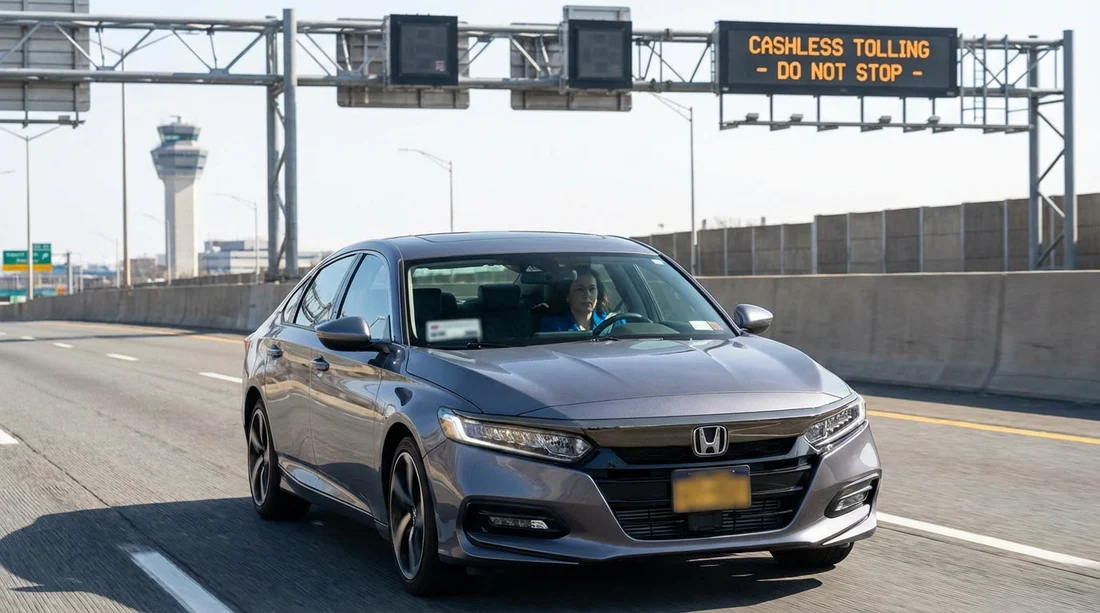
In New York City and surrounding areas, many crossings and roads use cashless tolling. Cameras read your number plate, and the toll is billed through an account (such as E-ZPass) or mailed to the registered vehicle owner. With a car hire vehicle, the “registered owner” is the rental company, which then bills you later. This is where surprise costs arrive, because the bill can include the toll plus an administrative fee per event or per day, depending on the provider and the agreement you accepted at the counter.
Even if you did not add a toll product, the car may still have a transponder, or it may rely on plate billing. In either case, the system will still capture the trip if you use a tolled facility. Your best defence is route choice, and your second best defence is fast communication if you make a mistake.
If you are comparing providers and vehicle sizes for New York trips, you can review options like Dollar car hire at New York JFK and Thrifty car rental at New York JFK. Different suppliers can apply different toll administration rules, so it is worth understanding the basics before you pull out of the lot.
The first “gotcha” routes leaving JFK that trigger cashless tolls
From JFK, it is easy to end up heading towards tolled crossings because the airport feeds directly into major parkways and expressways. The road network is busy, signage comes quickly, and a single wrong lane can commit you to a bridge or tunnel where there is no practical exit.
1) Van Wyck Expressway (I-678) towards Whitestone Bridge
Many drivers follow navigation towards the Bronx, Westchester, or New England and get routed up the Van Wyck. If you stay on I-678 north, you can be funnelled toward the Whitestone Bridge or the Throgs Neck Bridge, both tolled. It is a common “looks fine until it’s too late” situation because the approach is a multi-lane expressway with limited opportunities to change plan.
2) Belt Parkway to Verrazzano-Narrows Bridge
If you head towards Staten Island or New Jersey and your app chooses the “fastest” route, you may be routed to the Verrazzano Bridge, which is tolled and cashless. The Belt Parkway itself is not a toll road, but it can be a staging area that leads you onto tolled crossings depending on the direction and the interchange.
3) Manhattan crossings, especially tunnels
Trying to reach Manhattan from JFK can quickly funnel you to tolled facilities. The Queens Midtown Tunnel and the Hugh L. Carey Tunnel are common examples where drivers expect cash booths, but many toll points are cashless. If your destination is Manhattan, this is where the risk rises sharply because the most direct routes often involve tolled tunnels.
4) Express lanes and “optional toll” segments
Some routes present toll express lanes alongside free lanes. In heavy traffic, phone navigation may steer you into a tolled lane to save time, sometimes with minimal warning. If you see signs for express lanes, keep to general purpose lanes unless you are certain it is not tolled.
The important pattern is simple, if your navigation is set to “fastest”, it will often trade money for minutes, and it will not care whether you bought a toll pass.
How to force a no-toll route before you start moving
The safest moment to configure your routing is while you are still parked at JFK, before you join the stream of traffic. Do this in a calm order.
Step 1: Set “Avoid tolls” in your navigation app
In Google Maps, open the route options and switch on “Avoid tolls”. In Waze, go to Settings, Navigation, and enable “Avoid toll roads”. Then close and re-open the route preview to confirm it has recalculated. Some apps keep the original route cached unless you refresh it.
Step 2: Add a “control waypoint” on a free road
Sometimes “avoid tolls” still proposes a route that contains a tolled crossing because it classifies a segment incorrectly, or because there is no realistic alternative. Add a waypoint that forces your first 5 to 10 minutes onto a known free road, such as a local boulevard exit that keeps you within Queens or Brooklyn. Once you are away from the complicated interchanges, recheck the route for toll icons.
Step 3: Zoom in and look for toll markers, bridge icons, and tunnel names
Before you drive, inspect the route list. If you see any of the major tunnel or bridge names, assume it is tolled unless you know otherwise. Do not rely on “no tolls” text alone, look for the visual toll symbol and the route notes.
Step 4: Turn off “allow HOV/toll lanes” type settings
Some phones and in-car systems have a setting that allows “HOV lanes”, “express lanes”, or “toll lanes”. Disable anything that suggests paid lanes are acceptable. In New York, this matters when roads split and signage is brief.
Step 5: Decide your first safe stop for a re-check
If you are tired from a flight, choose a nearby safe place to pull in after 10 minutes, for example a fuel station or a larger car park, and re-check the route calmly. The most common mistakes happen when drivers try to correct navigation while already on an expressway.
No-toll tendencies for common directions from JFK
You cannot always reach every destination without tolls in the New York area, but you can often avoid the early toll “commit points” by choosing a slightly slower start. Use these as planning cues, not as a promise, because traffic and closures change.
Heading to Brooklyn or Queens
Local routes and the Belt Parkway can often keep you off toll facilities if you are staying within the boroughs. The “gotcha” is drifting toward a bridge or tunnel when your destination is near the water or near Manhattan-bound arteries. Keep your first leg on local roads until you are confident about the approach.
Heading to Long Island
Many Long Island routes can be completed without bridges or tunnels. The risk is letting navigation route you north toward a tolled crossing to “save time” via a different borough. Confirm your route stays on Long Island Expressway or local Long Island arterials without toll flags.
Heading to the Bronx or Westchester
This direction is where toll bridges become more tempting in routing. If you must avoid tolls, be prepared for a longer drive time and more complex surface-road navigation. Watch for signage that funnels you onto the Whitestone or Throgs Neck approaches.
Heading to New Jersey
Many practical routes into New Jersey involve tolled crossings at some point. If you truly cannot accept any toll events, you may need to plan a longer, surface-road route that avoids tunnels and certain bridges, and you should double-check feasibility for your exact destination. For context on the wider area, Hola Car Rentals also covers nearby airport and state options such as car rental at Newark Airport (EWR) and car rental in New Jersey (EWR).
On-the-road signage that signals “you are about to be tolled”
When you leave JFK, you may not have time to read every sign, so it helps to recognise a few high-signal warnings.
Bridge and tunnel names
If a sign names a major bridge or tunnel, assume it is tolled in this region unless you know it is not. The key point is that you might not see a toll booth, and you might not have an exit once committed.
“E-ZPass” and “Toll by Mail” language
If you see E-ZPass-only messaging or Toll by Mail, that is a cashless tolling indicator. It means you are entering a system that will bill the vehicle owner.
Lane splits labelled “Express” or “Tolled”
Stay in the general lanes unless you have confirmed the express option is not tolled. Do not make last-second lane changes, instead accept the slower lane and re-route later.
If you accidentally enter a tolled crossing, what to do immediately
One wrong ramp can happen to anyone at JFK. What matters is what you do in the next hour, because this is where you can reduce downstream fees and disputes.
1) Do not attempt unsafe U-turns or stopping
Once you are on an approach road, it is usually too late to avoid the toll. Focus on driving safely and continuing through. Stopping on shoulders or trying to reverse is dangerous and can lead to fines far worse than a toll.
2) Take a timestamped note of the event
As soon as you are safely parked later, write down the time, road name, and direction of travel. If your app can show route history, screenshot it. This helps if you later need to question duplicate tolls or mismatched dates.
3) Contact the rental company promptly and ask specific questions
Use the number on your rental agreement or the key fob tag. Ask: whether the vehicle has a transponder, whether tolls will be billed via plate, what administrative fee applies, and whether fees are per toll event or per day. If the agent offers to add a toll product retroactively, ask whether it applies to past tolls or only future ones, and ask for the terms in writing.
4) Avoid repeat toll events for the rest of the day
Your first accidental toll is painful, but repeated tolls can multiply administrative fees. Reset your navigation, add waypoints, and choose a simpler surface-road segment to stabilise the rest of the trip.
5) Keep receipts and your agreement together
If you later see toll charges you do not recognise, your rental agreement, timestamps, and route screenshots make it easier to query them. With a car hire, you are often dealing with delayed billing, so documentation is your leverage.
How to reduce the chance of extra admin fees later
Administration fees are where “small toll” becomes “big surprise”. You cannot always eliminate them after the fact, but you can reduce the likelihood of being hit by avoidable add-ons.
Check your agreement wording before you drive away
Look for sections on tolls, administrative fees, transponders, and “violations”. If something is unclear, ask while you are still at the counter or at the exit gate.
Do a quick transponder check in the car
Some vehicles have an E-ZPass device mounted near the windscreen. Do not remove it. Just note whether it exists and whether the agreement references it. The presence of a transponder does not mean you bought a pass, it just means tolls can be captured easily.
Prefer fewer crossings over faster crossings
If you must reach an area that almost always involves tolls, try to minimise the number of separate tolled facilities you use. One tolled crossing plus a longer free route can be cheaper than multiple tolled segments that each trigger a fee.
Pick calmer departure timing if you can
Heavy traffic can push navigation into toll lanes or tunnel routes. If you have flexibility, leaving slightly outside peak periods can keep routing simpler, and it makes it easier to stay in the correct lanes.
If you are travelling as a group and need more space, it can also help to decide routes in advance, because larger vehicles make last-second lane changes harder. See options such as minivan hire at New York JFK to match the vehicle to the driving reality.
FAQ
Can I avoid all tolls when leaving JFK in a New York car hire? Sometimes, but not always. Many local trips within Queens, Brooklyn, or Long Island can be planned without toll facilities. Trips toward Manhattan or New Jersey often involve tolled crossings, so you may need a longer surface-road alternative or accept at least one toll.
Will “Avoid tolls” in Google Maps or Waze guarantee a toll-free route? No. It reduces the chance, but apps can misclassify roads, and some destinations have limited realistic alternatives. Always check the route overview for toll icons and bridge or tunnel names before you start moving.
If I accidentally drive through a cashless toll, can I pay it myself? With a hire vehicle, the toll is typically billed to the rental company first, then recharged to you, often with an admin fee. Your best move is to contact the rental company quickly, confirm how billing works, and avoid additional toll events.
What should I do at JFK if I am nervous about tolls? Set “Avoid tolls” before you exit the car park, add a waypoint on a nearby free road, and take two minutes to review the first interchanges. If needed, pull into a safe spot shortly after leaving the airport to re-check directions.
Why do toll charges appear days or weeks after my trip? Cashless tolling relies on camera reads and back-office processing, then the rental company applies its billing cycle and any administrative fees. Delays are normal, so keep your agreement and trip notes until you see the final charges.






























































































