


Quick Summary:
- On two-lane Highway 1, use turnouts when five vehicles queue behind.
- Pull fully into the turnout, signal early, and keep wheels straight.
- Rejoin only with a clear gap, accelerate briskly, and cancel indicators.
- If you miss a turnout, continue calmly to the next safe, signed one.
Driving California’s coastal Highway 1 in a car hire is one of the world’s great road trips, but it comes with a very specific local habit, turnouts. These short paved bays and pull-offs are designed to let faster traffic pass on winding two-lane stretches where overtaking is unsafe. Visitors often wonder whether “slower traffic use turnouts” is advice or law, how long they can legally keep others behind them, and how to merge back out without frightening themselves or everyone else.
This guide explains the rule as it’s applied on Highway 1 and similar two-lane coastal roads, what “slower traffic” really means in practice, and a safe, step-by-step method for pulling in and rejoining. It is written for drivers in a rental, who may be adjusting to right-hand driving, narrow lanes, cliff edges, cyclists, and frequent scenic distractions.
What is a Highway 1 turnout, and why it matters
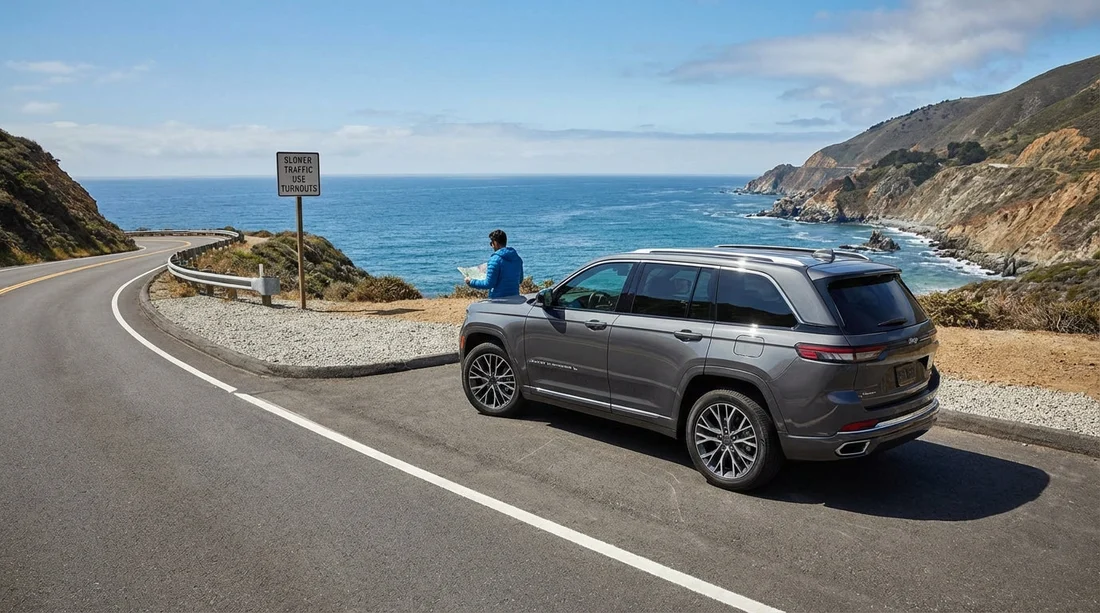
A turnout is a designated place to pull off the travel lane so vehicles behind can pass. On Highway 1 you will see signs such as “Slower Traffic Use Turnouts” and “Turnout 500 FT”. Some turnouts are paved, some are gravel, and some are simply widened shoulders. They exist because long, curving stretches with limited visibility make passing dangerous, while slow-moving vehicles, sightseers, cyclists, and heavy vehicles can create long queues.
Using turnouts correctly keeps traffic flowing, reduces risky passing, and lowers stress for everyone. It also reduces rear-end conflicts that can happen when impatient drivers tailgate through curves.
When must you use a turnout in California?
California Vehicle Code requires a slow-moving vehicle on a two-lane highway, where passing is unsafe, to pull off at a turnout or other safe area when five or more vehicles are behind it. On Highway 1, that is the practical trigger you should remember: if you look in your mirror and see a line of five vehicles stacking up behind you, you are expected to use the next turnout that is safe and reasonably available.
Important nuance, it is not only about your speed compared with the posted limit. You can be driving at or near the limit and still create a queue because of tight bends, fog, cyclists, slow lorries, or simply because you are leaving larger following distances for safety. The rule is about the effect you are having on traffic flow on a two-lane road where others cannot pass easily.
If you are driving a motorhome, towing, or in a heavier SUV, you may also lose speed on grades and out of corners. In that case, anticipate the queue building sooner and plan to use turnouts proactively.
How long can you legally hold up traffic?
There is no “minutes and seconds” allowance written for Highway 1 queues. Instead, the legal expectation is behaviour-based: once five vehicles are behind you and passing is unsafe, you should pull over at the next turnout or other safe area. In other words, you can be “in compliance” for a short time while you wait for a suitable turnout to appear, but you should not continue indefinitely past multiple opportunities.
The best way to think about it in a car hire is this: the clock is not the issue, the queue is. If you are steadily moving toward a turnout and take it as soon as it is safe, you are acting reasonably. If you ignore several turnouts while the line grows, you are not.
There are also situations where you should not stop immediately, even if the queue exists. Do not slam on brakes for a turnout you have just noticed, do not stop in a narrow shoulder that is not a turnout, and do not pull into a turnout that is blocked, too short for your vehicle, or requires a sharp manoeuvre that could cause a collision.
What if you are not the “slow” one?
On Highway 1, “slow” often means “slower than the drivers behind you want to go,” not “below the limit.” If you are choosing a relaxed sightseeing pace, you are exactly who the turnout system is for. Equally, if you are being cautious in fog, rain, or at night, it is still polite and often safer to let the queue clear behind you when the road allows.
On the other hand, do not feel pressured to drive unsafely just because someone is close behind. Use a turnout when you can, keep your speed appropriate for conditions, and avoid abrupt changes that could trigger a crash.
Step-by-step: how to pull into a turnout safely
1) Scan early and decide in advance. As soon as you notice a queue forming, start looking ahead for the next signed turnout, wider shoulder, or paved bay. Planning early prevents last-second braking on a blind curve.
2) Check mirrors and your blind spot. Motorcycles are common on Highway 1, and they can appear quickly in mirrors. Before you drift right, confirm the turnout entry is clear and that a cyclist is not using the shoulder line you are about to cross.
3) Signal right well before the turnout. Give following traffic time to understand your intention. On a curving road, earlier signalling is helpful because the turnout might be hidden until the last moment.
4) Reduce speed smoothly, stay in your lane until the entry. Brake progressively and avoid crossing the solid edge line too early. Keep your car stable, especially in a rental you may not yet fully judge for braking feel.
5) Pull fully into the turnout. Do not stop half in, half out. The goal is to clear the travel lane completely so others can pass without crossing the centre line. If it is a longer turnout, continue forward to create space for other vehicles to pull in behind you if needed.
6) Pause briefly and keep awareness. You generally only need to stop long enough for the queued vehicles to pass. Stay alert for cyclists filtering through, pedestrians taking photos, and drivers who may cut back in sharply.
7) Avoid opening doors into traffic. If you are only using the turnout to let vehicles pass, treat it like a traffic manoeuvre, not a scenic stop. If you do decide to park for views, choose a proper viewpoint or parking area, not a short turnout, and make sure you are fully off the roadway.
If you started your trip from San Francisco, the easiest way to settle into the driving style is to practise mirror checks and smooth signalling within the first hour. For pick-up planning, see car rental San Francisco SFO or Hertz car rental San Francisco SFO for location details and timing considerations.
Step-by-step: how to rejoin Highway 1 from a turnout
Rejoining is where many visitors feel most pressure, because traffic may be moving quickly and sightlines can be limited. Use this repeatable method.
1) Prepare before moving. Fasten belts, stow phones, and set navigation while stopped. You do not want to be looking down as you merge into a curve.
2) Signal left and look for a long gap. Turnouts are not merges like motorway slip roads. You are effectively entering a single travel lane. Wait for a clear opening that lets you accelerate up to the flow without forcing anyone to brake.
3) Check mirrors and blind spot again. A vehicle may have pulled out to pass a cyclist, or a motorcycle may be approaching quickly. Do not rely on mirrors alone.
4) Accelerate decisively, but smoothly. The safest merge is one where you match the speed of the lane promptly. In a car hire with a smaller engine, give yourself more gap than you think you need, especially uphill.
5) Steer out in one clean movement, then straighten. Avoid drifting along the edge line. Once you are fully in the lane, cancel your indicator and re-establish a safe following distance.
6) Resume scanning for the next turnout. If you are continuing at a relaxed pace, expect the queue to rebuild. Using turnouts regularly can be normal on popular sections, especially on weekends.
Common Highway 1 turnout mistakes to avoid
Stopping where there is no turnout. A narrow shoulder, a driveway, or a blind corner is not an acceptable substitute. It can create a collision risk and blocks cyclists.
Braking sharply to “be polite”. Sudden braking surprises tailgaters. If you have passed the turnout entry, continue to the next one rather than attempting a risky late move.
Pulling in too shallow. If your rear end is still in the lane, drivers may cross the centre line to pass and create head-on risk.
Rejoining too slowly. Merging at a much lower speed forces others to brake on a curve. Wait for a larger gap and accelerate firmly.
Using a turnout as a photo stop when others need it. Scenic stops are best in signed viewpoints and car parks. Turnouts are a traffic-management tool first.
Special situations: cyclists, lorries, and night driving
Cyclists: Highway 1 is a major cycling route. You may be “slow traffic” because you are waiting for a safe place to pass a cyclist. If a queue builds behind you while you follow a cyclist, use the next turnout after you have passed, or if you cannot pass safely, use a turnout to allow the queue behind you to clear while you continue at a safe following distance behind the cyclist.
Large vehicles: If you are in a larger hired vehicle, such as an SUV, remember the vehicle may be wider and longer than you are used to. Choose turnouts with adequate length and avoid gravel pull-offs if your tyres are not suited or if the surface is soft. If you are collecting a larger vehicle near San Jose, SUV rental San Jose SJC can help you compare options and plan a route that matches your confidence level.
Fog and dusk: Visibility can change quickly along the coast. In fog, other drivers may approach a turnout at speed without seeing you early. Use lights appropriately, signal earlier than usual, and avoid stopping in unlit areas unless it is a designated turnout with enough width. When rejoining, be especially conservative about the size of the gap you accept.
How turnouts fit into a smoother car hire road trip
The fastest way to enjoy Highway 1 is to treat turnouts as normal, not as a sign you are doing something wrong. In a car hire, you are often managing unfamiliar size, controls, and sat-nav, plus the temptation to look at the scenery. Letting locals and confident drivers pass reduces pressure, which in turn makes your own driving steadier.
If your California trip starts in Southern California, you might join coastal roads after collecting from Los Angeles or Orange County. Planning pick-up timing can help you avoid rush hours before you reach the more relaxed coastal stretches, see car hire California LAX or budget car hire Santa Ana SNA for location guidance.
Finally, remember that “slower traffic use turnouts” is as much about safety culture as it is about enforcement. A calm mirror check, an early signal, and a proper pull-in and merge-out will make you a better Highway 1 driver within the first day.
FAQ
Is using turnouts on Highway 1 legally required or just a suggestion? It is legally expected when you are holding up traffic on a two-lane highway where passing is unsafe, typically when five or more vehicles are queued behind you.
Do I have to use a turnout if I am driving at the speed limit? Yes, potentially. The rule is about the queue behind you on a two-lane road, not only about the posted limit. If you are creating a line of five vehicles, plan to use the next safe turnout.
How long should I stay in the turnout? Usually only long enough for the queued vehicles to pass. Once the line has cleared and you have a safe gap, signal and rejoin smoothly.
What if I cannot find a turnout for several miles? Keep driving steadily and safely until you reach the next signed turnout or a genuinely safe pull-off. Do not stop on a blind corner or narrow shoulder just to let others by.
Can I use a turnout as a scenic stop? If it is a larger paved area and you are fully off the lane, you can stop briefly, but avoid occupying short turnouts needed for traffic flow. Prefer signed viewpoints and car parks for longer stops.






























































































