


Quick Summary:
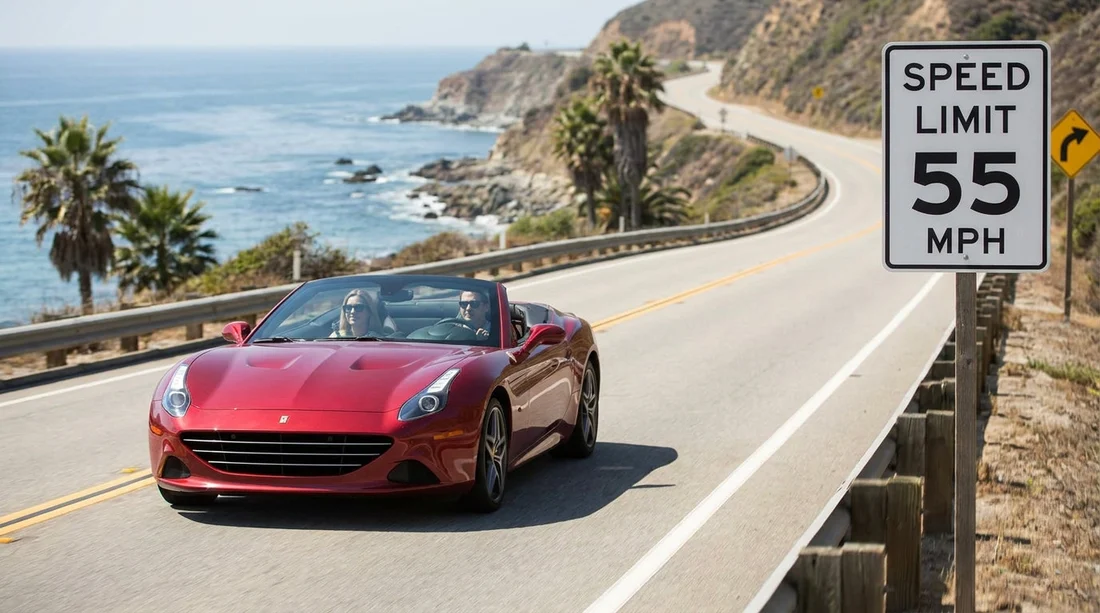
- All speed limits are in mph, never km/h, so check signs often.
- Know stop, yield, and four-way stop order before leaving the car park.
- Watch lane markings, HOV diamonds, and right-turn-on-red restrictions at junctions.
- Expect wide multi-lane roads, slip lanes, and frequent freeway exits close together.
If you are picking up a car hire in California after flying from the UK, the first few minutes can feel deceptively familiar. Everyone drives on the right, signs look broadly similar, and the roads are usually well maintained. The real differences show up in the details, especially speed-limit units, lane control, and junction rules. This quick pre-pickup primer focuses on what you will see on Californian road signs and markings, and what tends to surprise UK drivers most.
If your arrival point is the Bay Area, the signage style around airports and freeways can feel busy. For collection planning and local context, Hola Car Rentals has pages for San Francisco Airport (SFO) and San Jose (SJC). Southern California driving can be equally intense, and you can compare local notes for San Diego and the wider Los Angeles area via Los Angeles (LAX).
Speed-limit units in California: it is all mph
The most important unit change is simple. Speed limits are posted in miles per hour (mph), not kilometres per hour. If your UK brain is still thinking in mph, that part is easy. What can catch people out is how fast freeway traffic flows relative to the posted number, and how quickly the numbers change as you move between surface streets and freeways.
Common posted limits you will see include 25 mph in residential areas, 35 to 45 mph on larger city roads, and 55 to 70 mph on freeways depending on location. You may also see lower limits near schools and in roadwork zones. The key is to look for the rectangular white signs that say SPEED LIMIT with a number beneath.
Two practical UK-to-California adjustments help immediately. First, because roads are wide and straight, 35 mph can feel slow at first, especially on multi-lane city roads. Second, distances between junction decisions can be shorter than you expect on freeways, so keep scanning ahead rather than relying on a last-second glance at the speedometer.
Regulatory signs: STOP, YIELD, and the four-way stop
Most regulatory signs are easy to recognise, but the rules at junctions can differ from what you instinctively do in the UK. The red octagonal STOP sign means a full stop, even if the road appears empty. Many junctions use ALL WAY or 4-WAY stop control, where every approach has a stop sign. The right of way is generally determined by arrival order: the first vehicle to stop goes first. If two vehicles stop at the same time, the vehicle on the right usually proceeds first.
The triangular red-and-white YIELD sign means you slow down and give way to cross traffic, you do not necessarily stop. In practice, treat it like a give way line in the UK: look early, match the flow, and only stop if you need to.
One of the biggest surprises for UK drivers is how common the four-way stop is in residential areas. It feels informal at first, but it works well when everyone takes turns. If you are unsure, make eye contact where possible, and do not wave people through if it creates confusion.
Traffic lights and turning rules: right on red, and protected turns
Traffic lights operate broadly as you expect, but turning conventions can be different. In California, you can often turn right on a red light after coming to a complete stop and yielding to pedestrians and traffic, unless a sign prohibits it. Look for NO TURN ON RED where it is not allowed.
Left turns are where the signalling gets more varied than in the UK. Many junctions provide a dedicated left-turn lane and a green arrow, sometimes called a protected left. When you have a green arrow, you have priority to turn, but still watch for late pedestrians. When you have a normal green light with no arrow, you may be permitted to turn left after yielding to oncoming traffic, which can feel closer to a right turn across traffic in the UK. Make sure your wheels stay straight while waiting so you are not pushed into oncoming lanes if hit from behind.
Also note that turning on red is not the same as filtering. You must stop first, then proceed only if it is safe. Pedestrians can step off the kerb late, and cyclists may be approaching on your right.
Road markings you will see immediately
Lane markings and painted symbols carry a lot of information in California. White lines separate lanes travelling in the same direction, while yellow lines separate opposing traffic. Double yellow lines typically mean no crossing into the oncoming side.
Look out for these common painted markings. HOV (carpool) lane diamonds indicate lanes reserved for vehicles with multiple occupants at certain times, and sometimes for motorcycles. Rules vary by corridor, so read the roadside signs for hours and occupancy requirements. STOP lines are thick white lines at junctions, and you should stop before the line. Arrows and “ONLY” markings appear often before junctions, so change lanes early rather than diving across late. Botts’ dots (raised pavement markers) can create a rumbling feel when you cross lines.
Guide signs on freeways: exits, lanes, and merging
Freeway signs in California are designed for fast reading. Exit numbers usually refer to the mile marker rather than a simple sequence, so exit 22 is roughly around mile 22 on that route. You will see large green guide signs with destination names and lane arrows. Start positioning early because exits can appear close together, and sometimes the “exit only” lane peels off to the right.
If you miss an exit, do not panic or stop. Continue to the next exit and loop back. This is normal in California, and far safer than trying to correct at the last moment.
What surprises UK drivers most after collecting car hire in California
Multi-lane decision making is the first surprise. Five or more lanes in each direction is common near big cities, with different lanes moving at different speeds. Pick a sensible lane early, keep your distance, and avoid rapid lane changes.
Right turn on red feels like a rule you will forget at least once. Remember, it is permitted only after a full stop and only if not prohibited. If you prefer not to do it, it is acceptable to wait, but be prepared for drivers behind you to expect the turn when it is clearly safe.
Four-way stops can be oddly polite. The trick is not to overthink it. Stop fully, confirm who arrived first, then proceed decisively when it is your turn.
Road sign density at complex interchanges can be intense. Use the rightmost lines of text first, focus on the next instruction rather than the whole board, and aim to be in the correct lane one sign earlier than you think you need.
FAQ
Q: Are speed limits in California shown in mph or km/h? A: They are shown in mph only. Speed-limit signs read “SPEED LIMIT” with a number beneath.
Q: Can I turn right on a red light in California? A: Often yes, but only after a complete stop and only if there is no “NO TURN ON RED” sign. You must yield to pedestrians and traffic.
Q: What does “ALL WAY” on a stop sign mean? A: It means a four-way stop where every direction must stop. Vehicles generally go in order of arrival, with the vehicle on the right proceeding first if tied.
Q: What does a diamond symbol on the road mean in California? A: It usually marks an HOV (carpool) lane or carpool-related marking. Check nearby signs for hours and occupancy rules.
Q: What should I do if I miss my freeway exit? A: Continue to the next exit and re-route safely. Do not stop or try to cross multiple lanes at the last moment.




























































































