


Quick Summary:
- Check if the mark is paint transfer using solvent-free wipe tests.
- Photograph the whole panel, close-ups, and surrounding context with timestamps.
- Report the damage immediately through the rental company’s documented channels.
- Keep parking receipts, location photos, and witness details to support disputes.
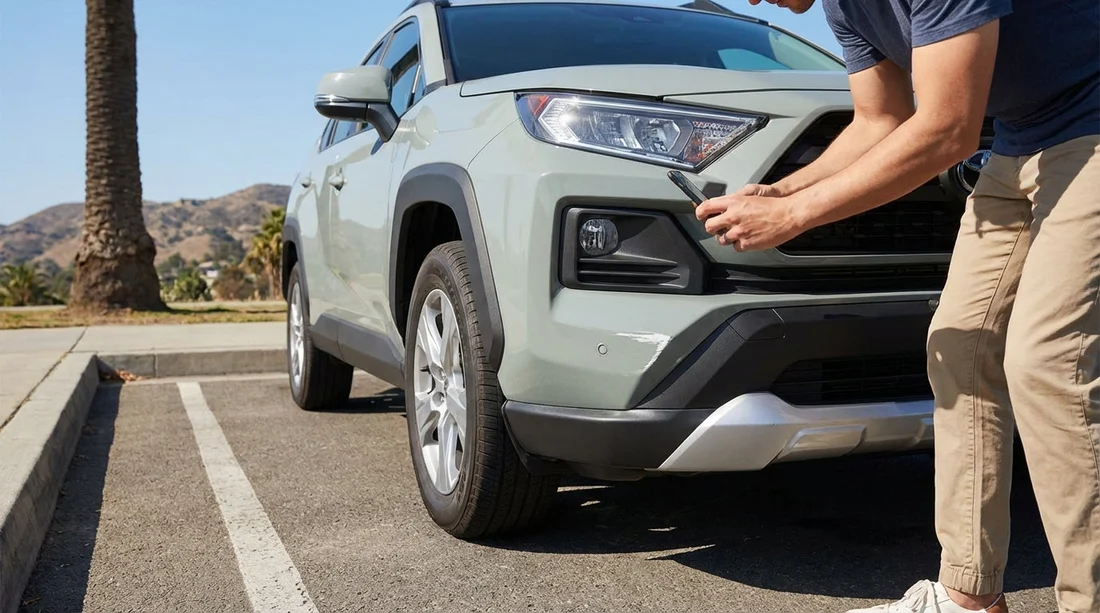
Finding a fresh scuff after parking can be stressful, especially on a car hire in California where deposits and damage claims can move quickly. The good news is that many “new scratches” are actually paint transfer or superficial scuffs that can be documented clearly and disputed fairly. What matters is how you assess the mark, how you record evidence, and how fast you notify the right people.
This guide gives you a practical, step-by-step checklist to tell paint transfer from a deeper scratch, capture timestamped photos that stand up to scrutiny, and report the issue in a way that protects you if a charge appears later. If you picked up your vehicle at a busy hub such as San Jose Airport (SJC) or returned it after a city stop like San Diego, these steps are especially helpful because quick turnarounds can mean less time for staff to discuss details.
Step 1: Stop, don’t “fix”, and secure the scene
When you notice a new mark, avoid trying to rub it off aggressively, wash it, or apply any product. Well-intentioned cleaning can alter the evidence, and some removers can damage clear coat. Instead, do three simple things:
1) Park safely and don’t move the vehicle immediately if you can avoid it. If you must move for safety, take initial photos first.
2) Note the exact location and time, including car park name, street address, bay number, and nearby landmarks. Your phone notes app is fine, but be specific.
3) Look around for sources, a bollard, pillar, shopping trolley bay, tight kerb, or another car with matching height. You are not investigating for blame so much as building context that supports your timeline.
Step 2: Tell paint transfer from a real scratch
A “scuff” can mean several different things, and the difference affects how claims are handled. Use this practical decision tree before you report it.
Paint transfer (often disputable as superficial)
Paint transfer happens when another object leaves its colour on the clear coat. Common signs are a raised or smeared look, a different colour than your car, and a mark that seems to sit “on top” of the paint. In many cases it is removable by a professional detailer, but you should not attempt that during your rental.
Clear-coat scuff (may polish out, still document)
This is usually lighter, looks hazy in sunlight, and changes appearance when viewed from different angles. It might not catch your fingernail. It can be real damage, but not necessarily a deep scratch.
Scratch through clear coat (more likely chargeable)
A deeper scratch often looks sharp, you may see a line of missing paint, and it can catch your fingernail when you lightly run it across (do not drag hard, just a gentle test). If you see primer (often grey) or metal underneath, treat it as more serious.
Quick tests you can do without “tampering”
Angle and light test: Use your phone torch and move it slowly. Paint transfer tends to reflect differently and can look like a smear; scratches appear as crisp lines.
Fingernail test: Very lightly across the mark. If your nail catches, it suggests depth. If it glides, it may be transfer or clear-coat haze.
Dry microfibre dab: Only dab, do not rub. If colour appears on the cloth, stop and photograph the cloth, this supports paint transfer, but don’t continue. Avoid any liquids or solvents.
In California, harsh sun can make scuffs appear worse at midday and less visible in shade. That is why you should photograph in both lighting conditions if possible, and include a short video to show the mark changing as you move.
Step 3: Take photos that are actually useful in a dispute
Most disputes are won or lost on evidence quality. A single close-up with no context can be dismissed as “unverifiable”. Aim for a complete, timestamped set that tells a story.
Use this 10-photo minimum set
1) Wide shot of the whole car, showing number plate, in the parking space.
2) Wide shot of the entire side where the scuff is located.
3) Mid-range shot of the panel (for example, the full door or bumper corner).
4 to 6) Close-ups from three angles, one with your phone torch, one without.
7) Photo showing distance to nearby hazards like a pillar, kerb, or trolley bay.
8) Photo of the ground for paint flakes, debris, or scrape marks.
9) Photo of the car park sign or address marker to pin down location.
10) Photo of the dashboard with time visible if available, or your phone lock screen time next to the panel (do not cover the damage).
Video matters
Record a 10 to 20 second video starting with the number plate, panning to the damage, then stepping back to show the environment. Narrate the date, time, and location. Keep it calm and factual.
About timestamps and metadata
Your phone’s EXIF data is valuable, but it may not be visible to staff. Do not edit the images, crop them heavily, or run them through messaging apps that strip metadata. Emailing photos to yourself immediately creates an additional timestamped record. If you picked up from a high-volume counter such as Sacramento SMF with Alamo, documentation like this helps when staff change between shift and return.
Step 4: Write a short incident note while it’s fresh
Take two minutes to write a clear incident note. This is not about admitting fault, it is about accuracy.
Include:
Date and time noticed, not just when it happened (if unknown).
Exact location, including car park level and bay number if possible.
What you did immediately, for example “took photos and video before moving vehicle”.
Any relevant context, such as “parked between two vehicles, no contact felt, scuff found upon return”.
Witness details if someone saw it, name and phone number.
If there is CCTV, note the camera locations. You typically cannot access footage directly, but your note helps the operator retrieve it if requested by the rental company or insurer.
Step 5: Report correctly, quickly, and in writing
To protect your deposit, speed and documentation are key. Report as soon as you notice the mark, even if you are unsure whether it is chargeable.
Where to report
Use the rental agreement instructions first. Many companies prefer that you report via their app, damage hotline, or customer service email. If you are near the pickup station, you can also return to the counter and ask for the damage to be noted, but still follow up in writing so there is a traceable record.
What to say (keep it factual)
State that you discovered a new scuff after parking, provide the time and location, attach your photos and video, and ask them to confirm receipt and log it on the rental file. Avoid speculation about who caused it, and avoid words like “my fault” or “I did it” if you do not know.
Keep a record of delivery
Save sent emails, screenshots of app submissions, and any case numbers. If you are on a tight schedule, for example returning at Sacramento SMF with Avis, a timestamped submission before drop-off can be valuable if the return inspection is rushed.
Step 6: Handle the return inspection like a checklist
At return, your goal is a clear, shared understanding of the vehicle condition.
Ask for a walkaround if staff are available. If they are not, take your own full return video: start at the fuel gauge and odometer, then walk the exterior slowly, ending on the number plate and the drop-off location signage.
Get written acknowledgement where possible. Some locations provide a digital check-in report, an email receipt, or an app status update. If the agent says “it’s fine”, ask for that in the return record.
Do not rely on memory. California airport returns can be busy, and you may not see the same person who checked you out.
Step 7: If a charge appears, dispute it with evidence
If you later see a claim against your deposit or card, respond quickly and methodically.
Request the claim details
Ask for the damage report, date and time logged, photos from the company, and a repair estimate or invoice. Compare their photos to yours, pay attention to panel alignment, wheel style, and background, to ensure the images are from your vehicle and rental period.
Use your timeline
Submit your incident note, your timestamped media, and any receipts showing where the car was parked. If you have evidence that the mark is paint transfer (colour on microfibre from a gentle dab, different colour layer, raised residue), point that out clearly.
Be specific about discrepancies
If their photo shows a longer scratch than yours, or damage on a different section, highlight that with side-by-side descriptions. Keep your tone neutral and professional.
Escalate through the correct channel
Most companies have a damage recovery unit separate from the branch. Ask for the case to be reviewed by that team and request written confirmation of the outcome. If you rented through a package that included a larger vehicle, such as via SUV hire at Santa Ana (SNA), also check whether any included cover changes the excess or claim handling, and reference the exact cover terms in your dispute.
Common mistakes that weaken your position
Only taking one close-up photo. Without a wide shot, it is hard to prove when and where it happened.
Editing images. Filters, annotations, and heavy cropping can trigger doubts about authenticity. Keep originals.
Waiting until return day to mention it. Same-day reporting is stronger, even if you are unsure.
Trying to polish it out yourself. Even if it improves, you may be accused of concealing damage.
Not keeping the paperwork. Your rental agreement, return receipt, and any case numbers matter as much as photos.
FAQ
How can I tell if it’s paint transfer or a scratch on a car hire? Paint transfer often looks like a different colour sitting on top of the clear coat and may not catch your fingernail. A true scratch is usually sharper, may catch your nail, and can show primer or exposed metal.
Should I report a minor scuff straight away, even if it might polish out? Yes. Reporting promptly creates a timestamped record and reduces the chance of a later surprise claim. Keep your wording factual and attach your photos and video.
What photos are most important for disputing a damage claim? A wide shot with the number plate, a full-panel shot, several close-ups in different light, and context photos showing the parking location and nearby hazards. A short walkaround video helps connect everything.
Can I remove the scuff myself before returning the car? It’s better not to. Cleaning or rubbing can be seen as tampering and can change the evidence. Document it, report it, and let the rental company advise next steps.
What if the rental company charges me after I’ve returned the vehicle? Ask for their damage report, photos, and repair estimate, then respond with your timestamped media and written timeline. Highlight any mismatch in location, size, or appearance of the damage.




























































































