


Quick Summary:
- Ask staff to locate a cargo cover, or note in the checkout report.
- Test rear seat-fold releases and the boot lock before leaving.
- Photograph boot area, rear glass tint, and any missing security parts.
- Keep luggage out of sight, and park smart to cut smash-and-grabs.
In San Francisco, a missing boot cover (also called a cargo cover, tonneau cover, or luggage cover) can turn a routine car hire into a higher-risk target for smash-and-grab theft. Thieves often look for quick visual cues, such as bags visible through the rear glass, a boot that cannot be concealed, or rear seats that fold down easily. The good news is you can reduce risk at pick-up by doing a short, structured inspection and documenting what you found.
This guide explains exactly what to check at pick-up, what photos to take, and how the documentation helps you in two ways. First, it supports your request for a replacement vehicle or missing equipment note. Second, it helps demonstrate you took reasonable steps to secure the vehicle if an incident occurs.
If you are collecting near the airport, the process is the same whether you arranged your vehicle via San Francisco SFO car rental or you picked up in the wider Bay Area and plan to drive into the city. The point is not to panic, it is to verify privacy and access control in the rear of the car before you load anything.
First, should you request a boot cover?
Yes, you should request one if the vehicle is designed to have it. A boot cover is a practical security feature because it blocks sightlines into the cargo area. In San Francisco, reducing visibility is a key theft deterrent, even when you do everything else correctly.
If staff cannot find a cover, ask whether a comparable vehicle is available that includes one. If no replacement is available, ask for the absence to be recorded on the condition report, ideally with wording that the vehicle was supplied without a cargo cover. You are not trying to assign blame, you are creating clarity about the condition at handover.
Not every vehicle has a cover, for example many saloons have enclosed boots, and some SUVs have fixed configurations. The important part is whether luggage will be visible. If it will, treat it as a risk factor and compensate with stricter habits for parking and storage.
Pick-up checklist: missing cargo cover, seat release, and boot tint
Do the following checks before you leave the lot, ideally before you move your bags from the terminal trolley. It takes five minutes and can prevent hours of hassle later.
1) Confirm the cargo cover presence and how it attaches
Open the boot and look for the cover itself and the mounting points. Some covers clip into side grooves, some use pegs, and some are integrated into a retractable cassette. If it is missing, check whether it was removed to fit a larger boot load previously and left behind.
Also check for loose fittings. A cover that does not latch properly can slide, expose items, or rattle, which can lead you to remove it and forget to reinstall. If it is present, extend it fully and confirm it stays in place when you close and reopen the boot.
2) Test rear seat release mechanisms from both sides
Thieves sometimes break a small window, pull a seat release, and access the boot through the cabin. That is why the seat release design matters, especially in hatchbacks and SUVs.
Check these points:
From the boot: look for a strap, lever, or button that folds seats. If it is easily reachable through a broken window area, your priority is to keep the boot empty when parked.
From the cabin: sit in the back seat and locate fold levers. Ensure they require a deliberate action and are not stuck half-open. Fold one side down and return it, confirming it latches securely. A seatback that does not lock can leave a gap that exposes the boot.
From the driver area: some cars have a remote boot release or fold control. Confirm you know how it works, and whether it can be disabled.
If you are continuing south after collection, the same approach applies at other airport desks, including San Jose SJC car rental, because the underlying risk is about visibility and access, not the pick-up location.
3) Check boot lock behaviour and keyless access settings
Close the boot and lock the car, then try to open the boot without unlocking. Confirm it stays locked. With keyless systems, test whether the boot opens when the key is nearby. In busy areas, you do not want the boot popping open because you brushed the sensor.
Also confirm whether there is an interior boot release button. Some vehicles let you disable it via a valet or security setting. If you can activate a valet mode that limits boot access, it can be useful when using attended parking or leaving the car with hotel staff.
4) Assess rear glass tint and privacy glazing
Rear tint is not a guarantee of safety, but it changes what can be seen at a glance. Look at the car from a few metres behind in daylight. Can you clearly see inside the boot? If you can, assume a thief can too.
Be realistic about tint. At night, interior lighting, streetlights, and phone screens can make luggage visible even through tinted glass. If there is no boot cover and the tint is light, treat the car as if it has no visual privacy at all.
5) Confirm the parcel shelf or cover is actually the right one
Sometimes a cover is present but does not match the vehicle, leaving a gap. If it does not span the full width, or it sits too high and exposes bags below, it is not doing its job. Ask staff to confirm it is the correct part for that model or note the limitation in the report.
What photos to take at pick-up (and why each one matters)
Photos are not only for accident damage. They help prove the condition and equipment at handover, which matters when you request a replacement, dispute a claim about missing items, or simply need to show you acted responsibly.
Take photos in good light, with wide shots plus close-ups. Include something that shows date and time if your camera app adds it, and keep the originals.
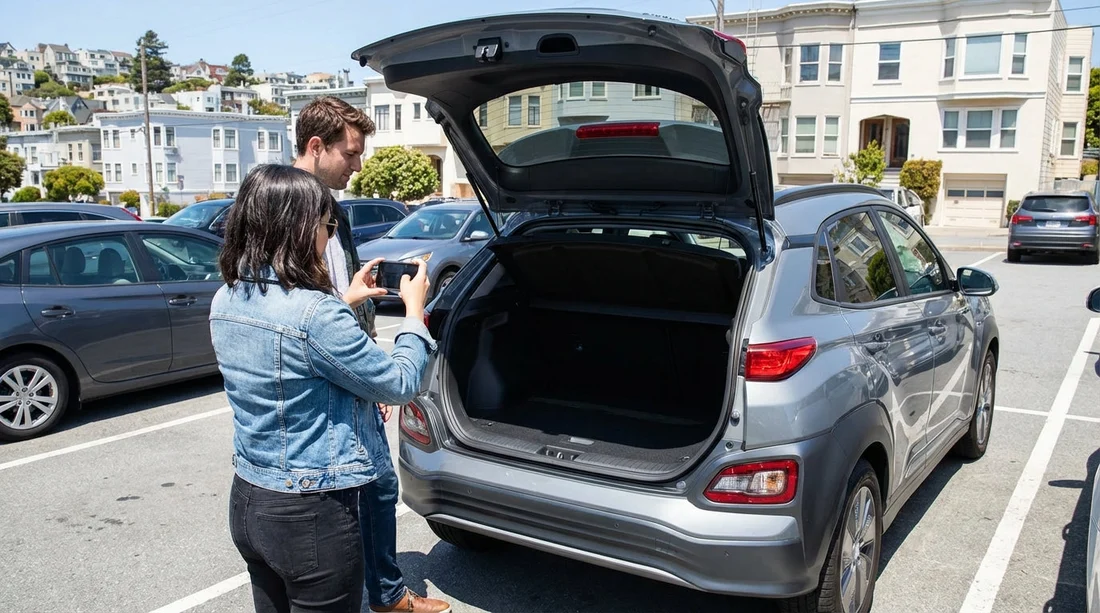
1) Boot open, wide shot
Stand behind the car with the boot open and photograph the entire cargo area. This establishes whether a cover is present, whether mounting points exist, and whether anything looks tampered with.
2) Boot cover mounting points or missing cassette area
Photograph the left and right mounting grooves or clips. If it is a retractable unit, photograph the area where the cassette would sit. This helps demonstrate the vehicle is designed to have a cover, not that you lost it.
3) Rear seats upright and latched
Take a photo from the boot looking toward the rear seats, showing the seatbacks upright. If there is a latch indicator, capture it. This helps if a seatback later seems misaligned or will not lock.
4) Seat release levers or straps
Take a close-up of the seat release mechanism in the boot and in the cabin. The purpose is to document how easy it is to access, which supports your argument that the car lacks a basic privacy barrier if the cover is missing.
5) Rear glass tint, outside view
Stand behind the vehicle with the boot closed and take a photo showing how visible the interior is. Do one straight-on and one slightly angled. This is useful if you later explain why you avoided leaving anything visible.
6) Condition report screen or paper, showing notes
If staff add a note about the missing cover, photograph the note. If they cannot, photograph the screen showing no option, and then email yourself a short note immediately with the time, desk location, and staff name if available. Documentation works best when it is created at the point of handover.
If you hired through a partner brand desk, your inspection process remains identical. Whether the keys come from a mainstream counter or through a comparison platform such as National car hire San Jose SJC, you are verifying equipment and security-relevant features before loading valuables.
How documenting a missing cover reduces smash-and-grab risk
Documentation does not physically stop a theft. It reduces risk in three practical ways.
It increases the chance of an immediate fix. When you can show clear photos and describe the exact missing component, staff can quickly locate a spare cover, swap vehicles, or add a formal note. Vague complaints slow everything down.
It nudges better behaviour from you and anyone travelling with you. If you have photographed the boot being fully visible, you are more likely to keep it empty, use hotel storage, and avoid casual stops with bags in the car. Those habits matter most in tourist-heavy areas.
It supports your position if you need to explain decisions later. If something happens, being able to show that the car had no boot cover and limited privacy can support why you parked in attended lots, avoided leaving luggage, and asked for a note at pick-up.
Practical habits in San Francisco when you cannot get a cover
If the car simply does not have a cover available, you can still reduce exposure with consistent routines.
Keep the boot empty when parked. The simplest rule is also the most effective. Move luggage to your accommodation, use bag storage, or plan errands so you are not leaving bags in the vehicle.
Do not move items into the boot at the kerb. If you rearrange bags in a visible place, you advertise that valuables are now in the car. Load quickly, then move on. If you must repack, do it at your destination indoors.
Choose parking for visibility and foot traffic, not isolation. Well-lit, attended garages can be preferable to quiet side streets. If you are unsure about an area, treat it as higher risk and adjust accordingly.
Avoid leaving charging cables, jackets, or shopping bags visible. Small cues can trigger a break-in because they suggest more valuables might be hidden.
Use the rear seats strategically. If the rear seats fold easily and there is no cover, consider keeping the boot completely clear and placing only low-value items on the floor behind the front seats, still out of sight.
If your trip includes group travel or bulky equipment, consider whether a different vehicle type makes concealment easier. A larger vehicle can be helpful, but only if it allows items to be hidden properly. For people moving more gear, van rental San Jose SJC options can sometimes provide a more enclosed load space, depending on the model, which may reduce visibility compared with a glass-heavy SUV.
What to say at the desk to get the right outcome
Keep it simple and specific. Describe what is missing, why it matters, and what you want recorded.
You can say:
“This vehicle is missing the cargo cover that conceals the boot. Can you fit one or swap the car?”
If they cannot:
“Please note on the condition report that the vehicle was supplied without a cargo cover.”
If you are concerned about rear seat access:
“The rear seat release is accessible from the boot area. Without a cover, luggage is visible. Can you offer a model with an enclosed boot or working cover?”
This approach is calm and factual. It makes it easier for staff to help, and it creates a paper trail without escalating the situation.
FAQ
Q: If my San Francisco car hire has no boot cover, is it unsafe to use?
A: It can still be fine to use, but you should treat it as higher visibility. Request a cover or a swap if the model should have one, and avoid leaving anything in the boot when parked.
Q: What if the desk says a cargo cover is not guaranteed?
A: Ask whether your specific model normally includes one, and request a note on the condition report if it is missing. Even if it is not guaranteed, documenting the absence helps set expectations about the vehicle’s equipment.
Q: Which photos are most important for documenting a missing boot cover?
A: Take a wide boot-open photo, close-ups of mounting points, a rear-glass visibility shot with the boot closed, and a photo of the condition report note confirming the missing cover.
Q: Can rear seat releases really increase smash-and-grab risk?
A: Yes. If a thief can access a seat release after breaking a window, they may reach the boot through the cabin. Testing the latches and understanding the release points helps you decide how strict you must be about leaving the boot empty.
Q: Should I buy a temporary cover or use a blanket to hide luggage?
A: A blanket can reduce visibility, but it can also signal that something is being hidden. In San Francisco, the safest approach is not to leave luggage in the car at all, especially in areas with frequent break-ins.




























































































