


Quick Summary:
- Bus-lane cameras ticket vehicles driving in marked lanes during posted hours.
- Read “BUS LANE” signs for days, times, and authorised vehicle types.
- If you enter by mistake, signal, exit at the next safe gap.
- Never block buses, turn across solid lines, or stop in-lane.
Bus lanes in New York can feel like a trap when you are new to the city, especially in Queens and Brooklyn where wide avenues, parked cars, and constant lane shifts make it easy to drift into the wrong space. With car hire, you may be navigating unfamiliar routes while watching for cyclists, pedestrians, delivery trucks, and sudden turns, so it helps to understand how NYC bus-lane cameras work and what the signs are really telling you.
NYC uses dedicated enforcement cameras on buses and on roadside poles to issue civil penalties when a vehicle drives or stops in a bus lane during restricted hours. These tickets are based on images of your number plate and the lane markings and signage, not a police stop, so you may not realise anything happened until a notice arrives later. That is why prevention and calm, legal corrections matter more than quick reactions.
If you picked up your vehicle at JFK Airport car rental locations and are heading into Queens, you will likely encounter bus lanes on major corridors. The same applies when coming from New Jersey after collecting a vehicle near Newark Airport car rental counters and driving into Brooklyn via crossings and expressways that feed onto busy arterials with bus priority.
What NYC bus-lane cameras actually enforce
Bus-lane camera enforcement focuses on keeping priority lanes clear for buses, not on minor positioning mistakes that you immediately correct. In practice, tickets tend to come from a few common situations: continuing to travel in a bus lane for more than a brief distance, stopping or standing in the lane, or using the lane to bypass traffic during restricted times.
Camera systems capture evidence such as your vehicle in the bus lane, the lane marking, and nearby signs indicating restriction hours. Some enforcement cameras are mounted on buses themselves, which means a moving bus behind you can record your vehicle ahead while you are in the lane. Others are fixed cameras at known choke points.
Importantly, these are civil violations. That does not make them trivial, because penalties can still be costly, especially if you get more than one. With car hire, you may also see administrative fees added by the hire company for processing the notice, depending on the rental terms. The best strategy is to recognise bus-lane design early and choose a legal alternative before you commit.
Common bus-lane sign formats you will see in Queens and Brooklyn
NYC bus-lane signs are more readable than they first appear. The key is to scan for three pieces of information: who can use the lane, when, and what other restrictions apply.
1) “BUS LANE” with days and hours
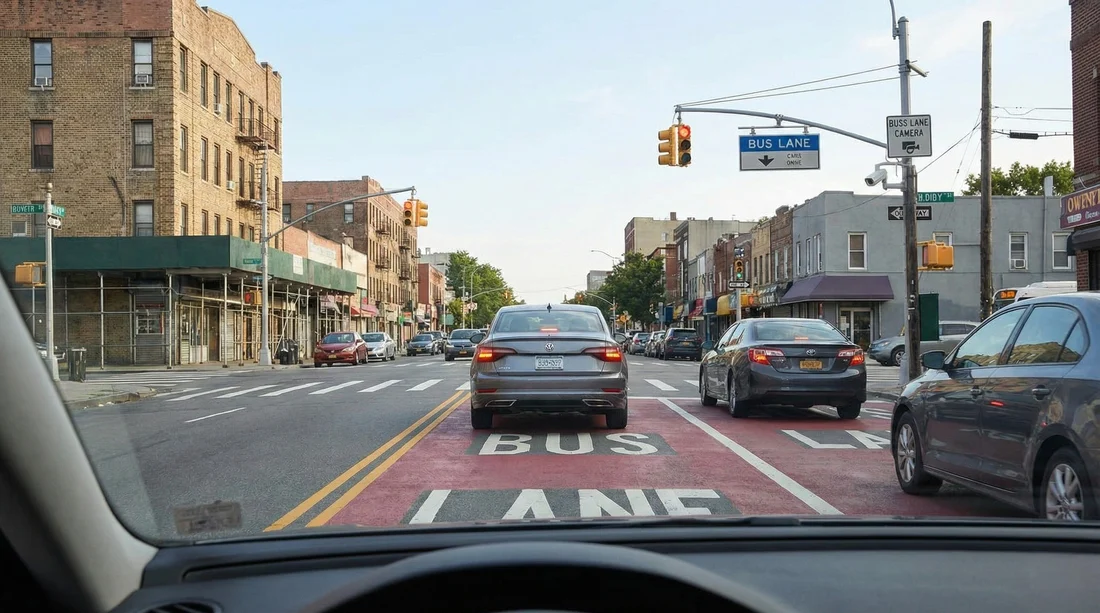
Look for a rectangular sign that states “BUS LANE” and then lists the operating days and times. Some signs include multiple time windows. When the sign indicates the lane is in effect, general traffic is not permitted to drive or stop there, unless a specific exception is shown.
2) “Buses only” or “Bus and right turns only”
On some corridors, the sign will clarify that the lane is exclusively for buses. Other locations permit right-turning vehicles to enter the bus lane shortly before the intersection to make a right turn. The permission is typically limited to the approach to the turn, not an invitation to cruise in the lane to get ahead.
3) “No standing” or “No stopping” overlays
You may see additional restrictions that apply even when the bus lane is not in effect. A lane can be a bus lane during peak times and still prohibit stopping at other times. This matters for drop-offs, navigation checks, or waiting for passengers.
4) Ground markings and lane colour
NYC often uses “BUS ONLY” painted on the roadway. Some segments may have a red-tinted lane surface. Road markings are a strong clue, but always trust the posted sign for the legal hours, because markings alone do not show times.
5) Curbside bus lanes versus offset lanes
In Queens and Brooklyn, many bus lanes run along the curb. That creates confusion because curb lanes also host parking, deliveries, and right turns. If you see a curb lane that looks unusually clear with repeated bus markings, assume it is regulated and find confirmation on the next sign.
Typical operating hours and patterns (and why you must still read the sign)
Many NYC bus lanes operate during weekday peak commuting periods, commonly in the morning and late afternoon or early evening. Some corridors run a bus lane for extended weekday hours, and a smaller number may include weekend restrictions, particularly in high-demand areas or near major destinations. In other words, a lane that is unrestricted on Sunday could be restricted on Saturday, or vice versa, depending on the route.
Because hours vary by street and sometimes change after updates, treat “typical” as a starting point only. Your safest habit is to scan for the next “BUS LANE” sign whenever you turn onto a new major avenue, especially in Queens near Jackson Heights, Flushing approaches, or long commercial strips, and in Brooklyn on major north-south routes where buses carry heavy passenger loads.
If you are driving a larger vehicle, for example after arranging van rental from Newark EWR, give yourself extra margin. A longer wheelbase makes last-second lane corrections harder, so earlier sign checks reduce stress and sudden manoeuvres.
How to spot a bus lane early, before the camera does
Bus lanes are designed to look different, but New York streets are visually busy. Use these quick cues to identify them sooner.
Repeat signage cadence
Bus-lane corridors place signs at regular intervals. If you see one, assume another is coming, and do not dismiss it as a one-off warning.
Bus stop spacing
If you see frequent bus stops with shelters and a steady flow of buses, the curb lane is more likely to be regulated.
Unusually empty curb lane
In heavy traffic, a suspiciously clear curb lane is often clear for a reason. Do not treat it as a “fast lane” unless a sign explicitly permits general use at that time.
Painted legends
“BUS ONLY” or large “BUS LANE” roadway text is a near-certain indicator. Assume enforcement and start planning an exit if you are already there.
Safe last-second alternatives when you realise you are in a bus lane
Mistakes happen. What matters is how you correct them. NYC driving rewards predictable, lawful moves, not abrupt swerves.
1) Stay calm and keep a steady speed
Sudden braking in a bus lane can create a dangerous situation with buses, cyclists, and drivers behind you. Maintain a steady speed while you evaluate your next safe opportunity to merge out.
2) Signal early and merge out at the next safe gap
Use your indicator, check mirrors and blind spots, and merge into the adjacent general lane when there is space. Aim for the next clear opening rather than forcing an immediate move.
3) If you must turn right soon, use the permitted approach
On streets where right turns are allowed from the bus lane, the sign typically implies you may enter the lane shortly before the corner to make the turn. Do not travel in the lane for multiple blocks. Move in closer to the intersection, then turn.
4) Do not stop to “wait it out”
Stopping in a bus lane is one of the most ticketed behaviours. If you need to check directions, pull onto a legal side street, a legal parking space, or a loading area that permits stopping. If you are navigating after a pickup at Enterprise car rental at JFK and your phone route changes, take the next legal opportunity off the main avenue rather than pausing in-lane.
5) Avoid the three panic moves that create bigger problems
Do not cut across a solid line if present, do not squeeze between a bus and the kerb, and do not turn from a lane that does not permit it. A controlled merge a few seconds later is far safer than an aggressive correction.
Queens and Brooklyn scenarios that commonly lead to tickets
Curb lane confusion near commercial strips
In busy shopping areas, double-parked vehicles can push you outward, while a clear curb lane tempts you inward. If the curb lane is the bus lane, passing on the right can put you into enforcement range quickly.
Approaching bridges and expressway exits
Feeder roads often widen, with dedicated lanes that appear suddenly. If you are focused on making a particular exit, you may follow traffic into the wrong lane. When in doubt, prioritise correct lane discipline over last-second exits. Missing a turn in New York is usually cheaper than a ticket or collision risk.
Following a taxi or rideshare
Taxis and for-hire vehicles may behave as if every curb space is available. Do not mirror their movements. Bus lanes are not general loading lanes, even if another driver stops briefly.
Tourist navigation overload
If you are not used to NYC signage, you may fixate on street names and miss regulatory signs. Build a simple routine: after each turn onto a main road, scan right side for regulatory signs, then re-check at the next intersection.
Practical habits that reduce risk during car hire in New York
Plan for “one wrong block” tolerance
Set your route expecting that you might need to go around once. That mindset prevents sudden dives into bus lanes when you realise your turn is approaching.
Use voice navigation, but do not outsource judgement
GPS can instruct late lane changes. Treat it as guidance, then confirm with street signs. If it says “keep right” and the right lane is clearly marked as a bus lane at that time, stay out and take the next best legal option.
Allow extra time in peak periods
Bus-lane hours often align with commuter peaks. When traffic is worst, the temptation to use an empty lane is highest and enforcement is most valuable to the city. Padding your schedule reduces risky decisions.
Know where you started, because airport routes are bus-lane heavy
Drivers arriving from JFK or EWR quickly end up on major arterials where bus lanes are common. If you are collecting a vehicle from car rental near New York JFK, consider taking a minute before departure to set your route and identify the first few turns so you are not looking down at your screen on a busy avenue.
What happens if you do get a bus-lane camera ticket?
Typically, a notice is mailed to the registered owner of the vehicle. With car hire, that is usually the rental company, which may transfer liability to you under the rental agreement and charge an administrative processing fee. Timeframes vary, so a ticket might appear after your trip.
If you receive a notice, review the images and details carefully. Ensure the date, time, and location match your rental period and route. If you believe the lane was not in effect at that time, the sign was inconsistent, or the vehicle was not yours, follow the formal dispute process described on the notice. Avoid ignoring it, because civil penalties can increase if unpaid.
FAQ
Do NYC bus-lane cameras operate all the time?
No. Many lanes are enforced only during the days and hours posted on the bus-lane sign. Always read the sign on that block for the exact times.
Can I briefly enter a bus lane to make a right turn in Queens or Brooklyn?
Sometimes, yes, if signage allows right turns from the bus lane. The safe approach is to stay in general traffic, then move into the bus lane only near the intersection to turn.
Will I be pulled over if I drive in a bus lane?
Usually, camera enforcement happens without a stop. You may only learn about it later through a mailed notice, which can be forwarded through your car hire agreement.
What should I do if I realise I am already in a bus lane?
Signal, check mirrors and blind spots, and merge out at the next safe gap. Avoid stopping in-lane or making abrupt moves that endanger buses, cyclists, or pedestrians.
Are bus lanes the same as HOV lanes in New York?
No. Bus lanes are reserved for buses and any other vehicles specifically permitted by signs. HOV rules are different and are not interchangeable with bus-lane permissions.




























































































