


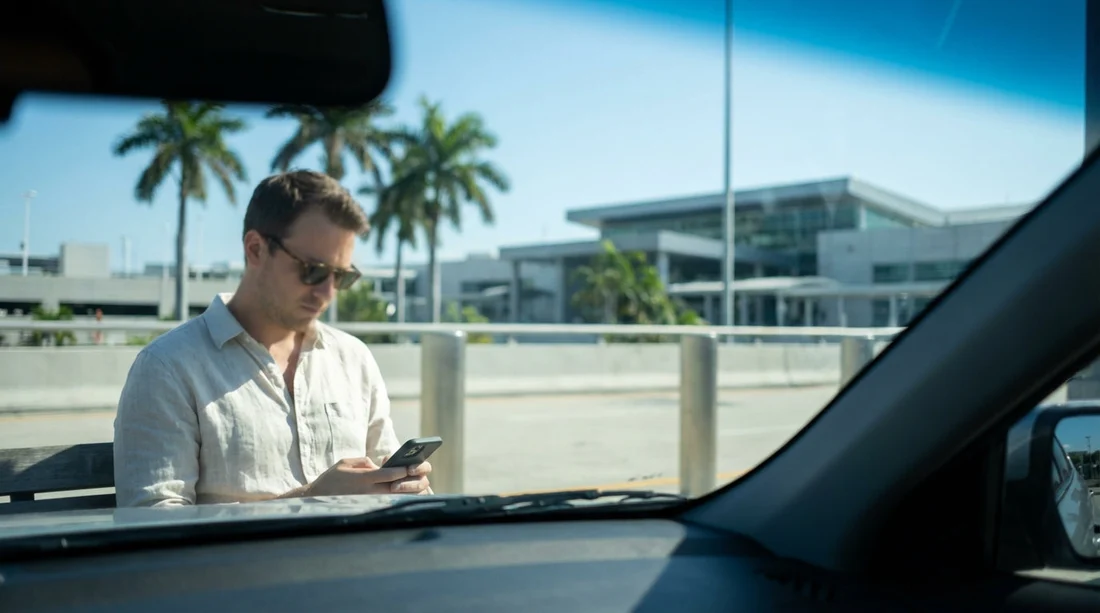
Quick Summary:
- Wait free in the MIA Cell Phone Waiting Lot until your passenger calls.
- Do not stop at kerbside unless the passenger is physically present.
- Use Departures for faster loading, but keep it under one minute.
- Agree a terminal door number and airline to avoid looping and fines.
Picking someone up at Miami International Airport (MIA) can feel like a test of patience, especially if you are new to US airport rules. The good news is that you can wait without getting ticketed, but only if you choose the right place and time it properly. With Miami car hire, the easiest way to avoid fines is to separate “waiting” from “loading”, wait off the terminal roadway, then drive to the kerb only once your passenger is ready to get in.
This guide explains the MIA Cell Phone Waiting Lot, what kerbside enforcement looks for, and a few low-stress alternatives when arrivals gets chaotic. If you are collecting friends, family, or colleagues, a two-minute plan before you set off can save you multiple loops around the terminal.
How pick-up enforcement works at MIA (and why people get fined)
At MIA, the terminal roadways are designed for active pick-up and drop-off only. Enforcement focuses on vehicles that stop and wait with no passenger at the kerb, block a lane, or leave the vehicle unattended. Even if you keep the engine running, “standing” at the kerb is typically treated as waiting.
In practice, a smooth pick-up looks like this: you arrive at the kerb, your passenger is already at the door with luggage, they load quickly, and you leave. Anything that turns into waiting, for example your passenger is still on the moving walkway or stuck at baggage claim, should happen away from the kerb.
If you are arranging Miami car hire and meeting someone at MIA, build in extra time for the passenger side rather than the driver side. It is usually easier for them to wait indoors than it is for you to wait on the terminal roadway.
The MIA Cell Phone Waiting Lot: the safest place to wait
The MIA Cell Phone Waiting Lot is designed specifically for drivers who are collecting arriving passengers. It is free, and it keeps you off the terminal roadway until the passenger is ready. Conceptually, it is simple: park, wait for the call or message, then drive to the correct terminal door for a quick kerbside pick-up.
To use it well, agree on a “ready to kerb” message with your passenger. The best time for them to message you is when they have collected bags and are walking outside to the pick-up level. If they message earlier, you may still end up doing laps because the kerbside rules do not allow you to wait at the door.
Practical tips for the waiting lot:
1) Ask for the exact terminal and door. MIA uses terminal letters and door numbers. “I am outside” is not enough, and the wrong side of the terminal can add ten minutes.
2) Confirm level: Arrivals or Departures. If traffic is jammed on Arrivals, meeting on Departures can be faster, but only do this if your passenger can comfortably get upstairs with bags.
3) Keep your phone ready and your route simple. As soon as they text “at kerb”, you should be able to leave immediately. Sitting in the lot for a few extra minutes is fine, but sitting at the kerb is what attracts fines.
If you are also sorting a vehicle for the wider trip, it can help to think about where you will be driving next. For example, if you are heading into Brickell after the pick-up, it is useful to know the typical traffic patterns into the city centre and where you can stop safely later. Hola Car Rentals has local pages such as car hire in Brickell that outline neighbourhood context for planning.
Kerbside rules: what you can and cannot do
Once your passenger is ready, you will choose Arrivals (lower level) or Departures (upper level). Both work, but the rules are similar: load quickly, stay with the vehicle, and leave as soon as the passenger is inside and belted.
Do:
Pull fully to the kerb, keep hazards on if needed, and load efficiently. If you have multiple bags, have the boot open and ready. If your passenger has a trolley, meet them at a wider section so you are not blocking others.
Do not:
Wait at the kerb for a delayed passenger, double park, stop in a travel lane, or leave the car unattended. Those behaviours are the ones most likely to lead to enforcement or being moved on. If your passenger is not there, loop around or return to the waiting lot.
Timing matters. At busy times, you may only get a short window to stop. The goal is a “touch-and-go” pick-up. Treat the kerb as a loading bay, not a meeting point.
Arrivals vs Departures: which is less stressful?
Arrivals (lower level) is the default for most pick-ups because it is where passengers naturally exit after baggage claim. It can also be the most congested, especially when several flights land close together. If your passenger is travelling light or arrives at a quiet time, Arrivals is usually simplest.
Departures (upper level) can be calmer at certain hours because it spreads traffic differently. It can also be easier for a passenger to spot your vehicle if the kerb is less crowded. The trade-off is that your passenger must go upstairs, which is not ideal with heavy luggage, young children, or accessibility needs.
A sensible rule: try Arrivals first, but agree a backup plan to switch to Departures if the lower level is gridlocked. The key is that you must decide before you reach the terminal, because changing levels last-minute often forces extra loops.
Best meeting-point script to avoid confusion
Use this simple message template when you are doing Miami car hire pick-ups at MIA:
“Text me when you are outside at Terminal [X], Door [Y], Arrivals. If it is too busy, go to Departures, same terminal and door area.”
Why it works: it makes “ready” mean “standing at the kerb”, and it gives you a clear terminal, door, and level. It also removes the common failure mode where the passenger messages at baggage claim, you drive in too early, and you end up forced to keep circling.
If your passenger is delayed: what to do instead of waiting kerbside
Delays happen, bags take time, and sometimes a traveller cannot find the right exit. When that happens, do not turn the terminal kerb into your waiting spot. Use one of these low-risk alternatives:
Return to the Cell Phone Waiting Lot. This is usually the best option, even if it feels like “going backwards”. It is better to wait five minutes legally than to risk a fine or get pushed along by enforcement.
Do a controlled loop. If you are only a minute away from the kerb and your passenger is almost outside, loop once and try again. Commit to one loop only, then go back to the lot if they are still not ready.
Switch terminals only if you are sure. If your passenger is at the wrong terminal, ask them to confirm their airline, terminal letter, and the nearest door number. Randomly switching terminals often increases stress and time.
Where to go after the pick-up: minimising stress with your route
Once the passenger is in the car, the stressful part should be over. The next stress point is often navigation, especially if you are heading to a beach hotel or downtown during peak traffic. If your plan is a Miami Beach stay, it helps to know in advance where you can stop to regroup, and what the typical driving corridors look like. For location context, see Hola Car Rentals’ Miami Beach car rental page.
If your group needs a roomier vehicle for luggage, prams, or sports gear, choosing an SUV can make the kerbside loading faster and safer, because bags fit without needing to shuffle seats. Hola Car Rentals provides local options like SUV hire in Miami (MIA), which can be helpful if you are planning around larger passengers and suitcases.
And if your trip includes a stop in downtown Miami, plan a post-airport pause point, such as a hotel loading zone or a paid car park, rather than trying to sort navigation while still in airport traffic. Neighbourhood guidance is available via pages like Enterprise car rental in Downtown Miami, which can help you orient your next leg.
Common mistakes that lead to tickets or warnings
Arriving too early. Being early feels responsible, but at MIA it often leads to illegal waiting. Use the waiting lot and time your approach.
Unclear passenger instructions. “Meet me at arrivals” is not specific enough. Terminal letter and door number matter.
Stopping in a travel lane. If the kerb is full, loop. Do not stop in the lane, even briefly.
Trying to renegotiate the plan at the kerb. If your passenger is not there, leave and reset from the waiting lot. Kerbside is not the place for phone calls or texts.
Overloading at the kerb. If your passenger has many bags, tell them to have everything zipped and ready. The faster the load, the less chance you will be moved on.
FAQ
Where can I legally wait at MIA before picking someone up? Use the MIA Cell Phone Waiting Lot and wait there until your passenger confirms they are at the kerb outside.
Can I wait at the arrivals kerb if I stay in the car? Typically no. Kerbside areas are for active loading only, and waiting without a present passenger can lead to being moved on or fined.
Is it better to pick up on Arrivals or Departures? Arrivals is easiest for most travellers, but Departures can be calmer at busy times. Agree the level in advance and keep it flexible if traffic is heavy.
What message should my passenger send to time the pick-up? Ask for: terminal letter, door number, level, and “standing outside now”. That ensures you only approach the kerb when they are ready.
What should I do if I miss my passenger at the kerb? Do a single loop and try again, or return to the Cell Phone Waiting Lot. Avoid stopping in a travel lane or waiting at the kerb.




























































































