


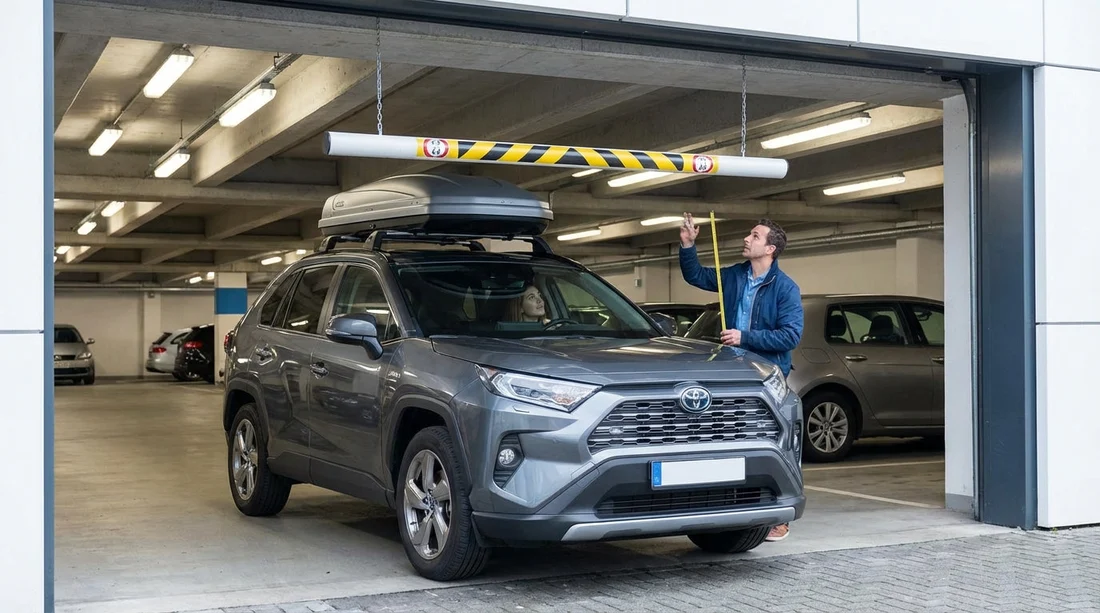
Quick Summary:
- Find the exact vehicle-plus-box height before leaving the pickup location.
- Treat NYC clearance signs as maximums, not comfortable margins.
- Choose open lots, street parking rules permitting, or higher-clearance garages.
- Photograph measurements, signage, and any guidance to dispute damage claims.
Taking a roof box into Manhattan is doable, but New York parking structures are unforgiving. The common failure point is assuming the listed vehicle height in a handbook matches your real-world height with crossbars, a box, and sometimes a slightly sagging suspension after loading. With a hire car, a roof strike can become an expensive damage charge, because roof rails, shark-fin antennas, tailgates and the roof skin are all costly to repair.
This guide focuses on three things: how to find your rental’s real height with the roof box fitted, how to interpret garage clearance signage in New York, and how to choose safer parking options so you reduce risk rather than relying on luck.
Step 1: Work out your real height, not the brochure height
Manufacturers publish vehicle height, but that figure usually excludes accessories. With a roof box, you need the total height from the ground to the highest point, which might be the front of the box, the rear hinge area, or even an antenna if it protrudes above the box line. You also need to account for how loading changes height: heavy gear can compress suspension slightly, and uneven tyre pressures can tilt the car and raise one corner.
Use a simple checklist while you still have space and time at pickup:
1) Identify the highest point. Stand at the side and sight along the roofline. Many boxes sit higher at the rear. If your vehicle has roof rails, the crossbars can add height even before the box goes on.
2) Measure the total height. The most reliable approach is a tape measure and a straight edge. If you have one person available, hold a rigid object (like a level or a flat board) on the highest point and measure down to the ground. If you are solo, measure to the top of the tyre first and add the tyre radius, but that increases error. Aim for accuracy within 2 cm.
3) Record the number in both units. NYC signage may use feet and inches, while your roof box manual might use centimetres. Write down your total height in metres and feet/inches. A quick conversion reference: 6 ft 6 in is about 1.98 m, 7 ft is about 2.13 m.
4) Add a safety buffer. Clearance signs are often tight, and ramps can change effective height as your vehicle pitches. Add a buffer of at least 2 inches (5 cm). If you are close to the posted limit, treat it as a no.
5) Keep proof. Take a photo of the tape measure showing the height, and one wide photo showing the measurement method. If you ever need to discuss a dispute, contemporaneous photos can help establish you acted responsibly.
If you are collecting at JFK, it can help to choose a vehicle class that naturally gives you more usable clearance margin. Hola Car Rentals’ New York pages can help you compare options and typical vehicle types, for example car rental at New York JFK or, for travellers browsing in UK English, car hire in New York JFK. The key is not the badge, it is the measured height of your specific vehicle with your fitted kit.
Step 2: Understand NYC garage clearance signs and what they really mean
In New York, you will see clearance information in several forms: at the street entrance, on a bar or sign overhead, on internal ramps, and sometimes near the payment kiosk. Treat the lowest number you see as the true limit, because internal beams and ramps can be lower than the entrance.
Posted clearance is not a comfort zone. A sign reading “6' 10"” often means exactly that at one point. It does not guarantee clearance across the full width, and it does not guarantee the same height while you are on a steep ramp where the rear of your vehicle rises relative to the roof. With a roof box, the highest point can shift as the car pitches.
Look for these common complications:
Hanging devices and sensors. Sprinkler pipes, lights, ducts and signage frames can hang below the concrete. These can snag a roof box even if the ceiling itself is higher.
Speed bumps and entry lips. Going from street to ramp can pitch the car and raise the rear portion of the roof box. Approach slowly and straight.
Sloped or crowned ramps. A diagonal approach increases the chance one side rises into a beam. Keep the vehicle centred and straight.
Seasonal signage and temporary boards. Some garages use temporary boards that can be inaccurate. If the sign looks improvised, assume it is not carefully surveyed and be conservative.
Units matter. A clearance of 2.0 m is about 6 ft 6.7 in. If your measured height is 6 ft 6 in, you are already close once you add a buffer. Do not round down.
When in doubt, ask, but do not rely on verbal assurances. Attendants may wave you in, but if you strike the roof, you can still be liable. If you do ask, confirm the posted clearance in writing on a receipt is rare, so your own photos of the sign and your height measurement are more dependable.
Step 3: Know the “real height” traps specific to hire cars
With car hire, two extra issues regularly cause trouble: vehicle substitutions and unrecognised add-ons.
Vehicle substitutions. You might reserve a class, then receive a different model with a taller roofline or different rail height. Measure the actual vehicle you are given, not the model you expected.
Factory rails, antennas, and roof trim. Some SUVs have raised rails, some have flush rails, and some have tall shark-fin antennas. With a roof box, the mounting hardware and clamps can also be the highest point, particularly if the box sits lower than the clamp heads.
Tyre pressure and load. Underinflated tyres can change how the vehicle sits on ramps and how it pitches. Keep tyres at the door-jamb specification and distribute weight evenly. Heavy items should go low in the cabin or boot, not up in the roof box.
If you are starting from Newark rather than JFK, similar planning applies. Hola Car Rentals has pages useful for orienting yourself to pickup locations and vehicle categories, including car rental at Newark Airport EWR and SUV rental at Newark EWR. Whichever airport you use, do the measurement before you reach Manhattan traffic.
Step 4: Pick safer parking options in Manhattan with a roof box
The safest strategy is to avoid low-clearance structures entirely. Manhattan has many garages built under older buildings with low beams, plus modern facilities with higher clearances. Your goal is to narrow choices to options that provide margin above your measured height.
Option A: Open-air lots. Open lots reduce the height risk to almost zero. The trade-off is availability and price, and you still need to watch for hanging tree branches near the perimeter.
Option B: Street parking where lawful and practical. If your itinerary allows, street parking avoids clearance risks, but you must comply with local regulations, meters, and street cleaning rules. Also consider that a roof box can make your vehicle stand out, so choose well-lit areas and do not leave valuables visible.
Option C: Higher-clearance garages, but verify twice. Aim for garages clearly marked with a clearance comfortably above your measured height plus buffer. Once inside, continue scanning for internal low points, especially near turns and near elevator lobbies where ductwork is common.
Option D: Park outside Manhattan, then use transit. If your roof box is tall and you do not need the car in Manhattan, parking in a higher-clearance facility outside the densest areas and using the subway can be lower stress. This can also reduce exposure to tight ramps and heavy traffic.
Whatever you choose, build a habit: photograph the entrance clearance sign before entering. If you later find internal clearance lower than the entrance sign, you have evidence supporting why you reversed out or sought staff help.
Step 5: A simple decision rule that prevents most roof strikes
Use this conservative rule whenever you approach a garage in New York:
If the posted clearance is less than your measured height plus 5 cm, do not enter.
This buffer accounts for uneven pavement, suspension movement, and the fact that “posted clearance” can reflect a best point, not the worst point. It also helps with the psychological trap of thinking you can “creep through” with millimetres to spare.
If you are already aligned with the entrance and suddenly realise the sign is too low, stop before the overhang, signal, and back out carefully with hazard lights if needed. Roof box strikes often happen because drivers commit early and then feel pressured by traffic behind them.
Step 6: What to do if you are unsure at the entrance
Uncertainty is a warning sign. If the clearance is close, or you cannot clearly see the lowest point, take these steps:
Pause and reassess. Pull over safely before the entrance and re-check your recorded height.
Check for a height bar. Some facilities have a hanging clearance bar designed to hit first. If there is no bar, the first thing to hit might be your roof box.
Ask staff to confirm the lowest internal point. Phrase it specifically: “What is the lowest beam clearance inside, not just at the entrance?” If they cannot answer, treat it as a no.
Choose a different option. In Manhattan, a short detour is cheaper than roof damage. Keep a mental list of alternatives: open lots, different garages on wider avenues, or parking outside the core.
Step 7: Reducing the risk of roof damage charges with car hire documentation
Damage charges typically hinge on condition evidence and responsibility. If you are operating a hire car with a roof box, keep your own documentation tidy:
Before you drive into Manhattan: photograph roof, rails, and the box from multiple angles. Ensure time stamps are enabled. Note any existing scuffs on the box.
At each garage: photograph the clearance sign, then a wider shot showing it relates to that entrance. If you decide not to enter, photograph the sign anyway. It supports that you made a reasoned decision.
If you hear contact or scraping: stop immediately, do not continue forward. Continuing can turn a light scrape into severe damage. Move to a safe area, take photos, and notify the garage staff. With rentals, prompt reporting is usually better than returning a vehicle with undisclosed damage.
On return: photograph the roof and roof box again under good light. If returning at night, use a well-lit area and multiple angles.
Also remember that many garages in New York operate on tight manoeuvring space. Even if height is adequate, narrow turns can bring the roof box close to walls, pipes, or signage frames. Move slowly, fold mirrors when safe, and follow attendants’ signals cautiously.
FAQ
How do I find the exact height of my hire car with a roof box fitted? Measure from the ground to the highest point of the fitted box using a tape measure and a straight edge, then record the number in feet/inches and centimetres, adding a small safety buffer.
Is a garage’s posted clearance in Manhattan always reliable? It is a useful guide, but not a guarantee. Internal beams, pipes, sprinklers and ramp angles can reduce effective clearance, so treat the lowest posted figure as the true limit and keep a margin.
What clearance should I look for if my vehicle height is close to the sign? If the posted clearance is less than your measured height plus about 5 cm, choose another parking option. Near-limit entries are where most roof box strikes occur.
Are open-air lots safer for roof boxes in New York? Yes. Open-air lots remove most height risks, though you should still watch for trees, lighting structures, and tight manoeuvring spaces when entering and exiting.
What should I photograph to reduce disputes about roof damage charges? Photograph your height measurement, the roof and roof box condition before and after, and the garage entrance clearance signage. Wide shots that show context are especially helpful.





























































































