


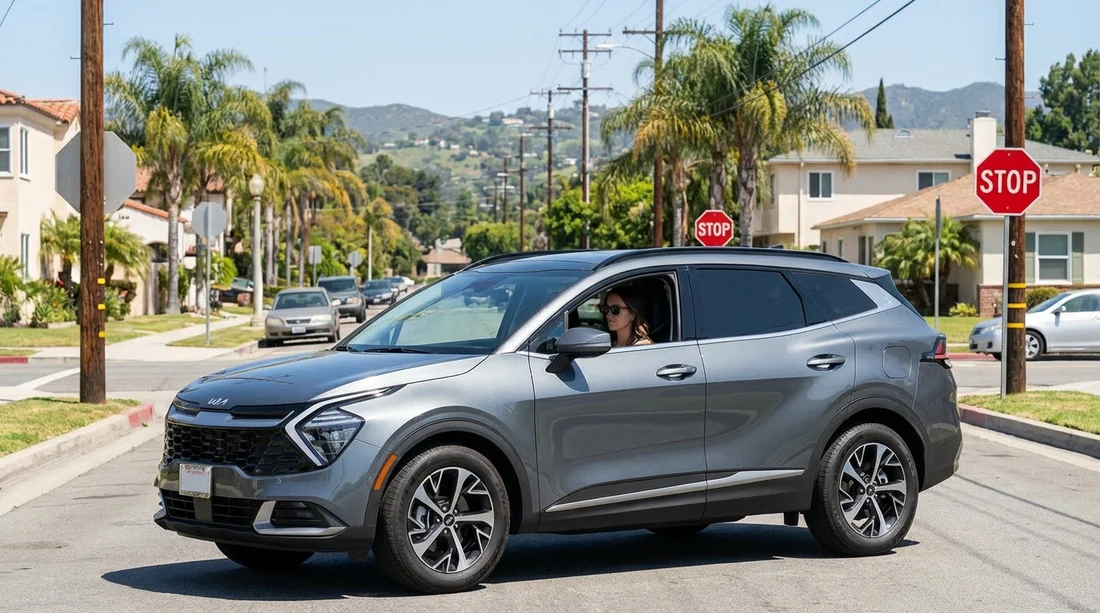
Quick Summary:
- Stop fully behind the line, then proceed in arrival order.
- If you arrive together, yield to the vehicle on your right.
- Left turns yield to oncoming traffic going straight or right.
- Signal early, make eye contact, and never wave others through.
Four-way stop junctions are common across Los Angeles, especially in residential grids and near busy arterials where smaller streets meet. If you are driving a car hire vehicle, understanding the exact priority order matters, because confusion at a stop sign quickly leads to honks, near-misses, or a ticket for failing to yield. The good news is that the rules are consistent. The challenge is that not everyone applies them calmly, so you need both the legal order and the practical habits that keep traffic moving.
If you have picked up a vehicle via car rental California LAX, you may meet your first 4-way stop within minutes of leaving the airport area. The key is to treat each approach as a simple, repeatable sequence, then adjust for ties, turning conflicts, pedestrians, and the occasional driver who rolls through.
What a 4-way stop means in Los Angeles
A 4-way stop is an intersection where every direction has a stop sign, and each driver must come to a complete stop. In California, a complete stop means your wheels stop turning, and you stop at the limit line, crosswalk, or, if neither is marked, before entering the intersection. Only after stopping do you determine who goes first.
Many Los Angeles intersections also have marked pedestrian crosswalks, even if they are un-signalised. Pedestrians and cyclists are part of the priority picture. Even if it is your turn among vehicles, you still must yield to a pedestrian crossing your path, and you must not creep into the crosswalk while waiting.
Step-by-step priority rule guide
Use this step-by-step process every time. It keeps you consistent, and consistency prevents the hesitation that triggers impatient horns.
Step 1: Make a full stop in the correct place
Approach slowly, brake early, and stop behind the limit line. If there is a crosswalk, stop before it, not on it. If you are unsure where to stop, stop before the intersection edge so you are clearly yielding. A rolling stop is one of the most common ticket reasons, and it can also remove your legal priority, because you never properly entered the queue.
In dense areas near LAX where traffic is heavy, a full stop also gives you time to scan. If you hired a larger vehicle, such as through minivan rental California LAX, allow extra space for your front end swing and ensure you can see around parked cars.
Step 2: Identify the “arrival order” queue
The default rule is simple: the first vehicle to stop is the first vehicle to go. Think of it as a four-corner queue. To apply it, do a quick scan left, ahead, right, then mirrors. Ask, “Who was fully stopped first?” That vehicle goes. After it proceeds, the next vehicle that stopped goes, and so on.
Practical tip: do not base this on who is closest to the intersection. Base it on who completed their stop first. Someone may have arrived later but rolled forward aggressively, and that does not give them priority.
Step 3: Handle simultaneous arrivals, yield to the right
When two or more vehicles stop at the same time, California’s tie-breaker is to yield to the vehicle on your right. If you and the driver on your right arrived together, let them proceed. If you are the vehicle on the right, you proceed first, assuming the intersection is otherwise clear.
If three or four vehicles arrive at once, the “yield to the right” rule still works, but it can feel circular. In practice, the vehicle that is most clearly on the right of another will go, and the rest will follow in a clockwise pattern. If it is messy, pause, keep your wheels straight, and proceed only when you are sure another driver has yielded to you.
Step 4: Resolve turning conflicts, straight and right usually win
Once you know whose turn it is among vehicles, you still need to check whether that vehicle’s path conflicts with someone else’s movement. At 4-way stops, the biggest conflict is the left turn.
If it is your turn and you are turning left, you must yield to oncoming traffic that is going straight or turning right, because they are crossing your path. This is true even if you stopped first. Your “turn” is conditional on being able to complete the movement safely without forcing someone else to brake.
If you are going straight, you generally have less conflict, but still check for someone turning left in front of you. If they began their turn properly after yielding, let them finish. If they jump the gap, do not accelerate to “prove” your right of way.
Right turns are usually the simplest, but still require you to yield to pedestrians in the crosswalk, and to cyclists travelling through the intersection. In Los Angeles, bikes may be less visible at night, so keep scanning.
Step 5: Watch for pedestrians, cyclists, and “late crossers”
At many Los Angeles 4-way stops, pedestrians will start crossing after you have stopped, even if they stepped off the kerb late. If a pedestrian is crossing in front of you, you must wait. If they are crossing a different leg of the intersection, you still need to check whether your movement would cut across their path, especially on a right turn.
For cyclists, treat them as vehicles when they are riding in the lane and stopping with traffic. If a cyclist arrives before you and stops, they are ahead in the arrival order. If they filter to the front after you stopped, be cautious: you still must avoid hitting them, but you are not required to surrender your lawful turn simply because they moved forward. In reality, prioritise safety, then proceed slowly when clear.
Step 6: Communicate clearly, but do not invent new rules
Use your indicators early, ideally before you stop, so others can predict your path. Make eye contact when possible. Keep your wheels straight while waiting to turn left, because if you are hit from behind, turned wheels can push you into oncoming traffic.
A key Los Angeles driving habit to avoid is the “polite wave-through” that breaks the order. Waving someone through can cause a side impact with a third vehicle that is following the rules, and if a collision happens, the wave does not protect you legally. Follow arrival order, yield-to-the-right in ties, and standard turning yields. Predictability is safer than courtesy.
Common 4-way stop situations, solved
Situation: You arrive first, but another driver rolls through. Legally you had priority, but do not take it aggressively. Let them clear, then re-establish the queue with whoever is now properly stopped.
Situation: Two cars opposite arrive together, both going straight. Both can proceed at the same time, because paths do not conflict. Proceed cautiously and hold your lane. If either car is turning left, the left turn yields.
Situation: You and the car opposite arrive together, you are turning left. Even though you arrived simultaneously, your left turn must yield to their straight movement. If they are also turning left, you can usually turn left in front of each other if space allows, but only if both drivers clearly understand it and pedestrians are clear.
Situation: Four cars arrive together. Yield to the vehicle on your right. If everyone hesitates, the driver with the clearest right-side advantage will usually go first. Keep your patience, because a half-move and stop creates confusion.
Situation: A pedestrian is waiting at the corner. If they step into the crosswalk, you yield. If they are waiting, you still may proceed on your turn, but be prepared for them to start crossing as you move. Slow starts help.
How to avoid honks and tickets in Los Angeles
Honks at 4-way stops usually happen for one of three reasons: you did not stop fully, you hesitated too long after it became your turn, or you tried to be “too polite” and waved someone else through. Tickets, meanwhile, often come from rolling stops, stopping past the line, or failing to yield on a left turn.
To stay smooth in a car hire vehicle, aim for a clean routine: stop fully, scan for arrival order, signal, go when it is clearly your turn, and do not second-guess yourself mid-move. Decisive does not mean fast, it means steady.
If you are new to driving in the area, choosing a familiar pick-up process can reduce stress before you even reach your first 4-way stop. Some travellers prefer a named brand counter like Enterprise car rental California LAX or Thrifty car rental Los Angeles LAX, then focus their attention on local driving norms once on the road.
Mini checklist for your next 4-way stop
1) Stop completely behind the line or crosswalk. 2) Identify who stopped first. 3) If tied, yield to the right. 4) If turning left, yield to oncoming straight or right traffic. 5) Yield to pedestrians in your path. 6) Proceed smoothly when clear, and do not wave others through.
FAQ
Do I always go first if I arrived at the stop sign first? You go first among vehicles if you were first to make a complete stop, but you still must yield to pedestrians and to oncoming traffic if you are turning left.
If two cars stop at the same time, who goes first at a 4-way stop? In California, if you arrive simultaneously, you yield to the vehicle on your right. If you are the vehicle on the right, you may proceed when safe.
Can two cars go at the same time at a 4-way stop? Yes. Opposing vehicles going straight can often proceed together because their paths do not conflict. Also, right turns on opposite sides may work, as long as pedestrians are clear.
What if someone waves me through even though it is not my turn? It is safer to follow the standard priority order. A wave does not give you legal right of way, and it can create a conflict with another driver who is proceeding correctly.
What is the most common mistake visitors make in Los Angeles 4-way stops? Rolling through without fully stopping, or stopping but hesitating so long that others move unpredictably. A full stop and a quick, confident decision prevent most problems.





























































































