


Quick Summary:
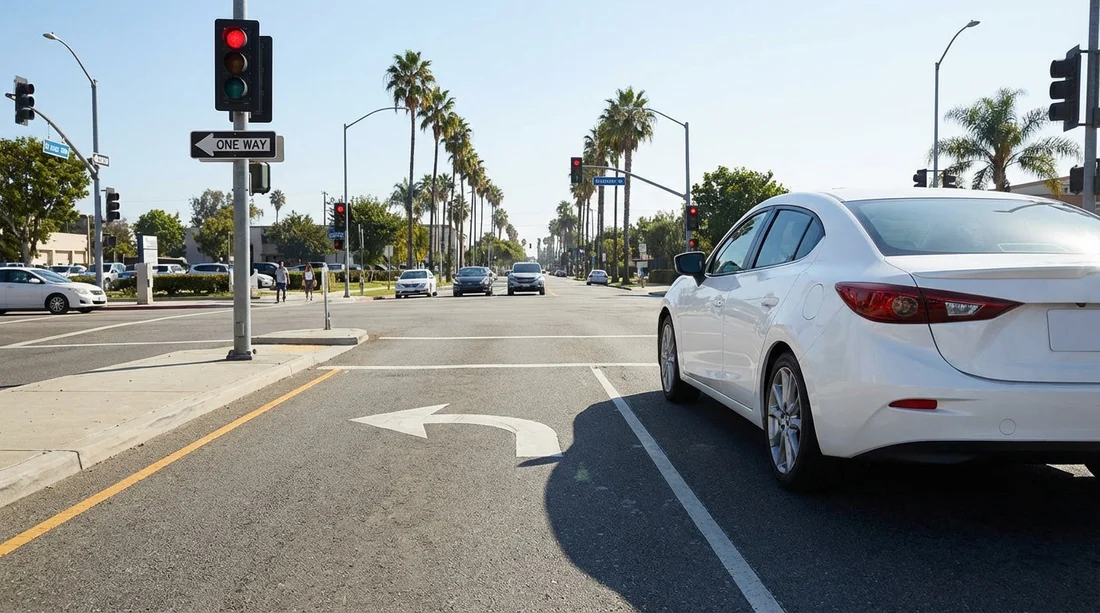
- Left on red is legal only from one-way to one-way streets.
- Stop first, yield to pedestrians, then turn if the way is clear.
- Any “No Turn on Red” sign or red arrow overrides permission.
- Downtown Los Angeles cameras punish rolling stops, blocked crosswalks and late turns.
If you are using car hire in Los Angeles, the “left on red” question matters more than you might expect. LA streets often include one-way grids, complex signal phases, busy crossings and enforcement that is less forgiving than tourists assume. California does allow a left turn on red in a specific situation, but only when strict conditions are met. Get it wrong and you risk a ticket, a near miss with a pedestrian, or a stressful encounter with impatient local traffic.
This guide explains when a left-on-red is permitted in California (one-way to one-way), which signs and signals override it, and how to drive defensively around camera enforced junctions in Downtown LA.
If you are collecting a vehicle near LAX, these rules are useful from the moment you enter city streets. Many travellers compare options via car rental Los Angeles LAX and then head straight towards Hollywood, DTLA, Santa Monica or Pasadena, all areas where junction discipline matters.
Is a left turn on red legal in California?
Yes, but only in a narrow case. In California, you may turn left on a red light only when you are turning from a one-way street onto another one-way street, and traffic on the destination street flows to your left. You must first come to a complete stop at the limit line, crosswalk or before entering the intersection, then yield to pedestrians and any traffic that has the right of way.
Think of it as the left turn equivalent of turning right on red. It is not a “California free-for-all”, it is conditional permission that disappears the moment signage or signals tell you otherwise.
When you are new to the city and driving a car hire vehicle, treat “left on red” as an exception, not a default. If you are unsure whether both roads are one-way, or you cannot see the full approach clearly, wait for green. The extra seconds are worth the reduced risk.
The exact situation where left on red is allowed
A legal left-on-red in California usually looks like this:
You are travelling along a one-way street, you stop at a red signal, and you are turning left into a one-way street that also carries traffic in a single direction. After stopping fully, you may turn left when it is safe and when you yield properly.
In practice, you should confirm four things before you even consider moving:
1) You are definitely on a one-way street. Look for “One Way” signs, the direction of parked cars, and whether oncoming lanes exist. DTLA can mix one-way and two-way streets very closely together.
2) The street you are turning into is also one-way. If the destination street is two-way, a left-on-red is not permitted, even if it “feels” safe.
3) You stop completely. A rolling stop is the easiest way to be cited, especially where enforcement is present.
4) You yield to pedestrians and traffic. Pedestrians may start crossing on the parallel green, and cyclists can appear quickly in central lanes.
Visitors who pick up at the airport often ask whether rules differ by county or city. The basic rule is statewide, but the key differences are signage, signal design and enforcement from junction to junction. If you are planning your trip from LAX with car rental California LAX, build in a little time buffer so you never feel pressured to “make” a questionable turn.
What signs and signals override left-on-red permission
Even when you are on one-way to one-way streets, you may not turn left on red if any controlling device forbids it. In Los Angeles, you will commonly see restrictions that remove the exception.
“No Turn on Red” sign. This is the most direct override. If the sign is present for your approach, you must wait for a green, regardless of one-way configuration.
Red arrow. A red left arrow means no left turn until the arrow changes. Do not treat it like a standard red circular signal.
Lane control signals and turn-only indications. If your lane has a turn-only arrow and it is red, you cannot proceed. If the junction has special phases for pedestrians, the city often uses arrows to manage conflicts.
Temporary restrictions. Roadworks and event traffic controls can add portable signs. In downtown and around major venues, do not assume yesterday’s pattern applies today.
Do not “interpret” missing signs. Some drivers look for a sign that says left on red is allowed. Typically you will not get that reassurance. You must infer it from the one-way to one-way layout and the absence of prohibitions, then still stop and yield correctly.
If you are driving a larger vehicle, such as a people carrier for a group trip, it can be harder to see signs and pedestrians at the corners. Consider choosing a size that matches your comfort level and routes. Hola also lists options like van rental California LAX if you need space, but in dense areas you may prefer a smaller footprint for easier junction positioning.
Downtown Los Angeles: how to avoid camera tickets and junction violations
Drivers associate “camera tickets” with red-light cameras. In Los Angeles, enforcement varies by area and over time, and you should not rely on assumptions about which junctions have active cameras. The safer approach is to drive as if every complex intersection is monitored and every stop must be textbook perfect.
Here are the behaviours that most often lead to citations or near-misses for visitors in a car hire vehicle:
Rolling through the stop. A complete stop means the wheels stop turning. If you creep forward to improve your view, stop again before moving into the crosswalk area.
Stopping on the crosswalk. Many LA crossings are heavily used. If you stop past the limit line, you can block pedestrians and increase your risk of a ticket and liability if someone steps around you.
Turning late on red. If you hesitate, then decide to go after a long pause, you may conflict with pedestrians who now have a walk signal, or with traffic that has started moving on a new phase. If you miss the safe gap, wait for green.
Following another car through. “They went, so I can go” is risky. The lead vehicle may be turning right, may have a green arrow, or may be ignoring a “No Turn on Red” sign you cannot see.
Not checking for cyclists. Downtown and near campuses, cyclists can approach quickly. Always scan mirrors and the near curb line before turning.
Underestimating pedestrians. In LA, pedestrians may begin crossing as soon as the walk signal appears, often while your approach still shows red. Your obligation to yield is absolute.
A simple habit helps: when you stop at red and think you might be allowed to turn left, say to yourself, “Stop, sign, arrow, people, bikes, then go.” It forces the right order of checks.
Step-by-step: making a legal left on red in LA
Use this process when the streets are one-way to one-way and you see no prohibition:
1) Position correctly. Move into the leftmost lane that permits a left turn. Do not turn from a through lane.
2) Stop at the right place. Stop at the limit line. If none is visible, stop before the crosswalk. If there is no crosswalk marking, stop before entering the intersection.
3) Check for an override. Look for “No Turn on Red” signs, red arrows, and any turn restrictions posted at eye level or on the signal mast.
4) Yield properly. Look left for cross traffic, ahead for pedestrians, and over your left shoulder for cyclists or scooters. If you cannot see clearly, do not go.
5) Turn smoothly into the correct lane. Avoid cutting across lanes. Stay in the nearest available lane unless markings direct otherwise.
6) Be ready to abort. If a pedestrian steps off the kerb or a cyclist appears, stop and yield even mid-creep, as long as you can do so safely.
This is one of those moments where local driving culture can feel fast. Let others honk if they want, your priority is legality and safety, especially in an unfamiliar car hire car with different braking feel and blind spots.
Common LA situations that confuse visitors
One-way streets that “look” two-way. Wide downtown roads with multiple lanes can still be one-way. Conversely, some smaller streets are two-way even if you only see traffic moving one direction at that moment.
Slip lanes and channelised turns. Some corners have a dedicated turn lane that curves around. Treat these like their own controlled movements, follow posted signs, and do not assume the red signal applies in the same way as a standard corner.
Red plus green arrow elsewhere. If another lane has a green arrow, yours might still be red for a reason, such as a pedestrian scramble or protected phase. Your movement must match your signal, not the next lane’s.
After dark in entertainment areas. In places with nightlife, crossings can be crowded and unpredictable. Even when legal, the safest decision may be to wait for green to reduce conflict.
If your trip includes Orange County drives as well as Los Angeles, note that the same statewide rules apply, but street layouts differ. Travellers sometimes collect near Santa Ana and drive into LA. You can review airport-area options like car rental airport Santa Ana SNA to match your itinerary, then keep the same intersection habits throughout the region.
How police and liability tend to view left-on-red mistakes
Left-on-red is allowed only when you can prove the conditions were met. If you turn left on red from a two-way street, or onto a two-way street, it is usually treated as a signal violation. If you fail to stop fully or you encroach on the crosswalk, it can be cited as a separate offence. And if there is a collision with a pedestrian or another vehicle, an improper left-on-red can weigh heavily in fault assessments.
For that reason, a good rule for visitors is: if you cannot quickly confirm it is one-way to one-way and unrestricted, do not take the turn on red. Waiting for green is always legal, and in most LA traffic it rarely costs more than a short signal cycle.
Practical tips for car hire drivers in Los Angeles
Use navigation, but do not outsource judgement. Sat-nav instructions can say “turn left”, but they do not tell you whether left-on-red is permitted at that junction.
Expect more one-way streets in DTLA. Around the central grid, you will see more opportunities for one-way to one-way turns, but also more signs restricting turns during certain hours.
Keep your windscreen clear and your seat height right. Better visibility helps you spot “No Turn on Red” signs and red arrows early.
Be conservative with larger vehicles. With vans or SUVs, your turning radius and sightlines change. Take wider, slower turns and avoid committing on red unless visibility is excellent.
Do not stop in the junction. If traffic is backed up beyond the turn, wait. Blocking the box draws attention and creates pedestrian conflict.
Finally, remember that California’s permissive rules still expect careful yielding. A legal left-on-red is never a right of way, it is a choice you make only when safe.
FAQ
Can I turn left on red in California from a one-way to a one-way? Yes, provided both streets are one-way, you stop completely first, and you yield to pedestrians and any traffic with the right of way.
Does a “No Turn on Red” sign cancel left-on-red from one-way to one-way? Yes. Any posted “No Turn on Red” sign for your approach overrides the general permission, even if the streets are one-way.
What if I see a red left arrow but the road is clear? Do not turn. A red arrow means the turn is prohibited until the arrow changes, regardless of visibility or one-way layout.
How do I avoid tickets at downtown Los Angeles intersections? Make a full stop at the limit line, keep out of crosswalks, check for signs and arrows, and only turn when you have a clear, legal gap.
Is it safer to wait for green even when left-on-red is allowed? Often, yes. If you are unsure about one-way status, signage, or pedestrian activity, waiting for green reduces risk and is always legal.





























































































