


Quick Summary:
- Check Caltrans chain-control level before leaving Los Angeles, and again uphill.
- Expect checkpoints on SR-18 and SR-330, especially after heavy snowfall.
- Carry correctly sized chains for your tyres, and practise fitting once.
- If you reach control without chains, use turnouts or buy nearby.
A winter drive from Los Angeles to Big Bear can be straightforward, or it can turn into a slow crawl behind ploughs and spinning tyres. The difference is usually preparation, especially understanding California chain-control rules and knowing where checkpoints tend to appear on the main routes. If you are travelling with a car hire, it is also important to understand what you can and cannot do with your tyres, and how to handle the situation if chain control starts after you have already begun climbing.
This guide explains the chain-control levels you will see posted, the two common approaches to Big Bear, and practical options if you arrive at a checkpoint without chains.
Choose the right pick-up location for a winter run
Most visitors begin with a Los Angeles car hire collected at the airport. If you are flying into LAX, start by comparing vehicles and winter-friendly features on car hire Los Angeles LAX and the broader options on car hire California LAX. Either way, you want clear visibility, decent tread, and enough space to carry chains, gloves, a torch, and warm layers.
If your arrival is via Orange County, picking up closer to the mountains can reduce city traffic time. Options around Santa Ana are covered on car hire airport Santa Ana SNA. Families travelling with bulky luggage often prefer a larger cabin, and van hire Los Angeles LAX is useful if you need extra space for snow gear, pushchairs, or multiple suitcases.
Whatever your pickup point, treat chains as standard winter equipment for a Big Bear run. Even if the weather in Los Angeles is sunny, chain control can be active in the mountains the same day.
California chain-control levels explained (R1, R2, R3)
On mountain highways, California uses three primary chain-control levels. You will see them on electronic signs, at roadside boards, and at staffed checkpoints. Knowing what each means helps you decide whether to continue, detour, or stop to install chains before you reach the control point.
R1: Chains required on some vehicles. Typically, chains are required on two-wheel-drive vehicles unless you are driving a four-wheel-drive or all-wheel-drive vehicle with snow-tread tyres. Even if you qualify for the exception, carrying chains is strongly advised because conditions can change quickly and R2 can begin higher up.
R2: Chains required on most vehicles. At R2, two-wheel-drive vehicles must fit chains. Four-wheel-drive or all-wheel-drive vehicles may be allowed to proceed without chains only if they have snow-tread tyres on all four wheels. In practice, officers may still ask if you have chains in the vehicle, because if conditions worsen you could be required to fit them further up.
R3: Chains required on all vehicles. This is the strictest level, meaning even four-wheel-drive or all-wheel-drive vehicles must fit chains. R3 is relatively rare on heavily travelled routes, partly because roads may be closed instead, but it does occur during intense storms.
Key point for car hire drivers: do not assume your vehicle has snow-rated tyres. Many standard hire cars in Southern California run all-season tyres that are not classed as snow tyres. If you cannot confirm your tyre rating, plan as though you will need chains when chain control is active.
Main routes to Big Bear and where checkpoints typically appear
Big Bear is most commonly reached via the San Bernardino Mountains. The two standard approaches from the Los Angeles area are:
1) I-10 or CA-210 to SR-330, then SR-18 (Running Springs route). This is a common choice for people coming from the west and northwest. You climb quickly once you leave the valley, and chain control can appear with little warning after a storm. Checkpoints often show up on the climb near the lower mountain communities, where there is room to pull vehicles off safely.
2) I-15 to SR-18 (Lucerne Valley route). This approach comes in from the high desert side. It can be a good alternative if the south and west faces are being hit by heavy snow, but it still sees chain control and closures depending on weather. Winds and drifting snow can also become an issue on exposed sections.
Exact checkpoint placement can shift, but you can expect patterns. Officers choose locations with wide shoulders, turnouts, and space for cars to fit chains without blocking lanes. After major snowfall, checkpoints may appear earlier on the climb than you expect, and they may also reappear further up if conditions change.
Also plan for temporary closures and escorts. During active ploughing, highways may close briefly for avalanche control, clearing, or to remove stuck vehicles. Even with chains fitted, you might be stopped until a convoy is formed or an incident is cleared.
Before you leave Los Angeles, do these checks
Winter mountain driving is less about bravery and more about reducing surprises. Before you start your Big Bear drive, take five minutes to set yourself up for chain control and detours.
1) Check road conditions and chain status. Look up current conditions for SR-18, SR-330, and any alternate route you might take. Conditions can change between morning and afternoon, particularly when temperatures drop after sunset.
2) Check your tyres and wipers. Good tread depth matters more than engine power. Make sure your windscreen washer fluid is full, and your wipers clear properly. Visibility often becomes the limiting factor in heavy snowfall.
3) Fuel up early. Fill up before you start climbing. Stop-and-go traffic at chain control burns fuel faster than you expect, and mountain fuel stations can have queues during storms.
4) Pack for a slow drive. Carry water, snacks, warm clothing, and a phone charger. If an accident closes the road, you might be stationary for a while.
5) Know how your car handles traction systems. Many modern cars have traction control, stability control, and different drive modes. Read the basics before you are on an icy incline trying to interpret warning lights.
How to choose and fit chains correctly
The best chain is the one that fits your tyre size and that you can install safely. Your tyre size is printed on the tyre sidewall, for example 205/55R16. Chains are sold by size range, and the wrong size can damage the vehicle or fail under load.
Carry basic fitting gear: waterproof gloves, a small torch, and something to kneel on. Your hands will get wet and cold fast in slushy snow, and good grip helps you tension chains properly.
Practise once in daylight. You do not need to be an expert, but you should know where the chain cable routes, how the tensioners work, and how tight is tight enough. A common checkpoint scenario is nervous first-timers blocking a turnout because they are reading instructions in a blizzard.
Follow speed limits for chains. Many chain sets recommend a maximum around 30 mph. Drive smoothly, leave extra distance, and avoid sudden braking. Chains help you move and steer, but they do not create miracle stopping distance.
What happens at chain-control checkpoints
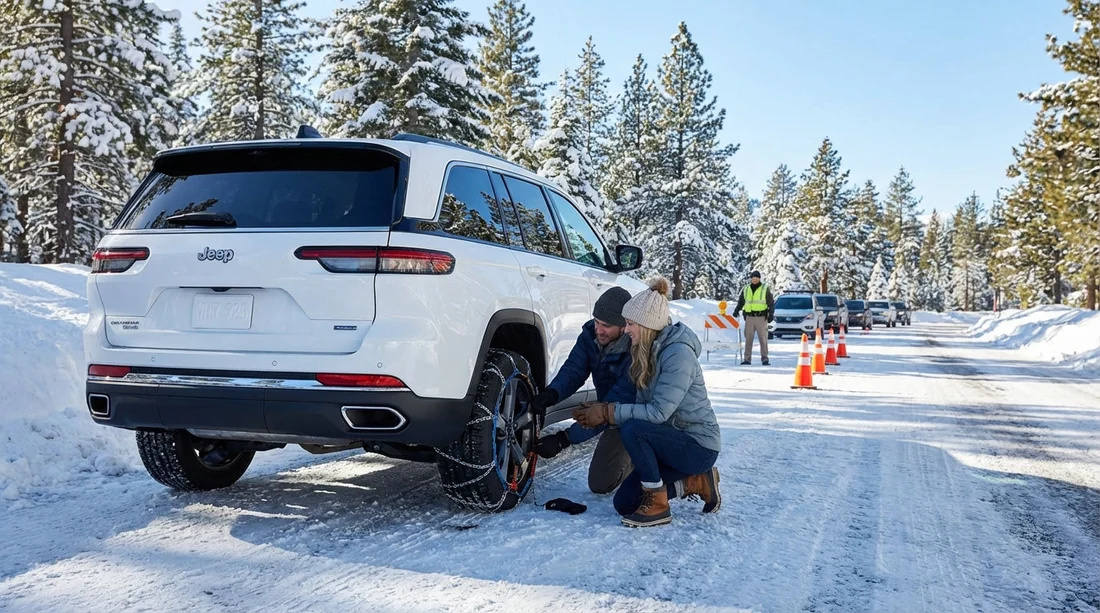
At a checkpoint you will usually see flashing signs, cones, and officers directing traffic into lanes. The interaction is typically brief, but it helps to be ready.
Expect to be asked: whether you have chains, whether they are fitted, and whether you have four-wheel drive or snow tyres. If chain control is active, they may visually check your tyres or look for chains on the drive wheels.
If you already have chains fitted: keep your window down slightly so you can hear instructions, and follow the officer’s hand signals. Do not remove chains the moment the road looks clearer, because icy patches often appear in shaded corners and bridges.
If you have chains but they are not fitted: you will typically be directed to a turnout to install them. Choose a safe, flat spot away from moving traffic, switch on hazard lights, and set the parking brake.
If you arrive without chains, your realistic options
This is the scenario that causes the most stress: sunny Los Angeles, then suddenly a checkpoint and an officer asking about chains. If you arrive without chains, here are the practical paths forward.
1) Turn around and buy chains lower down. During storms, shops near the base of the mountains often sell out, but you may still find stock in larger towns. Buying before you climb is usually cheaper and less chaotic than hunting near the checkpoint.
2) Use an alternate route, if open and appropriate. Sometimes the desert-side approach has lighter snowfall, or chain control begins later. However, do not rely on this as a guaranteed workaround. Chain control can be active on multiple routes at once.
3) Wait it out if conditions are worsening. If a storm is intensifying, chain control can shift from R1 to R2 quickly. Waiting for ploughs and a temperature change may be safer than pushing onward unprepared.
4) Do not assume you can hire chains at the checkpoint. Some areas have private sellers nearby during big weekends, but availability is unpredictable and prices can be high. Plan as if you must arrive self-sufficient.
5) If your hire agreement restricts chains, take it seriously. Some rental policies limit chain use or specify approved devices. If you are unsure, check your rental terms before you climb, and consider adjusting timing or destination if a major storm is forecast.
Detours, closures, and timing tips for the Big Bear winter drive
Even with chains, you should expect winter disruptions. Build extra time into your day, and avoid late-night arrivals if you are not confident fitting chains in the dark.
Leave early on peak weekends. Saturdays after fresh snowfall can bring long lines at checkpoints. An early start can mean less traffic and more daylight for chain installation.
Avoid tight itineraries. If you must check into lodging by a fixed time, give yourself a large buffer. Road closures for collisions are not rare during active snow.
Know when to stop climbing. If visibility drops, winds pick up, or you see multiple vehicles sliding, take the hint. Use a safe pull-off or a town stop to reassess conditions.
Carry a simple detour mindset. In winter, the best route is the one that is open, ploughed, and staffed. Be willing to reroute, or even switch to a lower-elevation plan for the day.
Driving technique with chains on mountain roads
Chains change how the car feels. Steering may feel heavier, and you will hear vibration and road noise. That is normal. What matters is smooth, predictable inputs.
Accelerate gently. Spinning tyres can snap chains or throw them off, especially if they are loosely tensioned.
Brake early and lightly. On steep descents, use lower gears where possible and keep braking smooth to avoid triggering skids.
Give other drivers space. Many drivers will be inexperienced, and sudden stops near bends are common.
Remove chains when appropriate. When you are back on clear pavement and chain control has ended, pull into a safe area and remove them. Driving on dry roads wears chains quickly and can damage the vehicle.
FAQ
Q: Do I need chains for a Los Angeles to Big Bear winter drive?
A: You should carry them. Chain control can be enforced on the climb even when Los Angeles is warm, and checkpoints can require you to fit them depending on conditions.
Q: Where are chain-control checkpoints usually located for Big Bear?
A: They are typically placed on the main climbs on SR-330 and SR-18, positioned where there are wide shoulders or turnouts for safe fitting. Exact locations vary by storm.
Q: What is the difference between R1, R2 and R3 chain control?
A: R1 requires chains for many two-wheel-drive vehicles, R2 requires chains for most vehicles except qualifying AWD or 4WD with snow tyres, and R3 requires chains for all vehicles.
Q: What should I do if I reach the checkpoint without chains?
A: Expect to be turned around or directed to leave the mountain to purchase chains. If conditions are severe, the safest option may be to wait and travel later rather than continue unprepared.
Q: Can I rely on four-wheel drive instead of carrying chains?
A: No. Four-wheel drive helps you move, but chain control can still require chains, especially at R2 and always at R3. Also, stopping distance remains limited on ice.





























































































