


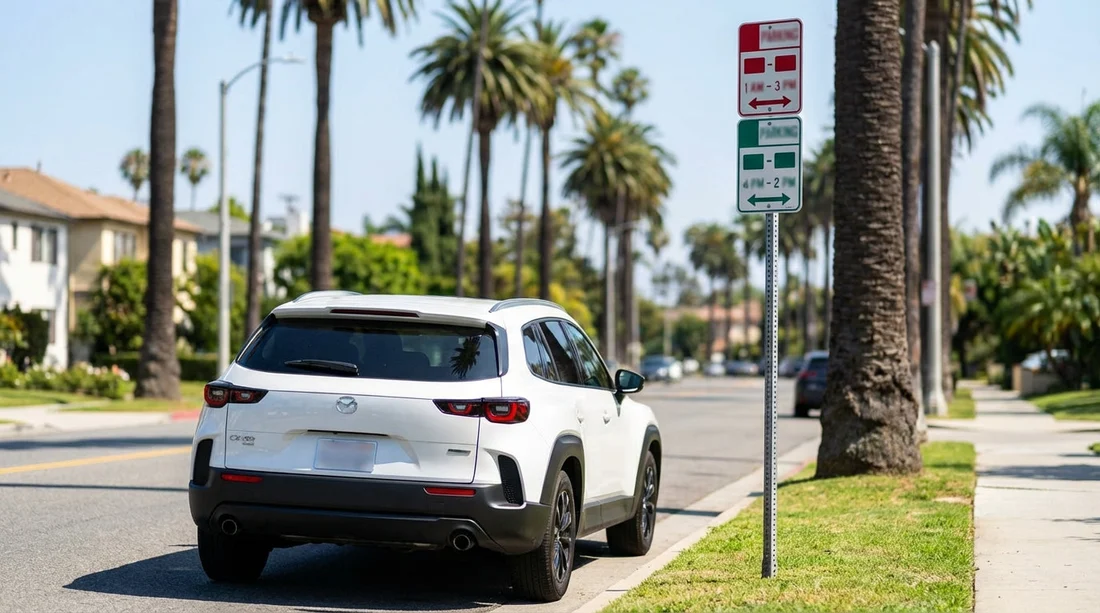
Quick Summary:
- Read all plates on the pole, then apply the strictest rule.
- Check permit exceptions carefully, they often change weekend time limits.
- Confirm street cleaning days and hours, even if 2-hour parking appears.
- Before walking away, photograph signs and note your arrival time.
Los Angeles parking signs look simple until you meet the classic combination, a green or white “2 HR PARKING” plate stacked with a “Permit exceptions” plate, plus street cleaning, plus a time-of-day restriction. At weekends, the confusion usually comes from assuming “weekend means free”, or missing that permit-only rules can still run on Saturdays, or reading only the first plate. With a car hire in Los Angeles, a few seconds of careful sign reading can save you a ticket and an interrupted day.
This guide breaks down how LA’s most confusing sign stacks work, and how to interpret them in the order the city effectively enforces them, the strictest applicable rule wins. It also includes a quick checklist you can run through on-street before you walk away.
Start with the golden rule, the strictest active rule wins
When multiple plates share a pole, you do not get to pick the one you like. You must follow every rule that applies at that time and day. If one plate says “2 HR PARKING 8AM-6PM” and another says “NO PARKING 7AM-9AM”, then between 7AM and 9AM you cannot park at all. From 9AM to 6PM, you may be limited to two hours, unless a permit rule replaces it.
For weekend parking, the biggest mistakes are ignoring time windows and assuming that if one plate does not mention Saturday or Sunday, it must not apply. In LA, plates often specify days. If days are not specified, read the entire plate carefully, because some signs imply daily restrictions, while others are clearly Monday through Friday. If you are unsure, treat it as active and pick a different space.
How to read “2-hour parking, permit exceptions” on one pole
“2 HR PARKING” usually means the general public can park for up to two hours during the posted hours. “Permit exceptions” means some permit holders can ignore that limit, often allowing longer stays or all-day parking, but only if they display the right permit for that zone.
Here is how to interpret common combinations you will see in Los Angeles:
Combination A: “2 HR PARKING 8AM-6PM” plus “EXCEPT WITH PERMIT”
During 8AM to 6PM, non-permit vehicles are limited to two hours. Permit holders may be allowed to exceed two hours, but only if their permit matches the zone and the wording. Outside those hours, parking may be unrestricted unless another plate limits it.
Combination B: “2 HR PARKING” plus a separate plate naming a permit district
The district plate usually tells you which permits are valid. If you are in a car hire, assume you do not have a valid local permit unless your accommodation has arranged one. Do not gamble on “it looks like a resident area” because enforcement in dense neighbourhoods can be strict.
Combination C: “2 HR PARKING” plus “NO PARKING” time windows
The “NO PARKING” window overrides the two-hour rule. This is common near commuter corridors and shopping streets. At weekends, pay attention to whether “NO PARKING” includes Saturday, it often does.
Combination D: “2 HR PARKING” plus “NO STOPPING” or “TOW AWAY”
“No stopping” is the harshest, you cannot stop to wait. “Tow away” indicates the area is actively enforced for towing during stated times. If any plate indicates tow-away conditions that are currently active, choose another space.
Decoding days, times, and the weekend trap
LA sign plates often compress a lot of information into short lines. Use this reading order:
1) Identify the days first. “MON-FRI”, “SAT”, “SUN”, “EXCEPT SUNDAY”, or “DAILY” changes everything. A two-hour limit that is only “MON-FRI” may be irrelevant on Sunday, but street cleaning might still run on Saturday on that same block.
2) Then read the time window. Many drivers see “2 HR PARKING” and miss the time range. If it says “8AM-6PM”, the two-hour clock only matters within that window.
3) Then look for permit language. “EXCEPT WITH PERMIT” does not grant you extra time, it grants permit holders extra time. If you do not have one, treat the limit as normal.
4) Lastly, check arrows. Arrows indicate which direction along the kerb the rule applies. If two plates have arrows pointing opposite directions, you may be at the boundary where rules change mid-block.
Weekends add a specific trap, some restrictions are posted as “MON-FRI”, but permit zones may still be enforced on Saturday in certain neighbourhoods. If you are visiting beaches, popular hikes, or shopping areas, assume weekend enforcement is common, and always verify the days on each plate.
Street cleaning signs often overrule everything
Street cleaning is one of the most ticketed issues for visitors, because the restriction may only be a short window once or twice a week, and it can appear on a separate plate. If street cleaning is active, you cannot park there, even if another plate suggests two-hour parking.
What to look for:
Posted weekday and time, often early morning. Some blocks have different cleaning days on each side of the street, so do not assume because the opposite kerb is clear you are safe.
“NO PARKING” for sweeping sometimes appears with a street name or zone note. If the time window overlaps with your planned stay, it is not worth the risk, even if you will “only be a few minutes”.
Temporary no-parking notices are sometimes posted for filming or works. Even without an external event, treat temporary notices as valid restrictions when they are clearly posted on the block.
Holidays, “except holidays”, and what it means for weekends
Holiday language is confusing because it can affect both time limits and enforcement days. If a plate says “MON-FRI EXCEPT HOLIDAYS”, it means the restriction is not enforced on the specified holidays. But do not assume every observed holiday changes the rules the same way for every sign stack. Some plates will not mention holidays at all, and those restrictions may still apply.
For practical weekend planning, treat holidays as a special case. If you park on a day that might be a public holiday, read each plate carefully for “EXCEPT HOLIDAYS” language. If none of the restrictions mention holidays, assume they still apply. This conservative approach is particularly useful when you are unfamiliar with local holiday observance patterns.
The permit exception details that catch visitors
Permit exceptions can be very specific. Here are the details that most often lead to tickets:
Zone matching. A permit must match the exact district. “Preferential Parking District” areas may have letters or numbers. A permit from a different district is not valid.
Time-limited permits. Some visitor permits only allow longer parking during certain hours. The sign may say something like permit holders are exempt during posted times only.
Permit display rules. If permits are required, they typically must be visible. If you are in a car hire, do not expect any default permit to be included.
Boundary poles. At the start or end of a zone, a pole can list rules for each direction. If you park right near the pole, double-check which arrow covers your exact spot.
A quick on-street checklist before you walk away
Use this short routine every time you park in Los Angeles, especially at weekends when demand is high and sign stacks are dense:
Step 1: Look for multiple plates and read them all. Scan up and down the pole. If there is a second pole within a car length, read that too, because rules can change mid-block.
Step 2: Find any “NO PARKING”, “NO STOPPING”, or street cleaning window. If one applies now or will apply before you return, move the car.
Step 3: Confirm days and time windows. Make sure the current day is included in the restriction. If it says “MON-FRI”, verify it really excludes Saturday and Sunday.
Step 4: If you see permits mentioned, assume you do not qualify. Unless you have a confirmed matching permit, follow the non-permit rule.
Step 5: Start a timer for two-hour limits. Two hours passes quickly when you are sightseeing. Set a phone reminder for 15 minutes before expiry.
Step 6: Take a clear photo of the sign stack and your position. Capture the arrows, times, and any nearby pole if rules differ. This does not guarantee cancellation, but it helps if you need to review what you missed.
Common weekend scenarios in Los Angeles, decoded
Scenario 1: Visiting a café on Saturday, sign says “2 HR PARKING 8AM-6PM EXCEPT WITH PERMIT”.
If it is within 8AM to 6PM on Saturday and the sign includes Saturday, you get two hours. If Saturday is not listed, verify whether the restriction is weekday-only. If any permit district plate is present, it does not help you unless you have that permit.
Scenario 2: You arrive Sunday morning and see “NO PARKING TUE 8AM-10AM STREET CLEANING”.
On Sunday, that street cleaning plate is not active. But you still must check if any other plate creates a Sunday restriction, including permit-only Sundays near busy destinations.
Scenario 3: You park Friday evening under “2 HR PARKING 8AM-6PM” and plan to leave Saturday afternoon.
Outside the posted hours, the two-hour limit may not apply. But street cleaning, permit-only overnight rules, or morning restrictions could apply. Always check all plates for overnight and weekend coverage.
Scenario 4: You see arrows pointing different directions on the same pole.
Interpret each arrow separately. If your car is on the left side of the pole, and the “2 HR” arrow points right, it may not apply to you at all, or a different plate may apply instead. If you cannot confidently map arrows to your parking spot, move to a simpler sign area.
How this affects visitors using car hire in Los Angeles
With car hire, you may be parking in unfamiliar neighbourhoods where resident parking is heavily managed. Plan a little extra time for sign reading when you arrive. If you are picking up at the airport, it helps to choose a provider with clear local guidance and flexible plans, for example Los Angeles airport car rental options or car hire at LAX can be a useful starting point when comparing providers.
If your trip includes neighbouring Orange County, you might also be comparing pick-up points such as Santa Ana airport car rental or car hire at Santa Ana SNA, then driving into Los Angeles where signage is denser. In that case, be prepared for stricter and more layered kerb rules once you reach central areas and beach-adjacent districts.
When in doubt, reduce risk rather than interpret creatively
If a sign stack feels like a logic puzzle, it is telling you that enforcement is common and the rules are layered. The safest choices are to park where there is a single clear restriction, use an off-street car park, or choose a different block with simpler signage. Most tickets happen when a driver is in a hurry, reads only one plate, or assumes weekend leniency.
Use the strictest-rule approach, verify days and times, treat permits as “not for me”, and check street cleaning first. That combination will prevent most weekend parking tickets in Los Angeles.
FAQ
Do “2-hour parking” limits apply on Sundays in Los Angeles?
Only if the sign includes Sunday or indicates a daily restriction. Many plates specify “MON-FRI” or “MON-SAT”, so you must check the days line on the sign.
What does “Except with permit” mean for a visitor?
It means qualifying permit holders can ignore the posted limit, usually the two-hour cap. If you do not have the exact local permit for that zone, follow the non-permit restriction.
If street cleaning is posted, can I still park for two hours?
No. If the street cleaning “NO PARKING” window is active, you cannot park there at all, even if another plate offers two-hour parking at other times.
How do arrows on LA parking signs work?
An arrow shows the direction along the kerb where that plate applies. If arrows differ between plates, each rule may apply to a different stretch of the block.
What is the quickest way to avoid weekend tickets when using a car hire?
Read every plate on the pole, check days and time windows, then set a timer. If any rule is unclear or permit-based, choose a simpler space.





























































































