


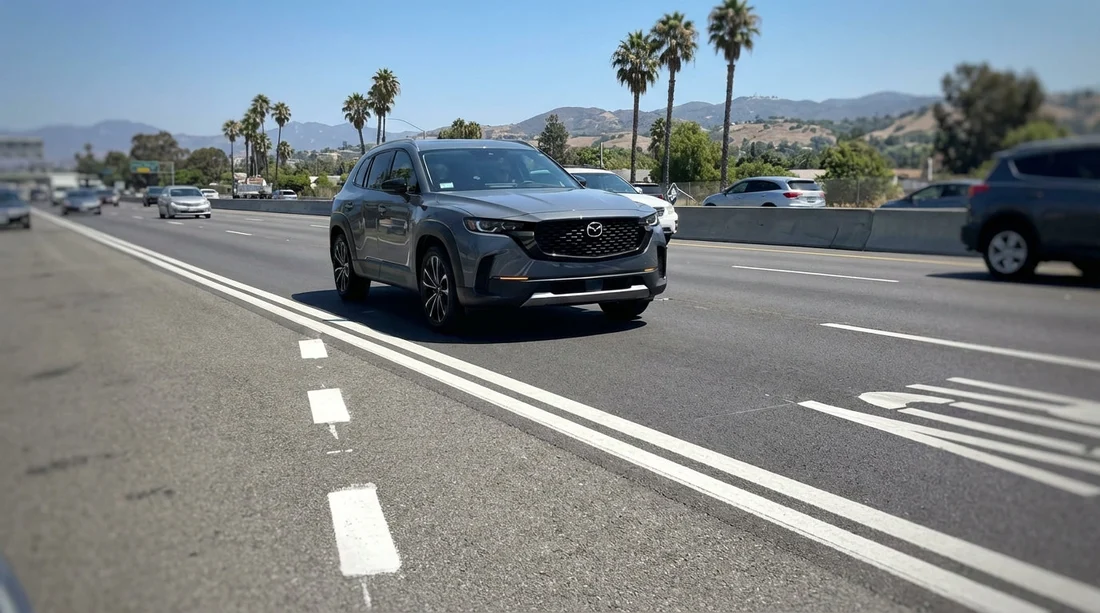
Quick Summary:
- Do not cross double white lines, wait for a marked opening.
- Enter only where the buffer breaks into dashed lines and signage permits.
- Plan early, move across gradually before the dashed section ends.
- Expect enforcement near interchanges, ramps, and sudden buffer-line changes.
California carpool lanes, also called HOV lanes, can save time, but they come with strict rules about when you may move in or out. The biggest point of confusion for visitors in a car hire is the pair of solid white lines between the carpool lane and the adjacent regular lane. Those “double white lines” are not just guidance, they are a no-crossing boundary.
This guide explains what the lane markings mean, exactly where you are allowed to enter and exit, and the common ticket traps that catch drivers who are unfamiliar with California freeways. The goal is simple, use the time-saving lane legally without making abrupt or prohibited moves.
What double white lines mean on California freeways
When you see two solid white lines running side by side between lanes, California treats that as a barrier you must not cross. In practice it works like a “do not change lanes here” rule, used to keep the carpool lane separated so traffic flows predictably and weaving is reduced.
You will most often see double white lines on major urban freeways where the HOV lane is on the far left. The carpool lane may also be labelled with a diamond symbol painted on the road, and there will typically be signs that say “Carpool Lane” or “HOV” along with the occupancy requirement (for example, 2+ or 3+).
Key takeaway, if the boundary is double solid white, you must stay in your current lane. Even if the carpool lane looks empty and you want to slip in for a mile, crossing those lines can lead to a citation.
Where you can legally enter and exit the carpool lane
California provides authorised “entry and exit zones” that interrupt the double white lines. Instead of two solid lines, you will see broken white lines, sometimes with wider spacing, creating a clearly marked opening. These are the only normal places where you should move between the general-purpose lanes and the carpool lane.
To do it legally and smoothly:
1) Scan ahead for the broken-line opening. You will often get advance signage, but the easiest cue is the road marking itself. Once you see the double white buffer change to broken lines, that is your window.
2) Set up early in the lane next to the buffer. If you are two or three lanes away, start moving over well before the opening. Drivers who rush across multiple lanes at the last second are more likely to miss the opening or make unsafe manoeuvres.
3) Change lanes within the broken-line section, not after it. Wait until you are aligned with the broken lines, signal, check mirrors and blind spot, then move across. If you are already past the opening and the double whites resume, continue in your lane and wait for the next authorised zone.
4) Exit the same way, through the next broken-line opening. If your off-ramp is coming up, you may need to leave the carpool lane earlier than you expect, because the next opening might be well before your interchange.
How visitors can spot authorised entry zones quickly
If you are new to California driving, especially in a car hire, the best strategy is to treat the carpool lane like a “gated lane”. You only use it if you can see the gate open.
Use these quick visual checks:
Look for the boundary change. The most reliable sign is the transition from double solid white to broken white lines. If it is still solid, do not cross.
Watch for frequent patterning near interchanges. In many areas, you get an opening, then a long stretch of double whites, then another opening. If you missed the last one, do not try to correct it illegally.
Know that some areas use a single solid line too. Some segments use a single solid white line separating lanes. While the double white is the clearest “never cross” marker, treat any solid separation into an HOV lane with caution and wait for an obvious broken-line entry area.
Do not rely on traffic behaviour. Locals sometimes cross late or illegally. Following them can still get you ticketed, and enforcement often focuses on predictable problem spots.
Common ticket traps around double white lines
Crossing double white lines is one of the most common HOV-related mistakes. Below are situations that create the most citations, particularly for visitors who are concentrating on navigation or unfamiliar exits.
Exiting too late for an interchange. Drivers stay in the carpool lane to the last moment, then realise the off-ramp is approaching and cut across the double white lines. If your route requires a right-side exit, start planning early. The carpool lane is far left, so you may need multiple lane changes and time to merge.
Entering early to skip a queue at a ramp. At some locations, the general lanes slow near an interchange. It can be tempting to hop into the carpool lane across double whites to bypass congestion, then hop back out. Those are exactly the places where police and CHP motor officers often watch.
Confusing special access lanes with normal HOV access. In some corridors there are dedicated connectors or express lanes. A marked connector is not an invitation to cross any solid buffer early. Stay with your lane markings and signage, and if uncertain, continue legally and reroute rather than make a prohibited move.
Focusing on occupancy but forgetting the markings. Even if you qualify with the right number of occupants, you still must use the correct entry and exit points. The violation is the lane crossing itself, not only whether you belong in the lane.
Assuming the lines are “advisory” at low speeds. Stop-and-go traffic does not change the rule. Crossing double white lines is still treated as an illegal lane change.
HOV lane basics that affect legal entry and exit
Double white lines are only one part of legal carpool lane use. Visitors should also keep these points in mind because they influence when you should choose the carpool lane at all.
Check the posted occupancy rule. Requirements vary by corridor and sometimes by time of day. If it says 2+ or 3+, the number of people in the vehicle must meet that minimum. Children count as occupants.
Check the operating hours. Some carpool lanes are active only during peak hours, others are 24/7. The sign will tell you. If the lane is restricted only at certain times, the entry and exit markings still matter, but you may be allowed to drive the lane as a normal lane outside those hours. Follow the signs for that specific freeway segment.
Look for other restrictions, including tolling. Some “diamond lanes” are HOV, while other lanes are express lanes that may charge solo drivers and require a transponder. The markings and signage will indicate whether it is HOV-only, tolled, or both with special rules.
Motorcycles often have different access rules. If you are driving a car hire, this may not apply, but it is useful context when you see different vehicles using the lane.
Practical steps to avoid mistakes in a rental car
Visitors often juggle unfamiliar road layouts, jet lag, and navigation prompts that arrive late. A few habits will reduce the chance of a costly lane-change error.
Use navigation with lane guidance, but do not follow last-second prompts. If your map tells you to take an exit in half a mile and you are in the carpool lane behind double whites, assume you may need to wait for an opening. If there is no opening, continue to the next one, then adjust your route.
Leave the carpool lane earlier than you think. If you have a complex interchange ahead, exiting the HOV lane one or two openings early is usually safer than trying to time the last opening perfectly.
Assign one person to watch for markings. With two or more occupants, have the passenger help spot the broken-line entry zone and confirm when the buffer changes. This is especially useful around Los Angeles and San Jose where freeways can be busy and signage dense.
Choose a vehicle that keeps everyone comfortable and visible. Good outward visibility helps with safe lane changes within the authorised opening. If you are travelling with family or luggage, a larger option can make trips calmer, for example an SUV hire in California at LAX or a minivan rental in California at LAX depending on your group size.
Know your pickup location and first freeway segment. Many visitors encounter HOV rules immediately after the airport. If you are landing in Southern California, it helps to review your route from car hire at Los Angeles LAX. For Northern California arrivals, routes from car hire in San Jose SJC often place you onto multi-lane freeways quickly.
These small preparations keep you from making rushed decisions that lead to crossing double white lines, missing an exit, or cutting across traffic.
What to do if you accidentally miss the authorised opening
If you realise you need to exit the carpool lane but the double white lines have already resumed, the legal move is to stay in the lane and wait for the next broken-line opening. Do not stop, do not straddle the lines, and do not force your way out across the buffer.
If the next opening will make you miss your planned exit, take the next exit instead and let navigation reroute you. In California, taking an unplanned exit is usually cheaper and safer than a citation or a collision.
Does it change near airports and major cities?
The rules do not change, but the environments around Los Angeles, San Jose, and Sacramento make the markings feel more stressful. Interchanges are frequent, signage can arrive quickly, and traffic density makes lane changes harder. That is exactly why California uses long stretches of double white buffer, to reduce chaotic weaving near ramps.
If you are starting your trip near Sacramento and travelling as a group, a larger vehicle can help passengers stay comfortable while you focus on lane discipline. Options like minivan rental at Sacramento SMF are popular for family road trips where meeting carpool occupancy is straightforward.
FAQ
Q: Can I ever cross double white lines to enter or exit a California carpool lane?
A: No. Double solid white lines mean you must not change lanes across them. Enter and exit only where the buffer changes to broken white lines.
Q: How do I know where the legal entry zone starts and ends?
A: Watch the lane boundary. The legal zone is the section where the two solid lines turn into broken white lines, creating a marked opening between the carpool lane and the adjacent lane.
Q: What if I am in the carpool lane and my exit is coming up?
A: Leave the carpool lane at the next authorised broken-line opening, even if it feels early. If you miss the last opening, stay in the lane and reroute rather than crossing the double white lines.
Q: Do the rules still apply when traffic is crawling or stopped?
A: Yes. The prohibition on crossing double white lines applies regardless of speed or congestion, so wait for the marked opening before changing lanes.
Q: If I qualify for the HOV lane with enough passengers, can I cross the double whites?
A: No. Meeting the occupancy requirement lets you use the lane, but you must still enter and exit only at designated broken-line sections.





























































































