


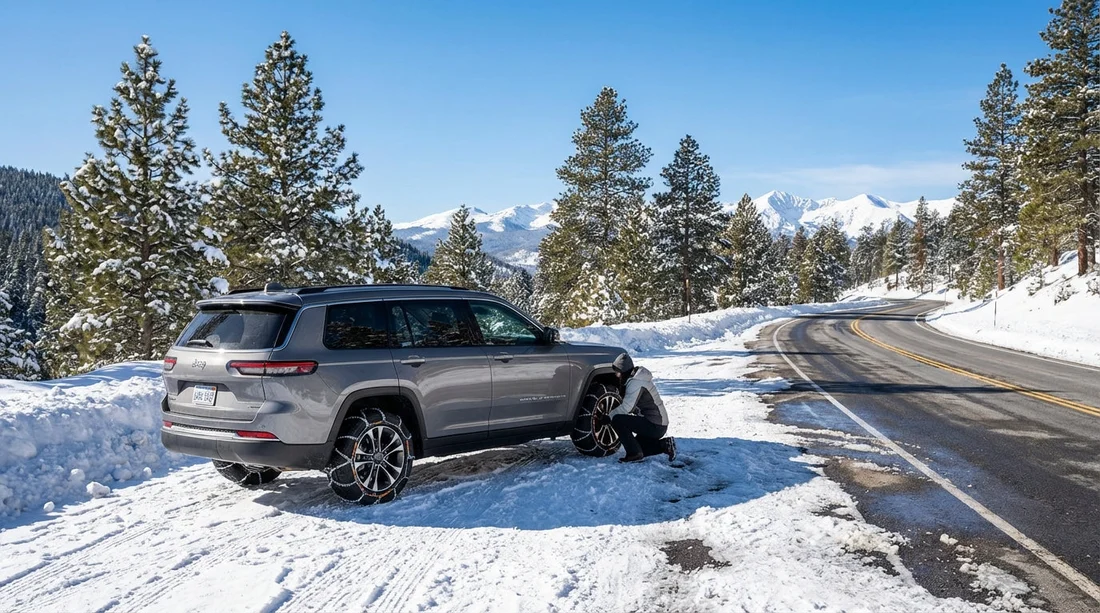
Quick Summary:
- Check chain-control level signs early, then decide whether to continue.
- Use signed chain-install areas or wide turnouts, never narrow shoulders.
- Know R1, R2 and R3 rules before leaving Sacramento and the foothills.
- If your car hire restricts chains, switch routes, timing, or vehicle class.
A winter drive from San Francisco to Lake Tahoe can be straightforward, but storms and chain control can change your plan quickly. If you are travelling with a car hire, you also need to manage rental contract rules, tyre equipment, and where it is safe to pull off. This guide walks you through what chain-control levels mean in California, how to spot them on the road, where to stop safely to fit chains, and what to do if your rental agreement limits chain use.
Most visitors reach Tahoe via I-80 (to Truckee, North Lake, and parts of South Lake via Hwy 89) or US-50 (to South Lake Tahoe). Both corridors climb rapidly after the Central Valley, where temperatures can drop and pavement conditions change fast. The best approach is to treat chain control as a predictable workflow: check conditions, read the signs, decide early, and stop only in places designed for it.
Before you leave SF: set up your chain-control game plan
Start with the basics: ensure your car hire has suitable tyres for winter travel, know whether it is front-wheel drive, rear-wheel drive, all-wheel drive (AWD) or four-wheel drive (4WD), and confirm what the rental contract says about chains. Some agreements allow chains but only on certain tyre sizes, some allow only cable devices, and some restrict any chain use. If the contract prohibits chains, you need a plan that avoids chain-controlled conditions entirely or uses transport alternatives on storm days.
In California, chain controls are enforced by the California Highway Patrol (CHP) and Caltrans, and the terminology can appear on portable electronic message boards, roadside placards, and staffed checkpoints. Aim to check conditions before you reach the foothills, because once you are climbing and traffic slows, it becomes harder to turn back safely.
If you are collecting a vehicle near a major airport, you may see different winter readiness by fleet and vehicle category. For context on vehicle options and local pick-up points, browse Hola Car Rentals pages such as car hire California LAX if you are comparing starting locations, or car rental Sacramento SMF if you plan to stage your Tahoe run from Sacramento to shorten the mountain segment.
Step 1: Learn what R1, R2, and R3 actually mean
Chain control is commonly communicated using three levels. Exact wording can vary by signboard, but the practical meaning is consistent.
R1, chains required except 4WD/AWD with snow tyres. Under R1, 2WD vehicles must fit chains (or cables) on the drive wheels. Many 4WD/AWD vehicles can proceed without chains only if they have snow tyres with adequate tread. If you are in a typical hire car with standard all-season tyres, do not assume you qualify for the exemption, especially if you cannot confirm tyres are marked for snow service. If you are unsure, treat it as “chains needed”.
R2, chains required for most vehicles. Under R2, chains are required on all vehicles except 4WD/AWD with snow tyres on all four wheels. Even then, Caltrans sometimes recommends carrying chains because conditions can worsen. For car hire drivers, R2 is often the decision point: if you cannot legally or contractually fit chains, you should not continue into the control zone.
R3, chains required on all vehicles, no exceptions. Under R3, every vehicle needs chains. This level is uncommon but happens in severe storms. If you are in a rental that restricts chains, R3 is effectively a stop and wait, or turn around when safe and legal. Even if your contract allows chains, you must be confident fitting them correctly, because mistakes can damage the vehicle and create hazards.
Remember that “4WD” on a badge is not a pass. You still need suitable tyres and sometimes chains, and you must follow checkpoint instructions. The safest mindset is to consider chain control a legal requirement, not a suggestion, and to decide early while you still have options.
Step 2: Spot chain control signs early, and read them like a checklist
On I-80 and US-50, you will typically see a sequence: advance warning signs, then a message board showing the current level, then a checkpoint or enforcement area. The key is not just reading “R2”, but recognising what it implies for your exact vehicle.
Use this quick checklist each time you see a chain-control sign:
1) Confirm your drivetrain. If you are in 2WD, assume you must fit chains at R1 and above.
2) Confirm tyres. Unless you are certain you have snow-rated tyres, do not assume an exemption.
3) Confirm your chain equipment. If you have approved chains or cables, verify size and that they fit the driven wheels.
4) Confirm your contract rules. If chains are restricted by your car hire agreement, make a conservative decision now, before the control zone begins.
5) Decide where you will pull off. Plan to stop only in designated chain installation areas or wide, safe turnouts.
If you are unsure about any item, the lowest-risk option is to stop before the control zone and reassess. Do not wait until you are already on steep grades with limited shoulder space.
Step 3: Where to stop safely to fit chains, and where not to
The most common winter breakdown scenario is not an engine issue, it is a rushed chain installation on an unsafe shoulder. Safe pull-offs are part of your plan.
Best places to stop:
Signed chain installation areas. These are designed for safe off-road positioning, and you are more likely to have space, lighting, and other drivers moving slowly.
Large car parks near the last services before the pass. If conditions are deteriorating, fitting chains earlier in a flat, well-lit area is often safer than waiting until you are forced to stop on a grade.
Wide turnouts that are fully off the travel lane. If a turnout allows your whole vehicle to be clear of traffic and the surface is stable, it can work, but only if it is not already clogged with vehicles.
Places to avoid:
Narrow shoulders and bridge approaches. They leave no room for error and are exposed to fast-moving traffic.
Curves, crests, and shaded corners. Visibility is poor, and black ice is more likely.
Any spot where your vehicle cannot sit flat. Jackknifing or sliding while you work is a real risk.
Active lanes near checkpoints. If you miss the chain area, do not stop in a live lane. Continue to the next safe area if permitted.
When you do stop, make yourself predictable. Put hazard lights on, position the vehicle fully off the roadway, and keep passengers inside with seatbelts fastened until you are ready. Only one person should work outside at a time if space is tight, and they should stay on the side away from traffic whenever possible.
Step 4: Fitting chains without damaging the car hire vehicle
Damage from incorrect chain use is one reason many car hire agreements restrict them. To reduce risk, follow a careful routine.
Choose the correct axle. Chains go on the driven wheels. For most standard hire cars that is front-wheel drive, so chains go on the front tyres. Some vehicles have specific restrictions in the owner handbook, which may be in the glovebox or on the infotainment screen.
Practise the layout before you are cold and rushed. At a safe stop, lay the chains out and untangle them. Make sure the cross links are not twisted.
Fit, then roll, then re-tighten. After fitting, drive a short distance at very low speed in a safe area, then stop and tighten again. Loose chains can whip the wheel arch and cause expensive damage.
Drive slowly and smoothly. Chains are for traction, not speed. Sudden acceleration can break links and damage the vehicle.
Remove them as soon as you are on clear pavement. Driving on bare roads wears chains quickly and increases the chance of damage. Look for “end chain control” signs, then pull off in a safe spot to remove them.
If you are not confident doing this, consider delaying travel until conditions improve, or use a vehicle class that is more winter-capable. Larger vehicles can offer better stability and clearance, and travellers sometimes compare options like SUV rental categories versus compact cars when planning winter mountain routes, even if the pick-up location differs from your trip.
Step 5: What if your rental contract restricts chains?
This is common, and it is manageable if you decide early. If your car hire agreement restricts chains or prohibits them entirely, you have four practical options.
1) Adjust timing to avoid chain-control windows. Storm systems often have clear periods between them. If chain control is active, waiting a few hours, or travelling the next day, can turn an impossible drive into a normal one. Build flexibility into your Tahoe itinerary in winter.
2) Change route, but do not gamble. Alternate highways can be lower, but in major storms they also get controls or closures. Do not assume a different pass will be chain-free. If you must avoid chains, your route choice should be based on current restrictions, not hope.
3) Change vehicle class where possible. If you have not yet collected the car, consider a vehicle more likely to be equipped appropriately for winter travel. If you are travelling with a larger group, a van hire Sacramento SMF option could be useful from a staging city, but you still need to comply with chain-control rules and tyre requirements.
4) Use local transport in severe conditions. On heavy snow days, it can be safer to park in a lower-elevation town and use shuttles or other services into Tahoe, rather than risking chain installation conflicts with your contract. This can also reduce the chance of getting stuck during intermittent road closures.
Whatever you choose, do not attempt to bypass checkpoints or continue into an R2 or R3 zone without the required equipment. Aside from fines, you can be turned around in difficult conditions, and you may also invalidate insurance coverage if you breach contract terms.
Step 6: A simple SF to Tahoe winter decision flow
Use this step-by-step flow on your travel day:
1) Before departure: confirm weather along I-80 or US-50, check if chain controls are posted, and read your rental chain policy.
2) In the Central Valley: top up fuel, screenwash, and snacks, and set your first safe stop option.
3) At the first chain-control warning sign: decide whether you can comply if the level increases.
4) At a chain installation area: stop early if you need chains, or if you are uncertain.
5) At the checkpoint: follow instructions, keep speeds low, and leave extra stopping distance.
6) After the pass: remove chains when safe and legal, then continue cautiously because shaded sections can refreeze.
If your broader California itinerary includes other airports, Hola Car Rentals location pages like car hire airport San Diego can help you compare pick-up and drop-off planning, but for Tahoe in winter, the critical factor remains chain compliance and safe pull-offs.
FAQ
What does “chain control” mean in California? It means Caltrans and CHP require traction devices or specific tyre setups in a defined road segment due to snow or ice. You must follow the posted level and checkpoint instructions.
Do I need chains for Lake Tahoe if I have AWD? Sometimes. Under R1 or R2, AWD may proceed without chains only if you have snow tyres on all four wheels and meet tread requirements. If you cannot confirm your tyres, assume you may need chains.
Where is it safe to put chains on near Tahoe routes? Use signed chain installation areas, large car parks, or wide turnouts where your whole vehicle is off the roadway. Avoid narrow shoulders, curves, crests, and bridge approaches.
What should I do if my car hire agreement forbids chains? Do not enter an R2 or R3 control zone. Wait out the storm, change your travel day, consider a different vehicle class before collection, or use alternative transport into Tahoe during severe conditions.
Can I drive fast with chains fitted? No. Drive slowly and smoothly, avoid sudden braking or acceleration, and remove chains once you reach clear pavement to prevent damage and loss of control.





























































































