


Quick Summary:
- Stop in both directions on undivided roads when the red lights flash.
- On a divided highway, stop only if you are behind.
- Do not pass until the stop arm retracts and lights stop.
- Expect camera enforcement and fines, even in a rental car.
If you are visiting Orlando on car hire, few rules are as strict, and as heavily enforced, as what to do when a school bus stops with red lights flashing. Florida treats passing a stopped school bus as a serious safety risk because children may cross the road unexpectedly. The result is a clear stop requirement in many situations, plus growing use of stop arm cameras that can generate a notice even when a police officer is not present.
This guide is a practical decision tool. It focuses on the situations most likely to confuse visitors: two-lane roads versus multi-lane roads, and when a median or physical barrier changes the rule. It also explains how camera enforcement works, what fines typically look like, and what to do in the moment so you avoid a costly mistake.
If you picked up your car at the airport, it is worth taking five minutes to review these rules before you leave the complex. Visitors collecting vehicles via car hire at Orlando Airport often go straight from unfamiliar airport roads to busy arterials, where school buses are common on weekday mornings and afternoons.
What counts as a stopped school bus you must obey?
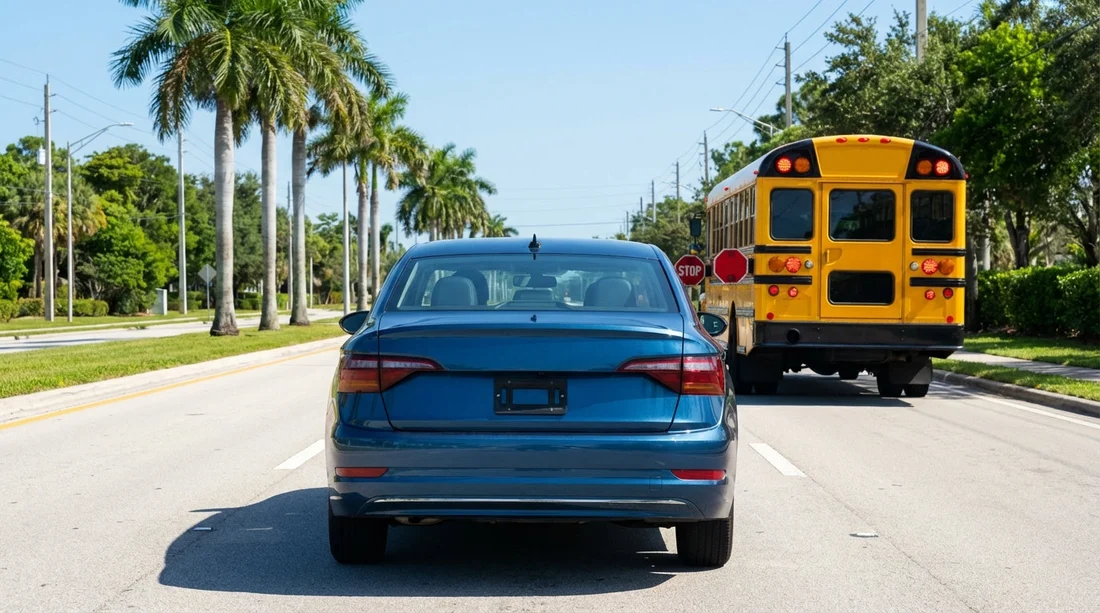
In Florida, you must treat a school bus as “stopped for children” when it displays flashing red lights and extends (or is in the process of extending) its stop arm. Amber lights are the warning phase, the bus is preparing to stop. Red lights mean stop now. If you see the bus slowing with amber lights, reduce speed and prepare to stop, because the bus may stop more abruptly than you expect.
Key point for car hire drivers: you are responsible for recognising the signals, even if you do not understand the route. Do not rely on the behaviour of the vehicle in front, because locals also make mistakes, and camera enforcement is based on your vehicle’s movement relative to the bus, not on whether traffic around you also violated.
Decision guide: must I stop, or can I proceed?
Use this step-by-step check. When in doubt, stop. The safest choice is usually obvious once you categorise the road correctly.
Step 1: Are the school bus red lights flashing?
If the bus has amber lights only, do not pass at speed. Slow and be ready to stop. Once red lights flash, you must stop in the situations described below. If you are already alongside the bus when the lights change, continue carefully rather than stopping abruptly in the bus’s blind spot, but do not accelerate to “beat” the stop.
Step 2: Is the roadway undivided or divided?
This is the most important distinction.
Undivided road (no median or barrier): Traffic in both directions must stop when approaching a stopped school bus with red lights and stop arm. This includes typical two-lane roads, but also multi-lane roads that still lack a median or barrier. In other words, extra lanes do not automatically make it “divided”. If there is just paint in the centre, you should assume it is undivided.
Divided highway (raised median, grass median, or physical barrier): Traffic moving in the opposite direction, on the other side of the divider, is generally not required to stop. Traffic behind the bus in the same direction must stop, as always. For visitors, the easy memory rule is: if a child would have to cross a physical divider to reach you, you are typically not required to stop when travelling the opposite way.
Common Orlando scenarios, simplified
Scenario A: Two-lane road, one lane each way. You must stop, whether you are behind the bus or coming towards it, as long as there is no physical divider. This is where many visitors make the worst mistake, passing a bus head-on because they assume only the cars behind it need to stop.
Scenario B: Four-lane road, two lanes each way, no median. You must stop in both directions. The presence of two lanes does not matter, the absence of a divider does.
Scenario C: Multi-lane road with a raised median, grass strip, kerb, or barrier. If you are behind the bus, stop. If you are approaching from the other side of the median, you can proceed carefully, but watch for pedestrians and obey any other traffic control devices.
Scenario D: Turn lane only (painted centre lane), no physical divider. Treat this as undivided. Painted turn lanes and double yellow lines do not create a “divided highway” for this rule.
Orlando has a mix of wide arterials and smaller resort-area roads. If you are driving a people carrier or larger vehicle, make sure you can see far enough ahead to spot the bus lights early, especially if you arranged a larger vehicle through van hire in the Orlando Disney area and need a bit more stopping distance.
How to stop correctly, and when you may move again
Stopping is not just about tapping the brakes. You should stop at a safe distance behind the bus, far enough that the bus driver can see your vehicle. Avoid stopping too close to the rear bumper, especially if the road is sloped.
Do not proceed until: the bus stop arm is fully retracted and the red lights are no longer flashing. Many violations occur because drivers creep forward while the red lights are still active, or they move as soon as children step onto the kerb, even though the bus is still signalling a stop.
Never pass on the right shoulder to get around a stopped bus. In Florida, using the shoulder to pass is dangerous and can add separate violations on top of the school bus offence.
Be cautious at intersections. If the bus stops near a junction, you still have to stop as required. Do not enter the intersection to turn across the bus’s stop zone. If you are already in the turn lane when the bus activates its red lights, stop before the crosswalk or stop line if you can do so safely.
What are the fines for passing a stopped school bus in Florida?
Fines vary by county and situation, and they can change over time, but visitors should plan on a meaningful penalty. In Florida, passing a stopped school bus is commonly treated as a moving traffic violation, and in the most serious cases it can be charged as a criminal offence depending on circumstances and injuries.
For many routine cases, drivers often see a base fine that can be in the hundreds of dollars once fees and surcharges are included. Some areas publish set amounts for camera-issued notices, and these can still be several hundred dollars. If a violation involves passing on the side where children are entering or exiting, or it creates a close call, the consequences can escalate quickly.
Also consider the practical costs for car hire customers: administrative fees may apply if the rental company has to process a notice, identify the driver, or handle correspondence. Those fees are separate from the government fine.
If you are renting from a known brand at the airport, such as via Hertz at Orlando MCO, the rental agreement typically explains how tickets and camera notices are handled, including any administration charges. Reading that section once can prevent surprises later.
Why these violations can be camera-enforced
Florida has allowed the use of school bus stop arm cameras in many districts. These systems mount cameras on the bus, and when the stop arm is out and red lights are active, they record vehicles that pass the bus unlawfully. The footage can capture the vehicle, position relative to the bus, and the number plate.
What this means for visitors: you may receive a notice after your trip, even if you were never pulled over. It is common for enforcement to be based on a review process rather than an officer witnessing it roadside.
Why it matters in a rental car: the notice typically goes to the registered owner first, which is the rental company. The rental company can then provide renter details, or in some cases pay and recharge, depending on the agreement and local procedure. Either way, camera enforcement reduces the odds of “getting away with it”, which is why relying on other drivers’ behaviour is risky.
Visitors arranging Payless near Disney Orlando MCO or any other provider should assume that camera enforcement can still reach them after the trip, because the plate is what matters, not whether you are a local resident.
Practical tips to avoid a costly mistake in Orlando
Expect buses on weekdays, but do not relax on weekends. School activities still run on some weekends, and there are also private and daycare buses that may follow similar stopping patterns.
Scan far ahead on wide roads. On larger arterials, a stopped school bus can blend into traffic until you notice the red flash. Look for a cluster of brake lights ahead, then confirm whether it is a bus stop event.
Do not “follow the median myth”. A painted centre line is not a divider. If you cannot point to a raised median, grass strip, kerb, or barrier, assume you must stop in both directions.
Be careful with right turns on red. If a bus is stopped with red lights in your direction of travel, do not turn past it unless you can do so without passing the bus and without violating the stop requirement. When unsure, wait.
Give yourself time in resort areas. Rushing to a park opening makes risky decisions more likely. Build a small buffer into your day, particularly if you are navigating unfamiliar routes from Orlando to Disney-area hotels.
If you are still deciding which pickup option suits your trip, Hola’s Orlando pages can help you compare arrangements, for example car hire at Orlando MCO and related options, without changing the basic safety rule: when the bus tells traffic to stop, you stop.
What if a police officer directs traffic differently?
Follow lawful directions from a police officer or traffic controller, even if they seem to conflict with the usual stop requirement. This is rare for school bus stops, but it can happen near special events or roadworks. If there is no officer directing you to proceed, follow the bus signals and the road type rules above.
FAQ
Q: Do I have to stop on a four-lane road in Orlando?
A: Yes, if the road is not physically divided. Two lanes each way without a raised median or barrier still requires both directions to stop for a bus with red lights.
Q: If there is a grass or raised median, can I keep driving the opposite way?
A: Generally yes. On a divided highway, the oncoming side across the median usually does not have to stop, but traffic behind the bus in the same direction must stop.
Q: When can I move again after stopping for the bus?
A: Wait until the red lights stop flashing and the stop arm is retracted. Do not creep forward while the stop arm is still out.
Q: Can I be fined if nobody was pulled over at the scene?
A: Yes. Florida districts can use stop arm cameras to record violations and issue notices after review, including for vehicles on car hire.
Q: What happens if the notice goes to the rental company?
A: The rental firm may transfer liability by providing your details, or may process the notice and recharge you, often with an administrative fee, depending on the agreement.

























































































