


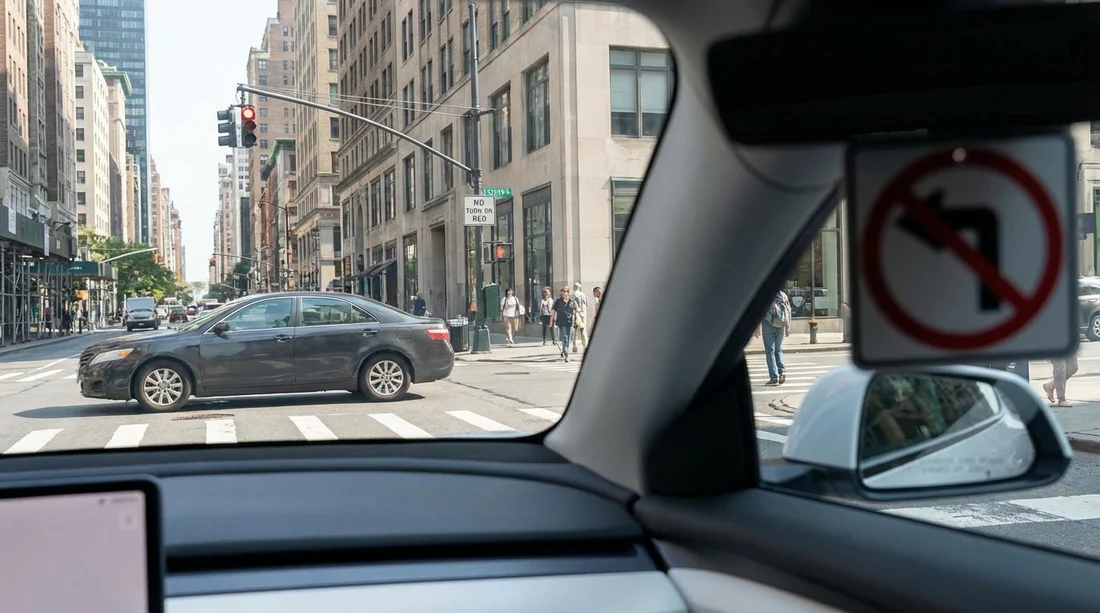
Quick Summary:
- In NYC, assume right on red is illegal unless a sign permits.
- Only turn on red where you see a “Right on Red After Stop” sign.
- Come to a full stop behind the line, then yield to all traffic.
- Watch for red-light cameras and officers at busy Manhattan intersections.
If you are arriving for New York car hire and planning to drive in Manhattan, Brooklyn, Queens, the Bronx, or Staten Island, the biggest rule that catches visitors out is simple: New York City generally bans turning right on red. In much of the United States, you can often turn right at a red light after stopping, but NYC is the standout exception. Misreading that difference can lead to an expensive, frustrating ticket, especially if you are unfamiliar with local signage and the pace of city driving.
The safest mindset is: in NYC, right on red is not a default permission, it is a rare exception. Treat every red light as a stop-and-wait situation unless a sign explicitly tells you the right turn is allowed on red after stopping. This approach keeps you legal, keeps pedestrians safe, and helps you avoid automated camera enforcement that does not care whether you were simply following the car in front.
NYC’s baseline rule: right on red is usually prohibited
New York State law allows localities to restrict right turns on red, and New York City does. That means the common “right turn on red after stop” practice you may have used elsewhere in the US is not a safe assumption once you cross into the five boroughs. For most intersections in NYC, if the signal is red, you must stop and wait for green before making your right turn.
This default ban is partly about pedestrian density and sightlines. At many NYC junctions, you have heavy foot traffic, cyclists filtering along the kerb, buses pulling in and out, and vehicles squeezing around double-parked cars. A driver creeping forward to look for a gap can easily block a crosswalk or miss a cyclist. The city’s rule aims to reduce that risk, and enforcement is taken seriously.
For travellers arranging car hire via airport locations, the rule becomes relevant quickly because driving routes into Manhattan often pass through busy signalised intersections. If you are collecting a vehicle at New York JFK car rental, expect NYC-style restrictions as soon as you are on city streets near neighbourhood shopping strips and arterial roads.
The rare exception: when right on red is allowed
So when can you legally turn right on red in NYC? Only when signage at that intersection explicitly permits it. The most common wording you will see is “Right on Red After Stop” or similar. If you do not see a sign that clearly authorises it, treat it as prohibited.
These permitted turns are not everywhere, and they can be inconsistent from one junction to the next. Two intersections a block apart can have different rules depending on pedestrian volume, crash history, street geometry, school proximity, or a dedicated turn lane setup. Relying on memory from a previous visit is risky, especially if you are driving a hire car and are focused on navigation.
Also note that some intersections will have signage that restricts turns during certain hours, for example during peak commuting times. If a sign indicates hours, follow them exactly. If the permitted window is not active, right on red reverts to prohibited.
How to spot a permitted right on red quickly
In New York, efficient sign spotting is a real driving skill. The key is to scan for turn-control signage as you approach the signal, not after you stop. Look on the signal pole, the mast arm, or nearby posts, typically at driver eye level or slightly above. The wording that matters is permission. If you see only “No Turn on Red”, it confirms the ban, but the absence of that sign does not mean the turn is allowed.
Use this simple sequence each time you approach a red light where you might want to turn right:
First, check for a dedicated right-turn lane and any sign governing it.
Second, look for pedestrian activity and bike lanes, since even a permitted turn still requires yielding.
Third, locate the stop line and crosswalk markings so you know where you must stop.
Fourth, only if you see an explicit permission sign, consider the turn after stopping.
This scanning routine matters because NYC has many intersections where buildings, parked trucks, scaffolding, or street trees can obscure signs until you are close. Slowing slightly on approach can improve visibility and reduce the temptation to creep into the crosswalk for a better view.
What “after stop” means in practice
Even where right on red is permitted, you must come to a complete stop before the stop line or crosswalk. A rolling stop can still earn a citation, and it also increases pedestrian risk. After stopping, you may proceed only if the way is clear, yielding to pedestrians crossing on a walk signal, cyclists travelling straight, and vehicles with a green light.
In NYC, yielding is not theoretical. Pedestrians often step off the kerb quickly when they have the signal, and cyclists may be moving faster than you expect, especially in protected lanes. If your view is blocked by a bus, a delivery van, or street furniture, the safe choice is to wait for green even if a sign permits right on red.
Be especially cautious with right turns onto one-way streets, which are common in Manhattan. The traffic flow may come from a direction you are not used to checking, and cyclists sometimes travel in lanes near the kerb or between lanes of traffic. The rule remains: you yield to any road user with priority, even if drivers behind you are impatient.
How tickets happen: cameras, officers, and “follow-the-leader” errors
NYC enforcement can be officer-led or camera-led. Red-light cameras are placed at many intersections, and while camera rules focus on vehicles entering an intersection on red, illegal right-on-red behaviour can still be cited depending on how the manoeuvre is captured and how the violation is defined at that location. Separately, officers may enforce turn restrictions at high-conflict junctions, particularly where turning traffic endangers pedestrians.
A common visitor mistake is following a local driver who turns right on red. Sometimes that driver is turning where it is actually permitted, but you have not seen the sign. Other times, they are simply breaking the rule. Either way, your hire car is the one recorded or stopped if you proceed illegally.
Another frequent cause is stopping past the line. Even if you do not turn, pulling into the crosswalk can create conflicts and may be ticketed. In NYC, being precise at stop lines is part of defensive driving, especially in congested areas where you may be tempted to edge forward for visibility.
Neighbourhood differences and routes from the airports
NYC’s rule applies across all boroughs, but your driving experience can differ dramatically by area. Midtown and Downtown Manhattan tend to have heavier pedestrian flows and more complex signal timing. Outer-borough commercial strips can have wide avenues and multiple turn lanes. Residential areas may have more stop signs and fewer signals, but still see heavy foot traffic near schools and parks.
If your trip starts outside the city and you are driving in from New Jersey, you may have spent time on roads where right on red is allowed as a default. That contrast is where mistakes happen, often right after you cross into NYC. If you are picking up outside the city, such as at Newark Airport car rental or browsing options like Hertz car rental in New Jersey, remind yourself before entering the city grid that NYC plays by a stricter turn-on-red rule.
The same applies if you are arranging larger vehicles for family travel. A longer wheelbase or reduced rear visibility can make tight right turns more demanding, and pressure from traffic can tempt a rushed turn. If you are comparing people-carrier options such as minivan hire near Newark, plan to drive even more conservatively in the city, because slow, deliberate turns reduce the chance of clipping a kerb, blocking a crosswalk, or missing a cyclist.
A quick checklist to avoid right-on-red trouble in your hire car
Assume it is banned. This one habit prevents most mistakes.
Search for permission, not prohibition. You need a sign that says the turn is allowed.
Stop before the line. If you cannot see, wait for green rather than creeping.
Yield completely. Pedestrians and cyclists can be close even when traffic looks clear.
Do not copy other drivers. Locals may take risks that visitors should not.
Keep navigation calm. If your sat-nav prompts a right turn, you can wait for green.
Finally, remember that city driving is about reducing decision load. In NYC, the simplest decision at a red light is often the correct one: stop, stay put, and go on green unless you are absolutely sure the intersection permits a right on red after stopping.
FAQ
Can I turn right on red anywhere in New York City? Generally no. In NYC you should only turn right on red where a sign at that intersection explicitly permits it, usually stating “Right on Red After Stop”.
What if there is no “No Turn on Red” sign? In NYC, the absence of a prohibition sign does not create permission. Treat right on red as illegal unless you see a sign that clearly allows it.
Do I have to stop even if the right on red is permitted? Yes. You must come to a complete stop behind the stop line or crosswalk, then proceed only if it is safe and you have yielded to pedestrians, cyclists, and traffic.
Will a red-light camera ticket me for a right on red? It can, depending on the intersection setup and how the manoeuvre is recorded and enforced. Even if a camera does not trigger, an officer can still ticket an illegal turn.
Does the NYC rule apply in all five boroughs? Yes. Manhattan, Brooklyn, Queens, the Bronx, and Staten Island follow the city rule, with exceptions only where signage specifically allows right on red.

























































































