


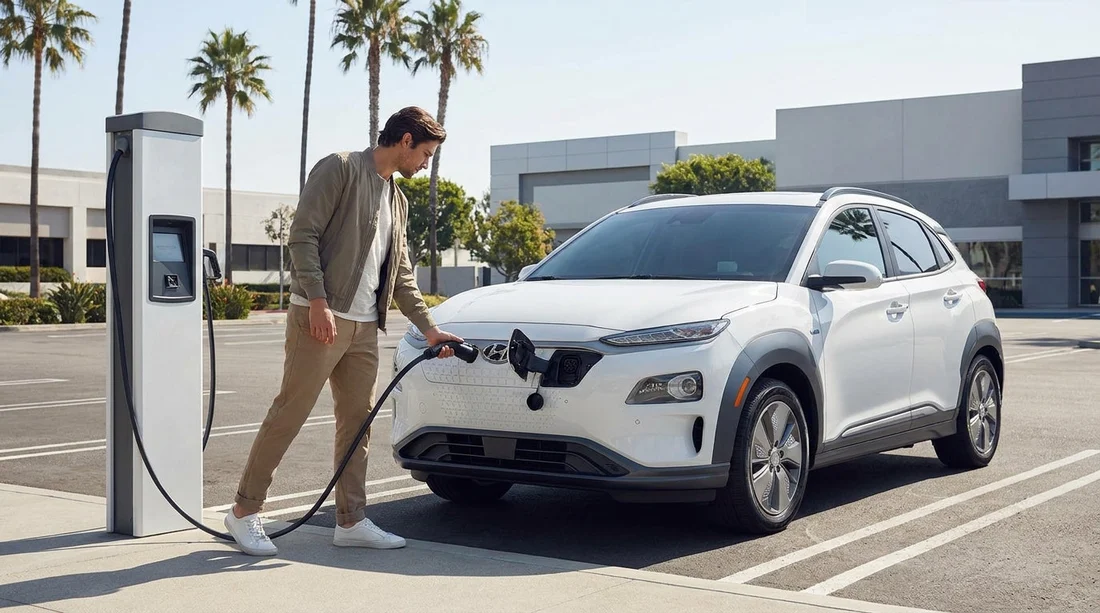
Quick Summary:
- Most EV rentals include a basic charging cable, but it is not guaranteed.
- Only pack a Type 1 J1772 cable if your rental confirms none.
- Plan apps and payments first, cables rarely help at DC fast chargers.
- Confirm connector type, included charging kit, and any fees before pick-up.
Picking up an electric vehicle for car hire in California often comes with one key question, do you need your own charging cable? For most travellers, the answer is no, because many rental EVs are supplied with a basic portable charging kit. However, what is included varies by rental brand, vehicle model, and location, so it is smart to confirm before you arrive, especially if your trip depends on overnight charging.
California has the widest EV charging coverage in the United States, with a dense network of public Level 2 chargers and DC fast chargers across cities and highways. That makes it easier to rely on public infrastructure, but it does not remove the need to understand connectors, included equipment, and any limitations in your rental agreement.
What cables are typically provided with an EV rental?
In California, many EV rental cars are handed over with a manufacturer-supplied portable charging cable, sometimes called an EVSE. This is the cable that plugs into a standard wall socket or, with the right plug head, a higher-power outlet. In rental terms it may be listed as a “charging kit” or “portable charger”.
Level 1 capability (standard wall socket) is the most common inclusion. It is slow, but useful if you are staying somewhere with a regular outdoor socket and you have plenty of time.
Level 2 capability (240V outlet) may be possible with the same portable unit, but only if the correct plug adapter is included. Some kits include it, others do not. Even with the right plug, you still need access to a suitable outlet, which many hotels do not offer.
Public charging cables are generally not required for DC fast charging. At most fast-charging stations, the connector cable is built into the charger, so you simply plug the station’s connector into the car.
Because “usually” does not mean “always”, it helps to think of the included cable as a bonus rather than a guarantee unless you have written confirmation from the supplier.
What you will not get, and why it matters
There are a few items renters assume will be included, but they often are not.
A separate cable for public Level 2 charging. In North America, most public Level 2 stations have a tethered J1772 connector already attached. You do not need your own cable in the way some European drivers do.
Every adapter under the sun. Rental locations rarely supply multiple specialty adapters. If the vehicle uses a connector standard that needs an adapter for certain chargers, do not assume it will be in the glovebox.
Guaranteed access to a wall plug at your accommodation. Even with a portable cable included, your hotel, Airbnb, or family home might not have a safe, convenient outdoor socket or permission to use one.
The big takeaway is that your ability to charge on the road in California depends more on connector compatibility and your charging plan than on carrying extra cables.
Connector types you may encounter in California
Understanding connectors helps you ask the right questions at pick-up.
Tesla (NACS) is common on Tesla vehicles and increasingly on other brands. Many fast-charging sites in California are Tesla Superchargers, although access for non-Tesla vehicles depends on the specific station and the vehicle’s capability.
CCS is widely used for DC fast charging on many non-Tesla EVs. The cable is always attached to the charger, so you do not bring your own.
J1772 is the standard for most Level 2 charging on non-Tesla vehicles. Again, in California the cable is typically tethered at public stations.
If you have a Tesla and plan to use non-Tesla Level 2 chargers, you may need a J1772-to-Tesla adapter. Some Teslas are supplied with one, but rental fleets vary, so it is worth confirming.
What to pack for EV car hire in California
For most trips, you can keep packing simple. Focus on access, apps, and backup options rather than buying hardware you may never use.
1) Your charging plan (apps and payment)
Many charging networks require their own app or account setup. Sort this before you land, so you are not trying to register with weak mobile signal at a roadside charger. Bring a bank card that works for US transactions, and keep your phone topped up.
2) A portable cable only if your supplier confirms none
If the rental company confirms the car will not include a portable EVSE and you need to charge from a wall socket where you are staying, then consider bringing a compatible cable. For most travellers, this is unnecessary and adds weight and cost.
3) A normal extension lead, only if you know it is needed
If you will be charging from a household socket, an outdoor-rated extension lead can help, but only if it is safe and permitted at your property. Many rentals prohibit unsafe charging practices, so check first.
How to confirm what is included before you arrive
The easiest way to avoid surprises is to confirm three specifics in advance. Whether you are collecting at a major hub like car hire at Los Angeles LAX or in Northern California via car hire at San Francisco airport (SFO), the questions are the same.
1) Does the vehicle come with a portable charging cable (EVSE)?
Ask them to confirm yes or no, not “usually”.
2) What plug heads or adapters are included with the cable?
If you are relying on a 240V outlet at a friend’s home, confirm whether the correct plug adapter is included.
3) What connector does the vehicle use for fast charging?
Knowing whether it is Tesla/NACS or CCS helps you plan routes and stations.
Also ask if there are fees for missing charging equipment on return. Some suppliers treat the cable as an accessory with replacement cost if lost.
What to check at the pick-up desk and at the vehicle
Even if you confirmed by email or in the booking details, take a minute at pick-up to verify what is actually in the car. If you are collecting around the Bay Area, locations linked to National car rental in San Jose (SJC) or Payless car rental in San Jose (SJC) may handle accessories slightly differently depending on the fleet and the day.
The portable cable is present if it was promised. Look in the boot and under-floor storage areas.
The cable looks undamaged and the plug ends are intact.
The car’s charging port opens and you know how to start a charging session. Many EVs require a specific button, screen sequence, or app pairing.
The current battery percentage and any return requirements. Some rentals specify the battery level you should return with.
So, do you need your own charging cable?
For most EV car hire in California, you do not need to bring your own charging cable. Public charging, especially DC fast charging, comes with tethered connectors. The only time a personal cable becomes useful is when you are relying on charging from a wall socket or specific outlet at a private property and your rental does not provide a portable cable or the necessary plug adapter.
The best approach is simple, confirm what is included, check the connector type, and plan charging stops as part of your route. That way, whether you are arriving via Los Angeles, San Francisco, or San Jose, you can collect your EV with confidence and avoid buying equipment you may not use.
FAQ
Do EV rentals in California usually include a charging cable?
Many do include a portable charging cable, but it is not guaranteed. Confirm in writing with your rental provider, and verify the cable is in the vehicle before leaving.
Can I use public chargers without bringing any cable?
Yes in most cases. Public Level 2 chargers in California usually have a J1772 connector attached, and DC fast chargers always have a tethered cable.
If I rent a Tesla, will I need an adapter for non-Tesla chargers?
Sometimes. A Tesla may need a J1772 adapter for some Level 2 chargers. Some vehicles include one, but you should confirm it is provided if you expect to use those chargers.
What should I ask the rental desk about EV charging equipment?
Ask whether a portable EVSE is included, which plug adapters come with it, the car’s fast-charging connector type, and any fees for missing accessories at return.
Is it worth charging from a normal wall socket during my trip?
It can be helpful for overnight top-ups if you have safe access to an outdoor socket, but it is slow. Many drivers rely mainly on public fast charging for travel days.

























































































