


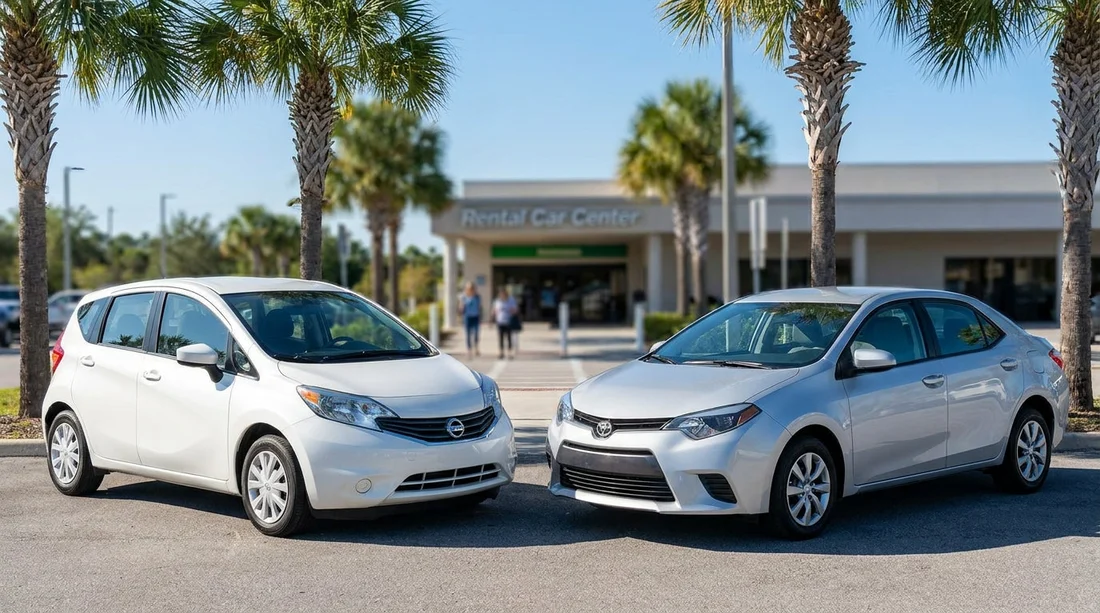
Quick Summary:
- Economy cars cost less and suit light luggage and short city trips.
- Compact adds rear-seat space and a bigger boot for suitcases.
- Choose economy for tight parking, compact for longer highway drives.
- For four adults plus luggage, compact feels calmer and less cramped.
When you’re comparing car hire in Florida, “economy” and “compact” can look similar on a booking page. Both are designed to be fuel-efficient, easy to drive, and practical for popular routes like Miami to Orlando. The difference is usually about a few crucial centimetres in cabin and boot space, plus how relaxed the car feels at speed. Those small changes can matter a lot once you add Florida heat, long straight highways, toll roads, and luggage for more than two people.
Below is a practical, traveller-focused breakdown of typical size, luggage capacity and comfort differences. Keep in mind that car hire classes are category-based, not model-specific, so exact dimensions vary. The goal is to help you choose the right class for your party and itinerary before you confirm.
What “economy” usually means in Florida
An economy car is typically a small hatchback or a small saloon. In Florida fleets, economy tends to focus on the lowest running costs and easy manoeuvrability. That usually translates to a narrower body, shorter overall length, and a simpler cabin layout.
Typical strengths: easy parking in busy areas, lower fuel use, and often the lowest daily rate within standard cars. If your plans are mostly short city trips, beach runs, and quick hops between neighbourhoods, economy can feel perfectly adequate.
Typical trade-offs: less rear-seat legroom, a smaller boot opening, and less “buffer” space around passengers. With Florida being a driving-heavy destination, the reduced cabin room can become noticeable on longer days, especially with adults in the back.
If you are arriving by air, choosing the right class can be even more important because you may be collecting luggage immediately and driving straight onto highways. For airport collections around Central Florida, travellers often compare classes when browsing options like car hire at Orlando MCO.
What “compact” usually means in Florida
Compact cars generally sit one step above economy. You often get a slightly larger body, a longer wheelbase, and a cabin that feels less tight. In practice, compact can mean a larger hatchback or a small-to-mid saloon, depending on the fleet.
Typical strengths: more rear-seat comfort, a boot that accommodates awkward luggage shapes more easily, and a more settled feel at highway speeds. Compact is often the “sweet spot” for couples with luggage, or for three to four people doing a mixed itinerary of city and motorway driving.
Typical trade-offs: slightly higher fuel use and price, plus a bit more care needed for tight city parking. The difference is not dramatic, but it is noticeable in dense areas and older multi-storey car parks.
In South Florida, where routes can combine city traffic with longer causeway or highway sections, compact can take the edge off fatigue. Travellers comparing pick-up points often look at pages such as car hire at Fort Lauderdale FLL to see what categories are available.
Size and manoeuvrability: why a few centimetres matter
Economy cars are typically easier to thread through tight gaps and to park in busy areas like Downtown Miami or popular beachfront districts. If your accommodation has limited parking, or you expect frequent kerbside parking, economy may reduce stress. Compact cars are still city-friendly, but the extra length and width can mean a slightly larger turning circle and fewer “easy” parking spaces.
That said, Florida driving is not only about squeezing into spaces. You might be doing long stretches on I-95, I-75, Florida’s Turnpike, or the Bee Line Expressway near Orlando. On those routes, a compact can feel more stable, especially when passing larger vehicles or dealing with crosswinds on exposed sections.
Luggage capacity: the biggest real-world difference
Boot space is often the deciding factor between economy and compact. A common scenario is two adults plus two suitcases, where economy can work if the suitcases are modest and you do not mind stacking a bag on the rear seat. Add a third person, a pushchair, or bulky beach gear, and economy becomes harder to live with.
Economy luggage fit, typical expectations: best for one large suitcase plus one cabin bag, or two smaller cases, with flexibility required. If you are doing a multi-stop itinerary, frequent unloading makes a smaller boot more annoying over time.
Compact luggage fit, typical expectations: more likely to take two larger suitcases with a couple of smaller bags, and to swallow soft items like beach chairs, a cooler bag, or shopping without blocking rear visibility.
Also consider that Florida trips often include theme parks and outlet shopping. A boot that looks “fine” on day one may feel cramped after you add purchases. Compact gives you a bit more breathing room for that reality.
Passenger comfort: who sits where, and for how long
Comfort depends on both seat space and how the car behaves over distance. Economy cars are generally comfortable for two adults in the front, with the rear seat better suited to children or shorter journeys. If you will have adults in the rear for more than an hour at a time, compact usually makes the trip calmer, with more knee room and a less upright seating position.
If you are planning time in central city areas, you might also be weighing pick-up convenience. For example, some travellers compare options like car hire near Downtown Miami alongside airport pick-ups when deciding what class is practical for city parking.
Fuel economy and costs: economy is not always the whole story
Economy cars usually have the edge on fuel use and can be cheaper to rent, but the difference can be smaller than people expect, especially with modern compact engines. If you are covering high mileage, economy can save money, but only if it meets your luggage and comfort needs.
Also remember that “cost” includes the hassle factor. If an economy boot forces you to fold seats or keep bags in the cabin, it can reduce comfort and increase the time you spend organising belongings. For many Florida itineraries, compact can be better value simply because it fits real travel patterns more smoothly.
Highway driving, tolls, and long days: choosing for the journey
Florida is a state where driving days can expand quickly. You might plan a two-hour transfer and end up adding a detour, a meal stop, or an unplanned beach visit. Compact cars often feel less buzzy at motorway speeds and can be a bit quieter inside, which reduces fatigue on long days.
If your itinerary includes multiple long-haul segments or you want extra confidence in heavy rain, you may also be considering a larger category. For travellers comparing classes beyond compact, it can help to understand how an SUV changes the experience, such as the options shown on SUV rental in Orlando MCO.
Tips to avoid surprises when booking economy or compact
Think in bags, not passengers. Two people with four bags can be harder than four people with one small bag each. Make a quick list of what is going in the boot, including beach gear and shopping.
Plan for the biggest driving day. Choose the class that will feel comfortable on your longest stretch, not your shortest hop.
Expect “or similar”. Categories describe a range. An economy car may be a hatchback one day and a small saloon another, which changes boot shape even if the class name stays the same.
Consider your pick-up and drop-off context. Airport queues, hotel parking rules, and city driving can all change what feels convenient. If you are comparing suppliers, Hola Car Rentals provides location pages that clarify what you are selecting, such as Hertz car rental at Orlando MCO.
FAQ
Is a compact car much bigger than an economy car? Not dramatically, but the extra cabin and boot space is often noticeable. Compact tends to feel less cramped, especially in the rear seats and around shoulder room.
Will an economy car fit two large suitcases? Sometimes, but it depends on the boot shape and suitcase size. If you have two large cases and additional bags, compact is more likely to fit everything without using the rear seat.
Is compact always better for families in Florida? For most families, compact is a more comfortable baseline than economy. If you have a pushchair, multiple day bags, or longer drives, consider moving up another class for easier loading.
Does compact use much more fuel than economy? Often the difference is small, especially with newer vehicles. The bigger factor is usually how and where you drive, such as highway speeds, traffic, and air conditioning use.
What should I choose for Miami and Orlando in one trip? If you are doing both city driving and long highway stretches, compact is usually the more balanced choice. Economy works best when you are travelling light and prioritising tight parking.





























































































