


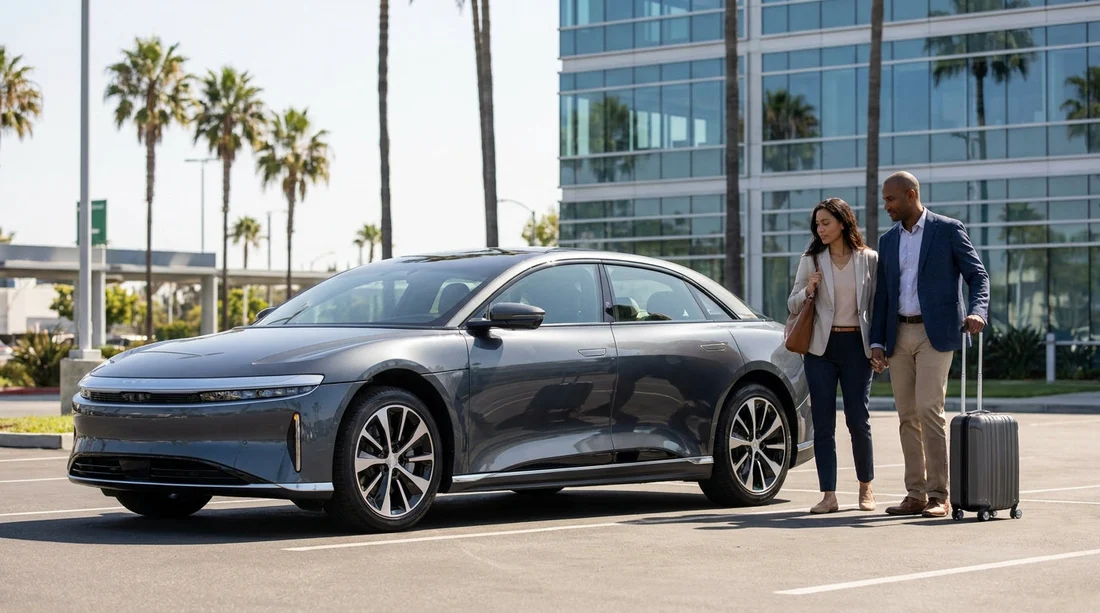
Quick Summary:
- Expect a roomy five-seat saloon, comfortable for four adults on longer drives.
- Plan for two large suitcases plus one to two smaller bags.
- Full-size usually means a smoother motorway ride and a quieter cabin.
- Choose full-size for road trips, but consider parking and luggage needs.
When you see “full-size” while comparing car hire options in California, it can feel like a clear promise, but US rental classes are labels, not exact measurements. “Full-size” generally sits above “midsize” and below “premium” or “luxury” in the standard line-up, and it usually refers to a larger family saloon rather than an SUV. The practical question is, what does that mean for your legs, shoulders, suitcases, and overall comfort across a long drive?
This guide translates the rental label into real-world expectations, so you can pick the right class for California distances, from airport pick-ups to coastal drives and inland national parks.
What a “full-size” rental car usually is in the US
In most US fleets, a full-size car is a four-door saloon with five seatbelts, a larger footprint than a typical midsize, and a boot designed for family luggage rather than just cabin bags. It is often front-wheel drive, sometimes all-wheel drive depending on model and availability, and it is normally an automatic with air conditioning as standard.
It is important to treat “full-size” as a category, not a guarantee of a specific model. Rental companies supply “or similar”, so your exact make and trim can vary by location and day. Still, the size class is useful, because the dimensions and usable space tend to fall within a fairly consistent range.
Cabin space: comfort for four adults, five in a pinch
For most travellers, the big benefit of full-size is shoulder room and rear legroom. You can expect comfortable seating for a driver and three adult passengers, with enough personal space for longer stints on California motorways. Five adults can fit, but the middle rear seat is usually best for a shorter passenger or shorter journeys, as the seat base is narrower and the transmission tunnel can reduce foot space.
If you are collecting near a major hub, browsing location guidance for car rental at Los Angeles LAX can be helpful, because availability and class mix can differ between airport and neighbourhood branches.
Luggage expectations: what fits in the boot
The luggage question is where travellers most want clarity. In practical terms, a full-size saloon usually handles about two large suitcases in the boot, plus one or two smaller bags, depending on the suitcase shells and how square they are. If everyone is travelling with a large case, you may need to choose a larger body style.
Here is a realistic way to think about it:
Two people: Full-size is easy, even with larger cases, plus day bags.
Three people: Usually fine if one person packs lighter, or you use soft duffels.
Four people: Often tight if everyone has a large suitcase. Consider a larger class, an SUV, or a minivan.
Five people: A saloon in any size class becomes a compromise. You will likely want a minivan or a large SUV for luggage and comfort.
If your trip involves bulky items, such as a pushchair, cooler, or photography kit, it is safer to treat full-size as a comfort upgrade, not a cargo solution.
Typical “full-size” models you might see
Specific models vary, but full-size commonly maps to larger mainstream saloons. You might see cars similar in footprint to a Toyota Camry, Chevrolet Malibu, Nissan Altima, or Volkswagen Passat, depending on fleet. Some locations classify certain hybrids similarly if they match cabin dimensions.
Because model supply changes, focus on the outcomes you need, comfortable seating for four, and luggage for roughly two large cases. If those outcomes are essential, consider filtering by class rather than chasing a particular badge.
How full-size compares with other US size labels
Travellers used to UK and European classifications can find US labels slightly counterintuitive. A quick translation is:
Economy and compact: Best for one or two people with light luggage, easiest to park in dense city areas.
Midsize: A sensible balance, but rear space and boot volume can be limited for four adults.
Full-size: A noticeable step up in cabin comfort, better for longer drives, boot still saloon-shaped.
Premium: Often similar size to full-size, but with higher trim, more power, and nicer interiors.
Luxury: More about brand and features than guaranteed extra boot space.
SUV classes: More vertical cargo space and easier loading, but can cost more and drink more fuel.
If you are flying into Northern California, you may see that SUVs are particularly common in some airport inventories. For comparisons, you can review options like SUV hire in Sacramento SMF alongside saloon classes, especially if your luggage is bulky.
California-specific considerations: distances, terrain, and parking
California driving can be deceptively long. A day that looks simple on a map can include slow urban sections, mountain gradients, and hot inland temperatures. Full-size cars tend to handle heat and high-speed cruising well, and the extra wheelbase can feel more stable in crosswinds.
Parking: In parts of San Francisco, Los Angeles, and coastal towns, space can be tight. A full-size saloon is still manageable, but it is less forgiving than compact classes in older car parks.
Fuel costs: Full-size saloons are usually efficient enough, but they often cost a little more to run than economy. If you are covering long distances, check the fuel type and expected consumption.
Mountain routes: For winter trips toward higher elevations, tyres and traction matter more than the “full-size” label. If you specifically need more ground clearance or all-wheel drive, an SUV class may be a better match.
For trips that start in Southern California, guides for car rental in San Diego SAN can be useful for understanding where collections happen and what classes are most prevalent.
Who should choose full-size for car hire in California?
Full-size is a strong choice if you want a comfortable saloon for a couple, friends, or a small family, and you are prioritising an easy drive over maximum luggage volume. It is also a sensible middle ground when you want more comfort than midsize, without moving into premium pricing or SUV fuel costs.
Choose full-size if you match any of these profiles:
Two to three adults with medium to large luggage, planning longer driving days.
Four adults with lighter packing, or one shared large suitcase plus smaller bags.
Parents with one child using a child seat, where extra rear space makes fitting easier.
If you are landing in Silicon Valley, checking logistics for car rental at San Jose SJC can help you plan pick-up timing, which matters when you want a particular class during busy arrival waves.
When to upgrade from full-size
Upgrade when you need one of the following outcomes more than you need a saloon shape:
More luggage height: Hard-shell suitcases stack poorly in saloon boots. An SUV or minivan gives you vertical space.
More than four adults: Five can work for short hops, but for a road trip it is rarely comfortable.
Ease of loading: Sliding doors and a low load floor make minivans practical for families.
For family travel, comparing with a people-carrier category such as minivan rental in Sacramento SMF can clarify whether you are paying for seats, luggage capacity, or both.
How to avoid surprises at the counter
Because classes are not exact models, the best way to avoid disappointment is to plan around space needs, not brand expectations. Before you travel, measure your largest suitcase, consider whether you will add shopping or sports gear mid-trip, and decide if rear-seat comfort is a priority.
FAQ
Is a full-size rental car an SUV in California? No. Full-size normally means a larger saloon. SUV is usually listed as a separate class.
How many suitcases fit in a full-size rental car? Typically about two large suitcases plus one or two smaller bags, depending on shapes. Four large suitcases is usually too much for a saloon boot.
Is full-size the same as premium? Not exactly. Premium can be similar in size, but it usually indicates a higher trim level, more features, or a more powerful model.
Will I get the exact full-size model shown online? Usually not. Car hire listings show an example, but you receive a full-size car or similar, based on fleet availability.
Is full-size worth it for long California road trips? Often yes for two to four travellers, because the cabin is quieter and more relaxed on long motorway drives. For maximum luggage space, an SUV or minivan may suit better.





























































































