


Quick Summary:
- Turn off AC, add cabin heat, and watch the temperature needle closely.
- Exit traffic safely, stop, switch off, and wait for cooling.
- Do not open the radiator cap, check coolant only when cold.
- Photograph warnings, note times, and contact support for a replacement.
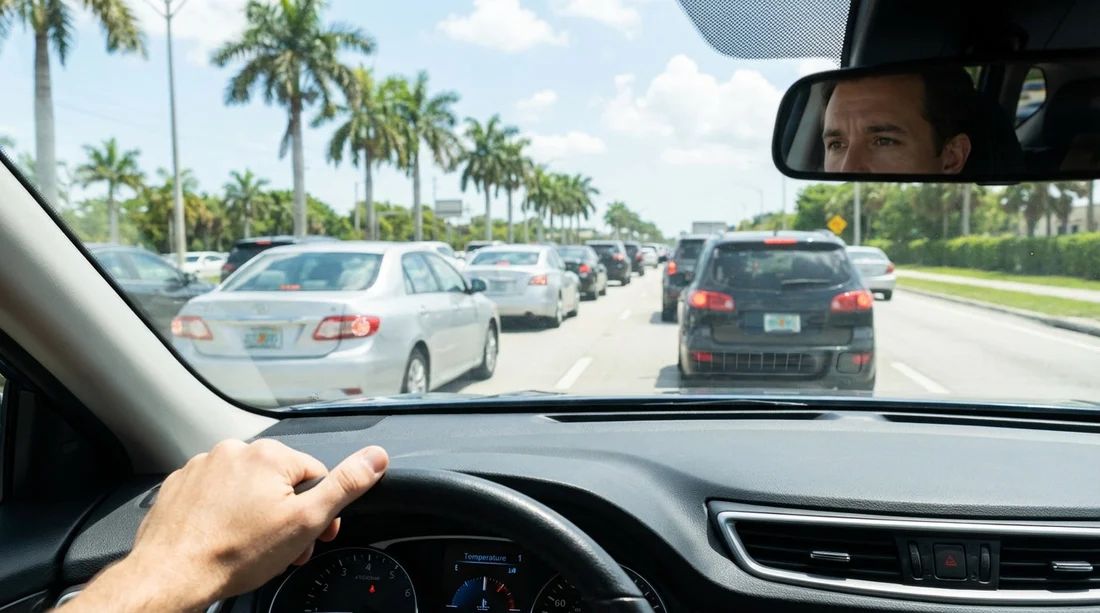
Florida traffic, high humidity, and long idling can push a cooling system to its limit, especially in a car hire you do not know well. The key is to act early, stay safe around fast-moving roads, and avoid doing anything that could worsen damage. This checklist is designed to help you protect passengers, protect the vehicle, and protect yourself from avoidable engine damage fees by documenting what happened and arranging a swap properly.
Recognise the warning signs, and decide if it is urgent
Most modern cars give you several clues before serious overheating. Watch for the temperature gauge moving above its normal midpoint, a red temperature warning light, a message such as “Engine temperature high”, or the air conditioning suddenly blowing warm air. You might also notice a sweet smell (coolant), steam from the bonnet, or the engine feeling weak.
If the gauge is climbing but not yet in the red, you often have a short window to reduce heat load and reach a safe stopping point. If the warning light is red, steam is visible, or the gauge is pegged at maximum, treat it as urgent. Continuing to crawl in traffic can quickly turn a minor issue into warped components, head gasket failure, or complete engine seizure, which is exactly what you want to avoid in a car hire.
Immediate actions while you are still moving
As soon as you notice the gauge rising, focus on reducing engine heat and finding a safe place to stop. Keep your attention on driving first, especially in dense Florida traffic.
1) Turn off AC and reduce load. Switch the air conditioning off. If safe, ease off hard acceleration, avoid rapid lane changes, and keep engine revs steady.
2) Turn cabin heat on, briefly. It sounds counterintuitive in Florida, but setting the heater to hot and fan to high pulls heat away from the engine through the heater core. Open windows for comfort. If this makes the gauge drop, it buys time to reach a safe shoulder or exit.
3) Aim for airflow, not idling. If traffic is crawling, try to maintain gentle forward movement rather than long stationary idles. If you are completely stuck and the gauge is rising fast, you may need to pull over sooner rather than later.
4) Watch for “limp mode” behaviour. Some vehicles will limit power to protect the engine. If this happens, prioritise getting off the live lane and onto a safe area.
Pull over safely in Florida, without creating a bigger risk
In Florida, pulling over can mean shoulders beside high-speed interstates, narrow urban roads, or busy ramps. Choose the safest option you can reach without pushing the engine.
Best options: a service station, a car park, a wide shoulder, or an off-ramp area away from moving traffic. If you are near an airport corridor or busy tourist routes, it may be better to take the next exit at low load than stop on a tight shoulder.
When you stop: indicate early, move smoothly, and avoid harsh braking. Once stopped, switch on hazard lights, put the car in Park (or neutral with handbrake), and keep passengers away from traffic. If you have cones or a warning triangle from the boot, only place them if it is safe and legal to do so, and never step into a live lane.
Do not keep driving “just a bit further” if the needle is in the red. Engine damage can occur in minutes at extreme temperature.
Shut down and cool down, the safe sequence
1) Turn the engine off. If the temperature is high, switching off stops heat generation. If you see steam, shut down immediately.
2) Do not open the bonnet straight away if there is steam. Give it a moment. Hot coolant can spray and cause serious burns.
3) Wait at least 15 to 30 minutes. In Florida heat, cooling can take longer. The goal is to let pressure drop and temperatures stabilise.
4) Never open the radiator cap when hot. Many modern cars have a pressurised expansion tank rather than a radiator cap. Either way, only check coolant levels when the system is cool to the touch.
5) If the gauge drops back to normal after cooling, still treat it seriously. Overheating is often caused by low coolant, a failing fan, a stuck thermostat, a leak, or a blocked radiator. Restarting and continuing without diagnosis can trigger a repeat episode, often worse.
Quick checks you can do without mechanical risk
With a car hire, your goal is not to repair the car, it is to prevent harm and report clearly. Only do checks that are low risk.
Check for obvious leaks under the car. Look for puddles. Clear water may be air-con condensation, but coloured fluid, especially green, orange, or pink, may be coolant. If you see active dripping, avoid restarting.
Check the temperature gauge behaviour. If it spiked rapidly after sitting still, it may be a cooling fan issue. If it rises steadily at speed, it may be low coolant or restricted flow. Note what you observed for the handover.
Check coolant level only when cold. If you can safely view the expansion tank markings, note whether it is below the minimum line. Do not add random fluids unless the rental provider explicitly instructs you. Adding the wrong coolant, or topping up when hot, can create more problems and disputes.
Do not remove engine covers, disconnect hoses, or attempt roadside repairs. Apart from safety, unapproved work can complicate responsibility later.
Document everything to reduce disputes and engine damage fees
Good documentation protects you when a warning light appears mid-trip. Capture facts, not assumptions.
Take photos and short videos: the temperature gauge, any warning messages, the odometer, your location screen if safe, and any steam or leaks from a distance. If the car can display vehicle status menus, photograph them too.
Write down a timeline: when you first noticed the gauge move, whether the AC was on, traffic conditions, outside temperature if shown, and when you stopped and switched off. Note any dashboard chimes or alerts.
Keep receipts if you buy essentials. If you are instructed to purchase coolant or pay for a small emergency top-up, keep itemised receipts and take a photo of the product. Only do this with clear guidance from the provider.
Do not clear codes if you have a diagnostic tool. Clearing faults removes evidence of what occurred.
Contact support, and arrange a swap the right way
Once everyone is safe and the car is cooling, contact your rental assistance channel. Provide your booking details, precise location, the dashboard warnings, and what you have already done. Ask for clear instructions on whether they want the vehicle towed, inspected on-site, or driven carefully to a nearby facility. If you are routed through Hola Car Rentals support, having your timeline and photos ready makes the process faster and clearer.
It helps to know your nearest logical exchange point. For example, if you are close to Miami International, you can reference car rental Florida MIA as a convenient handover area. If you are nearer Tampa, the relevant airport hub is car rental airport Tampa TPA. Around Orlando, you may be directed towards partners near Alamo car hire Orlando MCO or Budget car rental Orlando MCO, depending on your booking and availability.
Important: do not agree to drive the car any distance while it is still overheating. If support says it is safe to move, confirm the exact conditions, such as “only if the gauge stays normal” and “stop immediately if it rises again”. If the car overheats twice, the second event can be the one that causes major damage.
If you must restart to reposition, do it cautiously
Sometimes you may need to move off a dangerous shoulder to a safer spot. If the vehicle has cooled, and you have been advised it is acceptable, restart and monitor closely.
Run the cabin heater on hot, keep revs low, and avoid heavy acceleration. If the gauge starts climbing again, pull over immediately and shut down. Do not “nurse” it through multiple hot cycles.
Common mistakes that turn a warning into a breakdown
Ignoring the early rise. The best moment to act is when it first moves above normal.
Keeping the AC blasting. That adds load and heat to the system.
Opening caps while hot. This can cause burns and sudden coolant loss.
Pouring cold water on a hot engine. Rapid temperature change can crack components.
Driving with the needle in the red. Even a short distance can be costly.
Failing to document warnings. Without photos, later conversations become harder.
How to reduce the chance of overheating during the rest of your Florida trip
Once you have a replacement car hire or the vehicle is cleared to continue, make a few habits standard for Florida driving.
Keep an eye on the gauge in slow traffic. Congestion around theme parks, beaches, and airport approaches can be the toughest scenario.
Use recirculation and moderate fan speed. This keeps the cabin comfortable without pushing the system as hard as max cooling.
Avoid long idles when parked. If you are waiting, consider switching off if safe and legal, then restarting when you are ready to move.
Do a quick walk-around at stops. Look for fresh drips or a new smell before you set off again.
Know where you are relative to your return point. If you are travelling between hubs, having a sense of nearby support locations helps. For travellers moving between Miami and Doral areas, you may see options like car hire Doral DRL as a useful reference point for exchanges or partner desks.
FAQ
Q: If the temperature gauge rises but there is no steam, can I keep driving?
A: Treat any rise above normal as a warning. Turn off AC, use cabin heat briefly, and head for a safe place to stop. If it reaches the red zone, stop and switch off immediately.
Q: Should I top up coolant myself in a car hire?
A: Only if the rental provider instructs you to, and only when the engine is fully cool. Photograph the coolant level before and after, and keep receipts for any approved purchase.
Q: What if I am stuck on an interstate shoulder in Florida?
A: Stay in the vehicle with seatbelts fastened if it feels unsafe to exit, keep hazard lights on, and call the rental assistance line. Do not open the bonnet next to fast traffic if it puts you at risk.
Q: Will I be charged for engine damage if the car overheats?
A: Charges usually depend on whether you continued driving after warnings or ignored instructions. Stopping early, documenting the dashboard alerts, and following support guidance helps demonstrate you acted responsibly.
Q: What information should I give support to arrange a swap quickly?
A: Share your booking details, exact location, photos of the gauge and warnings, a timeline of events, and whether you see leaks or steam. Ask whether towing is required and where the exchange will happen.





























































































