


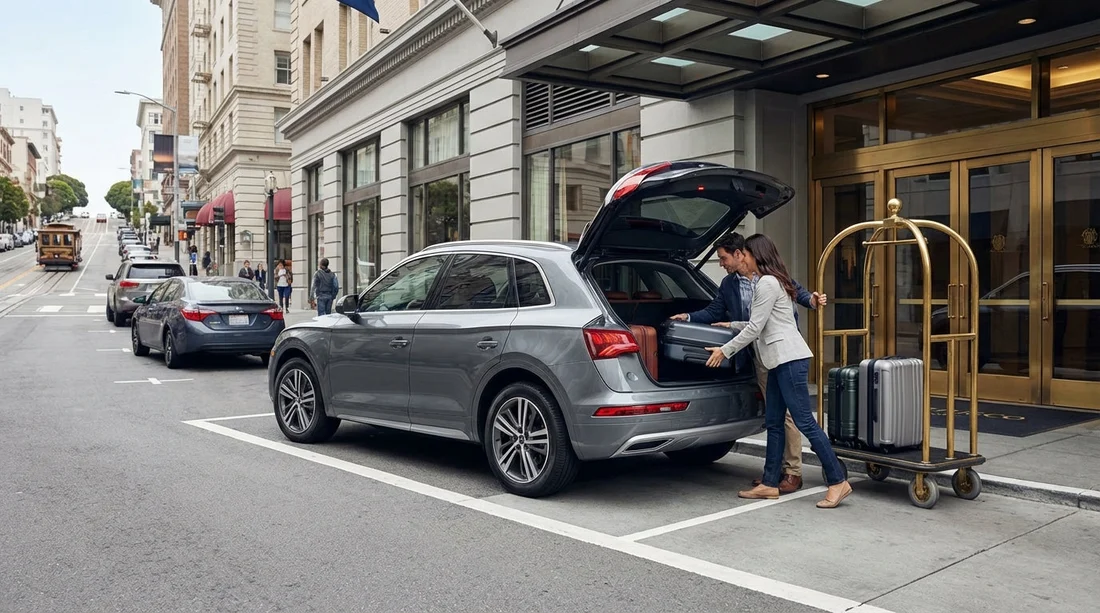
Quick Summary:
- Use signed white passenger-loading zones, follow posted hours and minute limits.
- Avoid red kerbs and bus stops, even for brief unloading.
- If valet-only, pull into the driveway only when waved in.
- Circle the block once, then choose the nearest legal zone.
Union Square is one of the toughest places in San Francisco to stop a car. Kerbs are busy, lane widths are tight, and parking enforcement is active. If you are arriving with a car hire and luggage, the safest plan is to treat your hotel like a small logistics job: identify the legal kerbside space first, understand when it is valid, then approach slowly and predictably.
This guide explains the kerb colours and signs you will see around Union Square hotels, how long you can legally load or unload, and what to do when the entrance is valet-only or the kerb outside is red. The goal is simple, get people and bags in without a ticket, tow, or blocking traffic.
Know the kerb colours around Union Square
Most problems start when drivers assume “just a minute” is acceptable. In Union Square, a one-minute stop in the wrong place can still be ticketed, and towing risk increases if you leave the vehicle unattended.
Red kerb means no stopping, standing, or parking. Do not pull over to unload, even with hazards on. Red is common near crosswalks, fire hydrants, driveways, and corners.
White kerb is typically passenger loading. It is designed for quick pick-ups and drop-offs, not extended baggage sorting. Posted signs will specify time limits and hours, so read them before you stop.
Green kerb allows short-term parking, often 10 to 30 minutes depending on the sign. This can be useful if you must run inside briefly, but do not assume it is for loading only. It is still regulated parking.
Yellow kerb is commonly commercial loading. Some yellow zones allow any vehicle to load during specific times, but many are restricted to commercial vehicles or have different rules by hour. Around Union Square, yellow zones can change rules between morning delivery hours and later in the day.
Grey kerb is general parking, but it will often be metered and time-limited. It may also be blocked by street cleaning hours or special restrictions.
How to read loading-zone signs correctly
At Union Square, the kerb paint is only part of the story. The sign is what enforcement uses. When you arrive, do a slow pass first and read the whole sign stack, not just the top panel. Look for:
Hours of operation. A white loading zone might only apply during daytime hours, then convert to general parking later, or it can be restricted during commute periods. If the sign says “No Stopping” during certain times, those times override everything.
Time limit. Passenger loading can be two, three, or five minutes depending on location. Green short-term zones are often 10 to 30 minutes. If you need longer, plan to park legally and walk luggage in, or use valet properly.
Vehicle type restrictions. Some yellow zones are “Commercial Vehicles Only”. If you are in a standard car hire, do not assume you can use them.
Special curb uses. Watch for bus zones, taxi stands, accessible loading, and hotel shuttle zones. A space that looks “empty” can still be restricted.
Legal kerbside options near Union Square hotels
Because hotels cluster tightly, the best practice is to look for a legal loading zone on the same block or the next block over, rather than forcing a stop directly in front. In many cases the safest move is to unload passengers and the heaviest bag, then park properly to bring the rest.
White passenger-loading zones are your first choice when they exist on the hotel’s block face. They are intended for exactly what you are doing, but they are often short limit and can be occupied. If you find one, pull in cleanly, stay with the vehicle, unload quickly, and move on.
Green short-term parking can work if you need a few extra minutes to check in, especially if you are travelling solo and cannot leave the vehicle in a pure loading zone while you step away. Do not exceed the posted minutes, and keep an eye on the clock.
Metered spaces on the next block are often the most predictable solution. It can feel inconvenient, but a legal metered stop beats a red-kerb ticket. If your hotel has luggage carts, a short walk may still be easier than circling for a perfect kerb.
Hotel driveways and porte-cocheres are ideal when they are open to the public for unloading, but in Union Square many are controlled by valet. Treat them like a private lane, enter only when directed, and do not stop in the street while waiting for permission.
Valet-only entrances: how to handle them safely
Many Union Square properties have a driveway that looks like a standard drop-off, but is managed by valet staff. If you pull in incorrectly, you can block the driveway or get stuck behind other vehicles.
Use this approach:
1) Approach slowly with your indicator on. Signal early so following traffic can anticipate your move. Avoid sudden braking, which is a common cause of near-misses in this area.
2) Look for an attendant and make eye contact. If they wave you in, proceed. If not, continue forward and circle. Do not stop in the travel lane waiting for someone to appear.
3) Ask where you may unload if you are self-parking. Some valet teams will allow a two-minute unload in the driveway, then direct you to a garage or nearby legal kerb.
4) Keep your keys and valuables organised. Whether you use valet or not, the kerbside moment is when items get left behind. Consolidate phones, passports, and bags before you pull up.
If your San Francisco car hire is part of a larger trip that starts at the airport, it helps to understand pick-up logistics in advance. Hola Car Rentals has dedicated pages for arrivals and provider options, including San Francisco Airport car rental, Hertz at SFO, and Enterprise at SFO.
Red zones, hydrants, and “just unloading”: what not to do
Union Square has many corners with red kerb extensions for visibility and pedestrian safety. Do not stop in them. Also avoid:
Bus stops and transit zones. These are actively enforced and can create safety issues. Even if a bus is not present, the restriction still applies.
Crosswalk approaches. Stopping near a crosswalk can be treated like a red zone even if the paint is confusing. If you are close to the corner, keep going.
Blocking a driveway. Hotel driveways, garages, and service entries are frequent. If you block one, you risk both a ticket and immediate towing, because you are obstructing access.
Double parking. It is tempting when the kerb is full, but it creates traffic backups and increases collision risk with cyclists and delivery riders. Enforcement can ticket quickly, and other drivers will not be patient.
A practical arrival plan for Union Square unloading
If you want a repeatable system that works at most Union Square hotels, follow this sequence.
Step 1: Pre-load the address and decide on a loop. Before you reach the busiest blocks, set navigation and identify a simple loop you can repeat if you cannot stop. One-way streets are common, so “one more lap” is normal.
Step 2: Do a slow scouting pass. On your first pass, look for any signed white or green zone near the entrance. If you see one, note its position relative to the hotel so you can return safely.
Step 3: Prioritise a legal stop over a perfect stop. A metered space half a block away is usually fine. Unload passengers first if needed, then park to handle the rest of the luggage calmly.
Step 4: Keep the driver with the vehicle in loading zones. If you must step away for check-in, do it from a legal parking space, not a loading zone. Loading is for active loading.
Step 5: Use hazard lights only as a visibility tool. Hazard lights do not make an illegal stop legal. Use them briefly while actively loading in a permitted zone.
Timing tips: avoid peak congestion and enforcement hotspots
Union Square traffic surges around standard check-in and check-out times. If you can choose your timing, arriving slightly earlier than check-in can reduce kerbside competition. Delivery activity can also be heavy in the morning, when commercial loading zones are busiest.
Even with perfect timing, expect limited kerb availability during events, holidays, and weekends. Plan a buffer so you do not feel pressured to stop illegally.
What to do if you cannot find any legal space
Sometimes every legal option is full. In that case, the safest choice is to keep moving and switch to a two-stage unload.
Option A: Drop passengers at a safe legal point nearby. If you find a legal passenger loading zone or a safe metered space on a calmer street, unload people and the most essential bags, then have them walk the short distance to the lobby.
Option B: Use a garage first, then walk in. Many hotels can recommend a nearby garage. Parking once and walking luggage in is often faster than circling repeatedly.
Option C: Call the hotel from around the corner. If the hotel has valet, they may be able to stage you for a short driveway unload when space opens. Do not stop in traffic while you call.
If you are combining Union Square with a broader Bay Area itinerary, you may be comparing pick-up points beyond San Francisco. Hola Car Rentals also covers nearby hubs like car rental in San Jose (SJC).
Car hire practicalities for Union Square: vehicle choice and luggage
The streets around Union Square reward compactness. A smaller car is easier to slot into short gaps and less stressful in tight kerbside manoeuvres. If you have several large suitcases, consider how quickly you can unload them. The longer you occupy a loading zone, the higher the risk you exceed the time limit or create tension with other drivers.
Before you reach the hotel, do a quick “arrival reset” at a calmer curb or garage entrance: consolidate loose items, place one person in charge of doors, and decide which bags come out first. In a short passenger-loading window, coordination matters more than speed.
Also watch for theft risk in busy tourist areas. Keep luggage out of sight when driving, and do not leave bags unattended on the kerb while you move the vehicle.
Common mistakes that trigger tickets or towing
Assuming the kerb paint is enough. Signs override paint, and hours change throughout the day.
Leaving the car “for just a minute”. Unattended vehicles in restricted areas escalate quickly from ticket to tow risk.
Stopping on red to “let someone out”. Red is no stopping, even for passengers.
Blocking the lane while waiting for valet. If the driveway is full, circle and try again.
Ignoring street cleaning or temporary restrictions. Temporary no-parking signs can appear for works and events. If you miss them, you still get cited.
FAQ
Can I unload luggage in a white passenger-loading zone outside a Union Square hotel? Usually yes, if the sign permits it at that time. Follow the posted minutes, stay with the vehicle, and load or unload actively.
Is it legal to stop briefly at a red kerb if I stay in the car? No. Red kerb means no stopping, even if you are in the driver’s seat and even for quick unloading.
What if my hotel entrance is valet-only and the kerb is restricted? Do a slow pass, then enter the driveway only when staff wave you in. If they do not, circle the block and use the nearest legal loading zone.
Are commercial (yellow) loading zones usable with a standard car hire? Sometimes, but many are restricted to commercial vehicles or certain hours. Read the full sign, and if it specifies commercial only, do not use it.
How long can I stay in a green kerb zone near Union Square? Green zones are short-term parking with a posted time limit, often 10 to 30 minutes. Do not assume, check the sign and leave before the limit.





























































































