


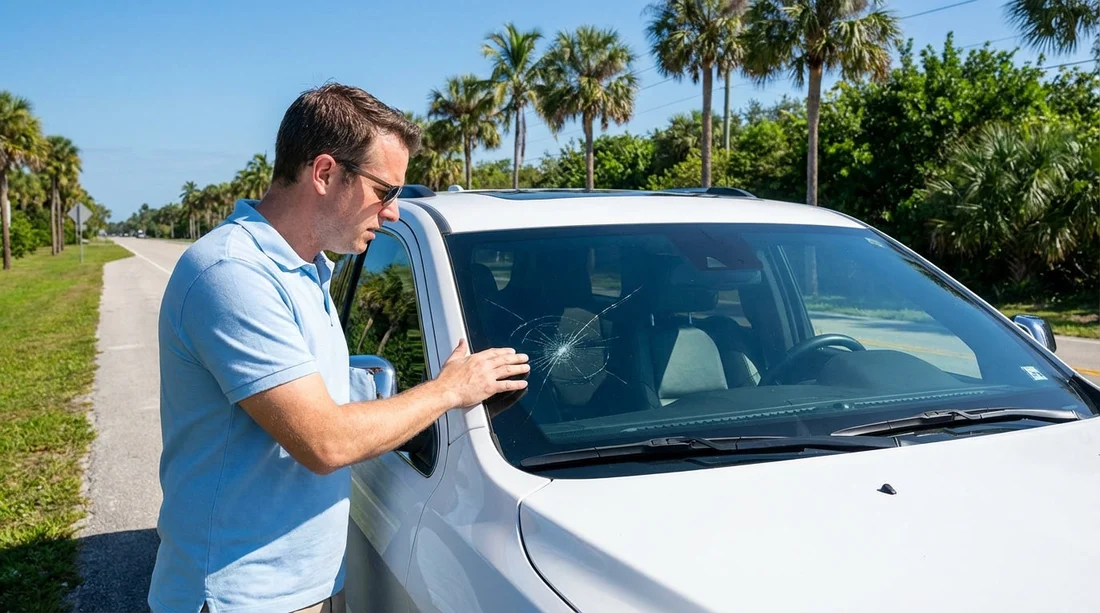
Quick Summary:
- Pull over safely, check visibility, and stop driving if cracking spreads.
- Photograph the chip and wider windscreen, then note time and location.
- Call the rental supplier first, then your insurer, and follow instructions.
- Avoid DIY repairs, keep receipts, and request written confirmation of next steps.
A rock strike on the windscreen is one of the most common issues on Florida roads, especially on highways where road debris can be kicked up at speed. If you are in a car hire vehicle and the windscreen cracks, the key question is whether it is safe and permitted to keep driving, and whether you can still claim. The short version is: you might be able to continue for a limited time if the damage is minor and visibility is not affected, but you should treat it as time-sensitive. Cracks can spread quickly with heat, air conditioning, vibrations, and potholes.
This guide walks you through what to do immediately, who to contact, how to document everything, and how to reduce the risk of extra charges when you return the vehicle. If you arranged your Florida car hire through Hola Car Rentals, the practical steps are the same. Document clearly, notify promptly, and follow the supplier’s process so you remain covered.
Step 1: Make the situation safe before you do anything else
As soon as you notice the impact, focus on control of the vehicle. A sudden crack can be distracting, and it is easy to drift or brake harshly. Keep a steady speed, increase following distance, and indicate before moving to a safe place to stop.
Once stopped, do a quick safety check:
1) Can you see clearly? If the crack is in your direct line of sight, or if it refracts sunlight or oncoming headlights, you should not continue driving. Visibility issues are a safety risk and can also become a legal issue if you drive with an obstructed view.
2) Is the windscreen structurally compromised? If the crack reaches the edge of the glass, if there are multiple cracks, or if the glass is beginning to spiderweb, treat it as unstable. Vibrations can cause rapid spreading.
3) Are there other hazards? If you are on a shoulder with fast traffic, it may be safer to drive slowly to the next exit, service area, or car park, provided visibility is unaffected. Prioritise personal safety.
Step 2: Capture evidence immediately, before the damage changes
Windscreen damage often looks small at first and then expands. That is why your first documentation should happen right away, while it is still in its initial state.
Take photos and a short video with your phone:
Close-up photos of the chip or crack from inside and outside the vehicle. Include a reference object like a coin, if possible, without touching the damaged area.
Wider shots showing the whole windscreen and the position of the damage, especially whether it is within the driver’s viewing area.
Context photos of where you are stopped, including a road sign or landmark if safe to capture, plus your odometer and fuel gauge. If you are on a toll road, note the road name and nearest exit.
Short video panning from the vehicle registration plate to the windscreen damage can help show continuity.
Also write down the time, the road name, the nearest intersection or exit, and what happened (for example, “stone flicked up from vehicle ahead”). If there was a roadworks area or a truck with unsecured load, note that too. Do not attempt to confront another driver, and do not put yourself at risk to gather details.
Step 3: Decide if you can keep driving, using practical thresholds
Whether you can continue driving depends on safety and on the rental supplier’s rules. Florida does not have a single universal “chip size” rule that applies to every situation, but there are common-sense thresholds used by repair networks and insurers.
As a practical guide, you should stop driving and request assistance if any of these apply:
The crack is in your primary viewing area, roughly the zone swept by the wipers in front of the driver.
The crack is longer than a few inches or is clearly growing while you look at it.
The crack reaches the edge of the windscreen, which often indicates spreading is likely.
There is glass delamination, milky whitening, or pieces appear loose.
If the damage is a small chip away from the driver’s line of sight, you may be able to drive carefully to an approved repair facility or to your accommodation, but only after you have reported it and received instructions. The reason is simple: unauthorised repairs or delayed reporting can lead to disputes about whether additional damage occurred later.
Step 4: Contact the right people in the right order
For car hire incidents, the order of notifications matters. In most cases, start with the rental supplier or the roadside assistance number on your rental agreement, then follow any insurance or card coverage process.
Call the rental supplier first. Explain that the windscreen has been cracked by a rock strike, confirm whether you should keep driving, and ask where they want the vehicle taken. Request that they note the incident on your contract and provide an incident reference number.
Then contact your coverage provider, if applicable. This could be a separate rental protection policy, your travel insurer, or credit card benefits. Ask what documentation they need and whether they require repair approval in advance.
If you arranged your vehicle through Hola Car Rentals at a major gateway, the local processes are usually straightforward. You can review location information for common pick-up points such as Orlando Airport (MCO) car rental or Miami (MIA) Florida car rental, which can help you locate supplier contact details and plan where to return or swap the vehicle if instructed.
When to call the police? A simple rock strike without collision is normally not a police matter. Call emergency services only if there is an accident, injuries, debris causing immediate danger, or you are in an unsafe situation. If there is a collision with another vehicle, follow Florida reporting expectations and your supplier’s accident procedure.
Step 5: Do not attempt DIY fixes unless explicitly authorised
It is tempting to buy a DIY resin kit from a petrol station or shop, but in car hire situations this can backfire. Some suppliers prefer repairs to be completed by their approved vendor, and an unauthorised repair can be treated as damage that must be replaced rather than repaired.
Instead, do this:
Ask the supplier where to go for assessment, and whether they authorise a repair rather than a windscreen replacement.
Get written confirmation by email or message, including the address of the repairer and any payment instructions.
Keep all receipts if you pay anything out-of-pocket, and photograph the invoice details and the repair outcome.
If you are driving around Miami and need a larger vehicle category, note that a replacement vehicle might be offered in a similar class, depending on availability. Information pages like SUV rental Downtown Miami can help you understand local category options, but always accept changes only through the supplier’s authorised process.
Step 6: Reduce the chance of the crack spreading on the way to help
If the supplier instructs you to drive to a specific location, treat the car as fragile glassware. Heat and vibration are what make cracks run.
To minimise spreading:
Avoid hard bumps by reducing speed over rough surfaces and leaving extra space so you can brake gently.
Keep cabin temperature stable. In Florida, blasting cold air conditioning onto hot glass can worsen stress. Use moderate cooling and avoid aiming vents directly at the windscreen.
Avoid slamming doors, including the boot. Pressure changes can worsen existing cracks.
Do not use hot water to clean the area. Rapid temperature changes can enlarge the crack.
Do not pick at the chip or press on the glass from inside.
Step 7: Understand how damage fees and claims typically work
Windscreen damage is usually treated as glass damage, which may be covered differently from body damage. What you ultimately pay depends on your rental agreement, any excess, and any separate protection products you selected.
Common outcomes include:
Repairable chip: the supplier authorises a chip repair and you pay nothing, or you pay up to a glass excess, depending on coverage.
Replacement required: if the crack is large, in the driver’s view, or reaches the edge, replacement may be necessary. The supplier may charge replacement cost plus admin fees, then your insurer may reimburse according to your policy terms.
Loss of use and admin charges: some agreements include charges for the time the car is off the road and processing costs. Your documentation and prompt reporting can help dispute avoidable add-ons.
If your Florida car hire is through a known supplier, you may see different procedures by brand. For example, pages like Payless car rental Florida (MIA) or Thrifty car rental Fort Lauderdale (FLL) reflect that different desks and fleets operate locally, but your safest approach is always: report immediately, follow instructions, and keep evidence.
Step 8: What to do at the desk, during a vehicle swap, or at return
If you are told to swap vehicles, ask the agent to record the windscreen damage as the reason for the exchange and to close out the original vehicle condition report. Take photos of the cracked windscreen at the handover point too, showing the location and the agent area signage if appropriate.
If you are keeping the vehicle until the end of the rental:
Reconfirm the note on your booking that the incident was reported when it happened.
Ask for written guidance on whether to obtain a repair, and by whom.
At return, request an inspection and a receipt or check-in report that acknowledges the windscreen condition.
Keep everything together, your original photos, call logs, emails, incident reference numbers, receipts, and return paperwork. If there is a later dispute about when the damage occurred, your timeline is your strongest protection.
Step 9: Preventing future rock strikes on Florida roads
You cannot prevent every chip, but you can lower the risk:
Keep distance behind trucks, especially those carrying gravel, landscaping materials, or construction debris.
Avoid passing on loose shoulders and be cautious near roadworks zones.
Check wipers and washer fluid, because dirty glass makes small chips harder to notice until they spread.
Choose routes thoughtfully. Higher-speed interstates can mean more debris exposure than slower surface roads, depending on traffic and construction.
Most importantly, treat any impact sound seriously. A chip repaired early is usually simpler than a replacement later, and early reporting during car hire keeps the process cleaner.
FAQ
Can I keep driving with a cracked windscreen in a Florida car hire? Sometimes, yes, if visibility is unaffected and the crack is small. However, you should pull over, document it, and call the rental supplier for instructions before continuing.
Will I still be able to claim if the crack gets worse after the rock strike? Usually, claims depend on prompt reporting and proof. Your initial photos, time and location notes, and supplier incident reference help show the damage started with the rock strike.
Should I repair the chip myself with a kit? Not unless the rental supplier explicitly authorises it in writing. Unapproved repairs can create disputes and may lead to replacement charges rather than a standard repair.
Do I need a police report for a rock hitting the windscreen? Typically no, if there is no collision or injury. Contact police only for accidents, injuries, road hazards, or if your supplier specifically instructs you to obtain a report.
What evidence best reduces damage fees on return? Clear photos from multiple angles, notes of time and place, proof you notified the supplier promptly, and a return inspection report showing the windscreen condition.





























































































