


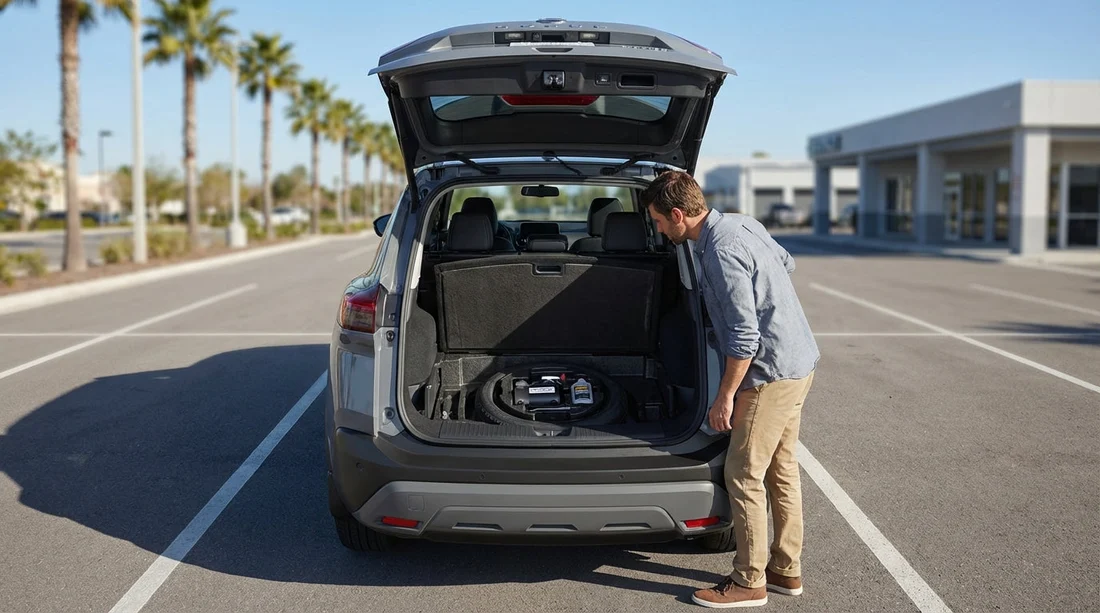
Quick Summary:
- Many United States rentals provide a sealant inflator kit, not a spare.
- Some SUVs, vans, and minivans may have a temporary spare.
- Check the boot and toolkit area before leaving the rental car park.
- Ask staff how punctures are handled, and whether roadside assistance applies.
If you are planning car hire in the United States, it is sensible to assume you might not get a full-size spare tyre. Many modern rental fleets prioritise weight savings and boot space, so a growing number of vehicles come with a tyre inflator and sealant repair kit instead. That does not necessarily mean you are unprotected, but it does change what you can do at the roadside and how quickly you can get moving again.
This guide sets expectations by vehicle type, explains what an inflator and sealant kit actually is, and outlines what you can confirm before you drive away. Policies vary by rental company, location, and even individual vehicle, so the goal is to help you check the right things at pick-up and avoid surprises later.
If you are comparing options for car hire in the United States, it helps to treat “spare tyre included” as something to verify rather than assume. Even within the same model line, one car may have a compact spare and jack, while another has only a sealant kit.
Why some rental cars have no spare tyre
Several factors have pushed manufacturers, and therefore rental fleets, towards repair kits:
Space and fuel efficiency: Removing a spare reduces weight and frees up room for luggage, which is helpful on smaller cars.
Cost and maintenance: A spare tyre is another component to inspect, inflate, and replace as it ages. In a high-turnover fleet, that adds complexity.
Vehicle design: Some cars simply do not have a dedicated spare wheel well, especially hybrids and EVs where battery packaging competes for space.
For you as the driver, the main implication is that a puncture may be handled by sealing and inflating the tyre temporarily, or by calling roadside assistance for a swap or tow, rather than fitting a spare yourself.
Spare tyre vs repair kit, what you might find by vehicle type
There is no universal rule, but these patterns are common across United States rental fleets.
Small and mid-size cars: Many come with an inflator or a sealant kit rather than a spare. If you are selecting a standard car through car rental in the United States, plan for the possibility that you will not have a jack and wheel brace in the boot.
SUVs: SUVs are more likely to have a spare than small cars, but it is not guaranteed. Some compact SUVs still use a repair kit, while larger models may include a temporary spare under the boot floor. If you know you will be driving long distances, you may prefer to review SUV hire in the United States options and then confirm the specific vehicle’s equipment at pick-up.
Vans and minivans: These often have a spare, sometimes mounted underneath the vehicle, but access can be awkward and may require a special tool. If you are looking at van rental in the United States for a group trip, it is worth checking both whether a spare exists and whether the tools needed to lower it are present.
Premium models, hybrids, and EVs: These are more likely to have no spare because of packaging constraints. The vehicle may rely on an inflator kit and roadside support.
Run-flat tyres: Some vehicles are fitted with run-flats, which can be driven a limited distance at reduced speed after a puncture. These may not include a spare, and using a sealant kit on run-flats is not always recommended. If the car has run-flats, ask what the policy is for replacement and where to go if the tyre is damaged.
What a tyre inflator and sealant kit is, and what it can and cannot do
A typical repair kit includes a small 12V air compressor that plugs into the car’s power socket, plus a bottle of tyre sealant (sometimes pre-attached) and a hose. The basic idea is to pump sealant into the tyre and then inflate it, so the sealant can plug small punctures in the tread area.
What it is good for: It can temporarily seal a small nail or screw hole in the tread, letting you drive to a tyre shop or a safe place to stop.
What it is not good for: It usually will not help with sidewall damage, large gashes, blowouts, or a tyre that has come off the rim. It also cannot fix a bent wheel.
Important limitations: Sealant is typically a temporary measure. After use, you often need a professional inspection, and the tyre may need replacement. Sealant can also make tyre repairs harder, and some shops will replace rather than patch a tyre that has had sealant inside.
Speed and distance limits: Many kits recommend driving slowly and only for a limited distance after inflation. Your vehicle’s manual or the kit label usually states the maximum speed and distance. If those instructions are missing, treat it as a short, careful drive to the nearest safe service location.
What you can check before leaving the lot
When you pick up your vehicle, you can quickly confirm what you have in a way that avoids confusion later.
1) Look for a spare and tools
Open the boot and lift the floor panel. If there is a spare wheel well, you may see a compact spare, a jack, and a wheel brace. If it is a van or larger SUV, the spare may be under the vehicle, and you should look for the lowering tool and the jack.
2) Check for an inflator and sealant kit
Kits are often stored in the boot side compartment, under the boot floor, or in a foam insert. Confirm the compressor, hose, and sealant bottle are present and appear unopened, if the bottle is missing or already used, ask for guidance immediately.
3) Ask what the breakdown process is for punctures
Even if the car has a spare, some rental companies prefer that you call their roadside assistance rather than changing it yourself, especially on busy roads. Ask which number to call, what information they will need, and whether there are any fees.
4) Photograph what you find
A quick photo of the boot compartment, spare or kit, and any instructions can be helpful if you need to describe what the vehicle has later.
5) Confirm tyre condition at pick-up
Do a brief walkaround. Check that all tyres look properly inflated and have no visible damage. If the car has a tyre pressure monitoring warning on the dashboard, raise it before you drive off.
If you get a puncture, what to do in practice
Your exact steps depend on whether you have a spare, a repair kit, or neither, but these principles generally apply.
Prioritise safety first: Pull over somewhere safe, away from traffic. Turn on hazard lights and follow local safety guidance. If you are on a motorway shoulder and it feels unsafe, it can be better to call for help rather than attempt a repair.
Identify the type of damage: A slow leak from a nail in the tread is the best-case scenario for a sealant kit. Sidewall damage or a shredded tyre usually requires professional assistance.
Using a sealant kit: Follow the kit instructions closely. Inflate to the recommended pressure, then drive slowly for a short period to distribute the sealant, and re-check pressure. If pressure will not hold, stop and call roadside assistance.
Using a temporary spare: Temporary spares are designed for short distances and lower speeds. Do not treat them like a normal tyre, and plan to get the damaged tyre addressed quickly.
Know when to call roadside assistance: If the tyre is badly damaged, you are in an unsafe location, you do not have the right equipment, or you are unsure what you are doing, call the rental provider’s assistance line. It is often the fastest route back on the road, and it helps ensure you stay within the rental agreement.
What to request or confirm when arranging car hire
You can reduce uncertainty by clarifying puncture support before you arrive.
Ask whether the vehicle has a spare tyre, a donut spare, or only a repair kit: If a spare is important for your trip, for example remote routes or long interstate drives, make it part of your pick-up checklist.
Confirm whether changing a wheel yourself is allowed: Some agreements prefer that you do not attempt a wheel change. This can be about liability, safety, or vehicle equipment.
Check what costs might apply: Roadside assistance may be included, optional, or chargeable depending on the cause of the puncture and the coverage you selected. Clarify how punctures are treated and what documentation is needed if a tyre must be replaced.
Understand tyre replacement expectations: If a tyre is irreparable, you may be directed to a specific tyre shop or asked to pay and claim back, depending on the provider and circumstances. The key is to follow the instructions you are given and keep receipts if you are told to pay.
Consider the vehicle class: If you want the best chance of a spare, a larger SUV, van, or minivan may improve the odds, though it is still not guaranteed. Comparing categories like minivan rental in the United States can be a practical way to balance luggage space with equipment expectations.
Setting realistic expectations for United States trips
For city driving, a repair kit plus a strong roadside assistance process is usually workable, because help and tyre shops are nearby. For rural routes, late-night driving, winter conditions, or long distances between towns, the difference between a spare and a kit can feel much bigger.
In other words, the most reliable approach is not to assume either option. Treat it like a checklist item, inspect the boot area, and confirm the support process. That way, whether your car hire vehicle in the United States has a spare tyre or just a repair kit, you will know what you are dealing with before the first mile.
FAQ
Do most rental cars in the United States have a spare tyre?
Many do not. A lot of modern rentals come with an inflator and sealant kit, while some SUVs, vans, and minivans may include a temporary spare.
Where should I look in the car to find a spare or repair kit?
Check under the boot floor first. Also look in boot side compartments. For some vans and SUVs, the spare may be mounted underneath the vehicle with a lowering tool.
Will a sealant kit fix any puncture?
No. Sealant kits usually only help with small tread-area punctures. Sidewall damage, large holes, or blowouts typically require roadside assistance and a replacement tyre.
Can I change the wheel myself if the car has a spare?
Sometimes, but not always. Rental agreements and safety policies vary, so it is best to ask at pick-up what they prefer, and which number to call if you get a puncture.
What should I confirm before driving off in a hire car?
Confirm whether you have a spare or a repair kit, check the tools are present, note the roadside assistance process, and ensure the tyres look properly inflated with no warning lights.





























































































