


Quick Summary:
- Install your child seat at pick-up, and only leave once secure.
- Confirm lower anchors and top tether points in your chosen seat.
- Check for under one inch movement at the belt path.
- Use either LATCH or the seat belt, unless permitted.
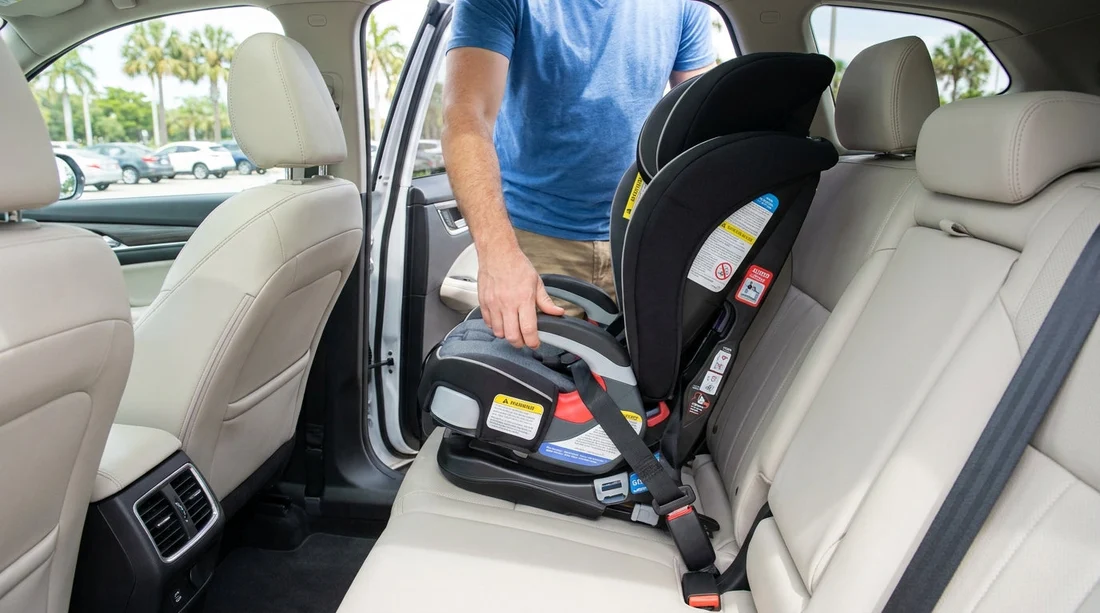
Yes, you can usually fit your own child seat using LATCH, also called ISOFIX in the UK and EU, before you leave your Florida car hire pick-up location. In the United States, most modern vehicles have LATCH anchors in at least two rear seats, but not every seating position has them. The safest approach is to allow time at pick-up, ask to inspect the rear seats before you drive away, and only proceed once you have a secure installation.
If you are collecting from a busy location, it helps to choose a branch that gives you space and time to check the vehicle properly, for example Florida car rental options cover several pick-up points where you can plan ahead. For family-heavy trips, a vehicle with easy access to third-row tether points can make fitting far simpler, such as a minivan rental near Orlando.
How US LATCH anchors work, and how they differ from ISOFIX
LATCH stands for Lower Anchors and Tethers for Children. It consists of two lower anchors located in the seat bight, the crease where the seat back meets the seat cushion, plus a top tether anchor located behind the seating position. The lower anchors are used with a pair of connectors on the child seat, and the top tether is used for forward-facing seats to reduce head movement in a crash.
Many UK child seats marketed as ISOFIX can be installed in US vehicles, but you must confirm compatibility and limits in your child seat manual. The connectors often look similar, yet weight limits and permitted installation methods can differ. Once your child exceeds the limit, you typically switch to installing with the vehicle seat belt, while still using the top tether for forward-facing seats if permitted.
A common point of confusion at a Florida car hire counter is that a vehicle can have seat belt locking features even if you use LATCH. LATCH is separate from the seat belt system, so you do not need to lock the seat belt when installing with lower anchors. If you are using the seat belt instead, you must ensure the belt locks properly, either via a switchable retractor or a locking latchplate, depending on the car.
What to check in the car before you leave the lot
Do these checks before you drive away. A few minutes now can prevent a long re-fit later in a car park, especially if you collect from a high-traffic area such as Tampa Airport or Downtown Miami.
1) Confirm the rear seating position you want actually has anchors
Most cars have lower anchors in the outboard rear seats. The centre seat may not have dedicated lower anchors, and you cannot assume. Look for the LATCH symbols on the upholstery, small tags, or plastic buttons, then physically feel for the metal bars in the seat bight.
Also locate the top tether point if you are installing a forward-facing harnessed seat. In sedans it is often on the rear shelf, in SUVs it may be on the seat back or cargo area floor behind the seat, and in some vehicles it can be on the ceiling. If you cannot find it quickly, check the vehicle’s child restraint section in the manual, which is often in the glovebox or accessible via the infotainment system.
2) Check that the seat belt can lock, in case you need it
Even if you plan to use LATCH, you may need to switch to a seat belt installation due to anchor availability, a weight limit, or a difficult fit. Test the rear belt by slowly pulling it all the way out and letting it retract. In many US vehicles, you will hear a ratcheting sound and the belt will not pull back out freely, which indicates a switchable locking retractor suitable for securing a child seat.
3) Assess space, headrests, and buckle stalks
Headrests can push a child seat forward and create a gap, especially with high-backed boosters and some forward-facing seats. If the headrest is removable or adjustable, set it according to your child seat manual. Next, look at the buckle stalk, the short webbing or rigid stem holding the buckle. If it is long and flexible, it can end up inside the belt path or press against the child seat frame, which can prevent a tight install.
4) Perform the “one-inch” tightness test correctly
Once installed, grip the child seat at the belt path, not at the top of the seat, and push and pull side-to-side and front-to-back. You are aiming for less than one inch of movement at the belt path. If you can shift it more than one inch, re-tighten the lower anchor strap or seat belt, compressing the vehicle cushion with your body weight as you tighten.
Common fitting pitfalls when using LATCH in a rental car
Using both LATCH and the seat belt at the same time. Many parents assume “more is better”, but most child seats are not designed to be secured by both systems simultaneously, unless the manufacturer specifically allows it. Choose one method, and follow your seat manual exactly.
Ignoring top tether for forward-facing seats. In the US, top tether use is strongly recommended and often required by the seat manufacturer for forward-facing harnessed seats. It is a separate strap that must be tightened after the main installation.
Attaching to the wrong bars. In some vehicles you will find metal bars under the seat that are not LATCH anchors, such as seat frame components. True lower anchors are a matched pair, spaced for car seats, and typically positioned symmetrically.
Twisted straps and misrouted belts. Twists reduce strap strength and make tightening harder. Run your fingers along the full length of the lower anchor strap and tether strap to confirm they lie flat. If using a seat belt, verify it passes through the correct belt path for rear-facing or forward-facing mode.
Overlooking LATCH weight limits. If your child is heavier, the manufacturer may require switching from lower anchors to seat belt installation. Because car hire vehicles vary, you may not have the vehicle manual to confirm anchor limits quickly.
Practical pick-up routine for Florida car hire
Build time into your pick-up plan. Collect the keys, open the rear doors, and do a quick anchor and tether scan before loading luggage. Install the seat, perform the one-inch test, then do a final check that the harness is adjusted for your child and the seat is not interfering with the front passenger airbag area.
When it may be better to request a different vehicle
Sometimes the issue is not your seat, it is the vehicle. Consider swapping cars before leaving if you cannot find a top tether anchor where your forward-facing seat must go, if the lower anchors are deeply buried and prevent a secure click, or if the seat belt will not lock and you need a belt install.
Choosing a branch with a good vehicle selection can help you avoid compromises, whether you are collecting in the city or near the coast, such as Budget car rental in Miami. The key is to treat the child seat fit as a non-negotiable part of the handover, just like checking for damage and confirming fuel level.
FAQ
Can I install my child seat at the Florida car hire pick-up area? Yes, you can normally fit your own seat before leaving. Allow extra time, install in a safe space, then do the one-inch movement check at the belt path.
Do all rental cars in Florida have LATCH anchors? Many do, especially newer vehicles, but not every seating position has lower anchors. Always confirm the specific rear seat location has both lower anchors, and a top tether if needed.
What if the centre rear seat has no LATCH anchors? Use an outboard LATCH position, or install in the centre using the seat belt if it locks correctly and your child seat permits.
Should I use the top tether for a forward-facing seat? Yes, in most cases it is required or strongly recommended. Find the tether anchor, attach the hook, remove slack, and re-check tightness after tightening.
Is it OK to use both LATCH and the seat belt together? Only if your child seat manufacturer explicitly allows it for your configuration. Otherwise, choose one method, either LATCH or seat belt, and follow the manual precisely.





























































































